4,068 posters, 219 videos, 101 topics, 69 sessions, 14,365 authors, 6,128 institutions
ePostersLive by SciGen Technologies S.A. All rights reserved.
Alzheimer's Association International Conference 2026
July 12-15, 2026 | London, United Kingdom, and Online

10066
Use Of Gabapentinoid Drugs And The Risk Of Alzheimer's Disease And Related Dementias: A Systematic Review And Meta-analysis
Poster Presenter
Authors
Anderson Matheus Pereira Silva, Marianna Leite, Giovana Menegucci, Maria Fernanda Negreli, Maria Eduarda Valverde, Amanda Carneiro Rodrigues, Sephora Almeida, Ana Carolina Gomes, Carolina Braga Moura, Isabelle Menezes, Ocilio Gonçalves, Yngrid Dieguez Ferreira, Jorge Dornellys da Silva Lapa, Diogo Haddad Santos
Affiliations
Cognitive and Behavioral Neurology, Irmandade da Santa Casa de Misericórdia de São Paulo, São Paulo, Brazil, Physiology and Pharmacology, Federal University of Pernambuco, Recife, Brazil, Santa Marcelina College, São Paulo, Brazil, Federal University of Santa Maria, Santa Maria, Rio Grande do Sul, Brazil, Federal University of Minas Gerais, Minas Gerais, Brazil, Faculdade de Ciências Médicas e da Saúde de Juiz de Fora – Suprema, Minas Gerais, Brazil, State University of Rio Grande do Norte, Rio Grande do Norte, Brazil, Federal University of Piauí, Piauí, Brazil, Federal University of Sergipe, Sergipe, Brazil
Part of Topic
Background
Gabapentinoids, including gabapentin and pregabalin, are widely prescribed anticonvulsant agents structurally related to γ-aminobutyric acid (GABA). Although commonly used for neuropathic pain and other off-label indications, their potential association with cognitive decline and dementia remains unclear. This systematic review and meta-analysis examined whether gabapentinoid use is associated with an increased risk of Alzheimer's disease and related dementias (ADRDs).
Methods
Following PRISMA and MOOSE guidelines, we searched PubMed, Embase, and the Cochrane Library from inception to November 2025 for observational cohort and case-control studies comparing gabapentinoid users with non-users or users of non-gabapentinoid medications. The primary outcome was incident ADRD, defined by validated clinical criteria or diagnostic codes. Random-effects meta-analyses using restricted maximum likelihood estimators pooled adjusted odds ratios (ORs) or hazard ratios (HRs) with 95% confidence intervals (CIs). Heterogeneity was assessed using I², and potential moderators were explored through meta-regression.
Results and Discussion
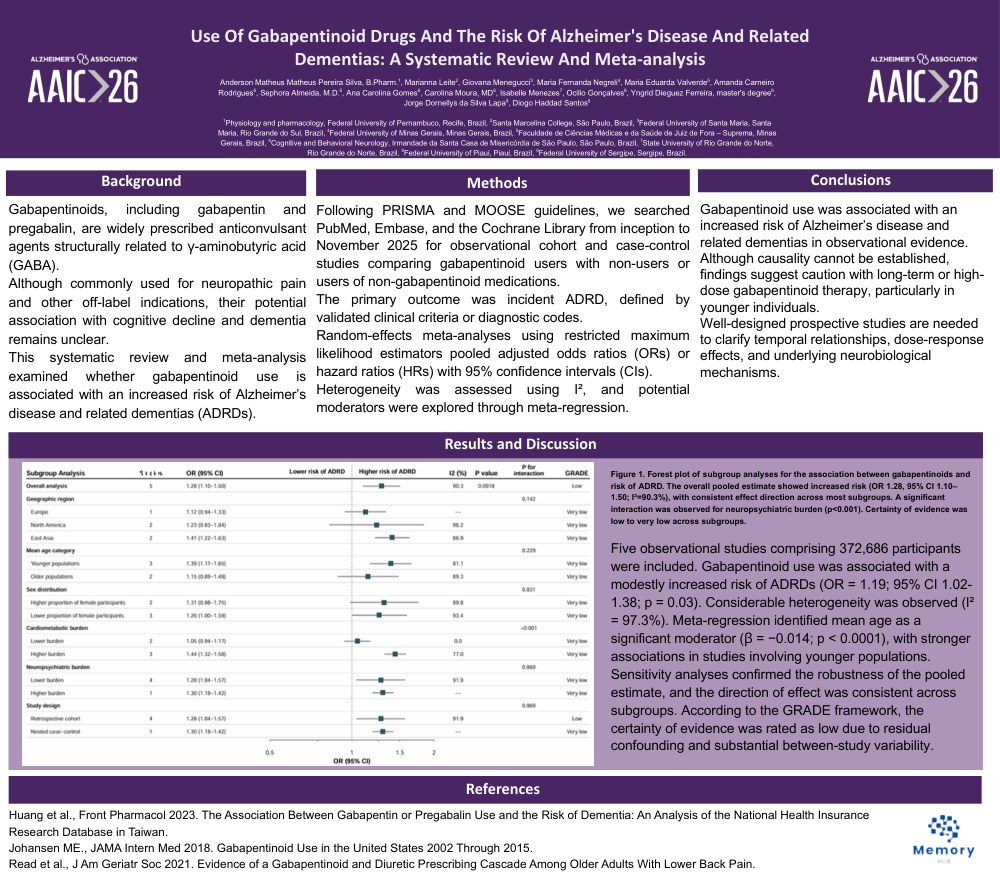
Five observational studies comprising 372,686 participants were included. Gabapentinoid use was associated with a modestly increased risk of ADRDs (OR = 1.19; 95% CI 1.02–1.38; p = 0.03). Considerable heterogeneity was observed (I² = 97.3%). Meta-regression identified mean age as a significant moderator (β = −0.014; p < 0.0001), with stronger associations in studies involving younger populations. Sensitivity analyses confirmed the robustness of the pooled estimate, and the direction of effect was consistent across subgroups. According to the GRADE framework, the certainty of evidence was rated as low due to residual confounding and substantial between-study variability.
Conclusions
Gabapentinoid use was associated with an increased risk of Alzheimer's disease and related dementias in observational evidence. Although causality cannot be established, findings suggest caution with long-term or high-dose gabapentinoid therapy, particularly in younger individuals. Well-designed prospective studies are needed to clarify temporal relationships, dose-response effects, and underlying neurobiological mechanisms.
Figure 1. Forest plot of subgroup analyses for the association between gabapentinoids and risk of ADRD. The overall pooled estimate showed increased risk (OR 1.28, 95% CI 1.10–1.50; I²=90.3%), with consistent effect direction across most subgroups. A significant interaction was observed for neuropsychiatric burden (p<0.001). Certainty of evidence was low to very low across subgroups.
References
- Huang et al., Front Pharmacol 2023. The Association Between Gabapentin or Pregabalin Use and the Risk of Dementia: An Analysis of the National Health Insurance Research Database in Taiwan.
- Johansen ME., JAMA Intern Med 2018. Gabapentinoid Use in the United States 2002 Through 2015.
- Read et al., J Am Geriatr Soc 2021. Evidence of a Gabapentinoid and Diuretic Prescribing Cascade Among Older Adults With Lower Back Pain.
Comments
Email is required but is not shown publicly.
Loading comments...