4,068 posters, 219 videos, 101 topics, 69 sessions, 14,365 authors, 6,128 institutions
ePostersLive by SciGen Technologies S.A. All rights reserved.
Alzheimer's Association International Conference 2026
July 12-15, 2026 | London, United Kingdom, and Online

2242
Participatory Partnerships Accelerate Implementation Of A Multi-site Digital Dementia Prevention Program
Poster Presenter
Authors
Walter Wittich, Kenny Southall, Hamid Golhasany, Ollivier Prigent, Edeltraut Kröger, Nicole Anderson, Nathalie Bélanger, Inbal Itzhak, Sylvie Belleville
Affiliations
School of Optometry, Université de Montréal, Montreal, Canada, Centre de recherche Institut Universitaire de Gériatrie de Montréal, Montréal, Québec, Canada, Centre d‘excellence sur le vieillissement de Québec, CIUSSS de la Capitale Nationale; Faculté de pharmacie, Université Laval, Québec, Québec, Canada, Rotman Research Institute, Baycrest Academy for Research and Education, Toronto, Ontario, Canada, Lady Davis Institute for Medical Research, Montréal, Québec, Canada
Part of Topic
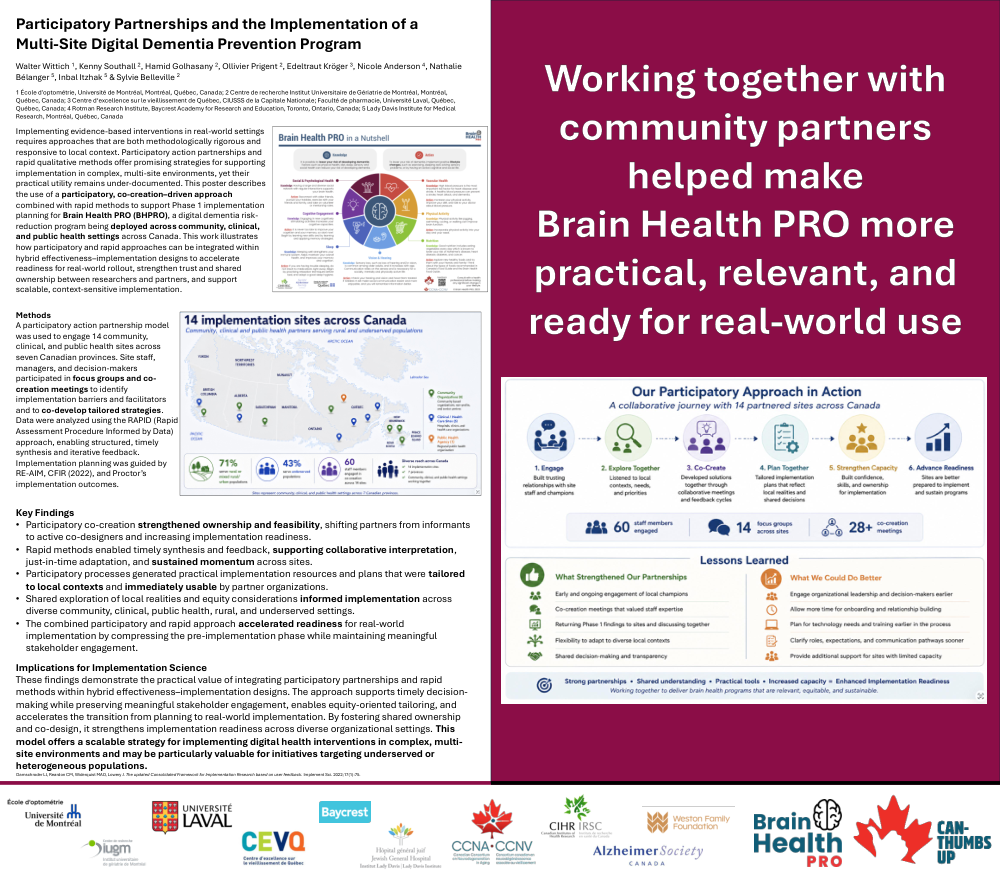
Background: Translating evidence-based dementia prevention interventions into real-worldpractice remains challenging, particularly across heterogeneous community, clinical, and publichealth settings. Programs often fail to achieve scale due to poor contextual fit, limited feasibility,and insufficient local ownership. Participatory action partnerships have been proposed as astrategy to enhance relevance, responsiveness, and scalability; yet empirical descriptions of theirusefulness in large, multi-site implementation studies are limited. This study describes applyinga participatory, co-creation-driven approach to support implementation planning across diversesettings in Canada for Brain Health PRO (BHPRO), a digital dementia risk-reduction program.Methods: Nine partner sites across seven Canadian provinces (7 community organizations, 2clinical services) were engaged through formalized partnerships. Site staff, managers, anddecision-makers participated in co-creation meetings to identify site-specific barriers andfacilitators and to co-develop tailored implementation strategies. Data were analyzed using theRAPID (Rapid Assessment Procedure Informed by Data) approach, enabling synthesis anditerative feedback to partners. Implementation planning was guided by the ConsolidatedFramework for Implementation Research and Proctor’s Implementation Outcomes, to ensurealignment with established implementation science frameworks.Results: Our analyses suggest that participatory engagement allowed our partners to becomeco-designers of implementation strategies, strengthening ownership, feasibility, and readiness for adoption. Partners indicated that the co-creation process enhanced the credibility and localrelevance of strategies and increased willingness to move forward with implementation. RAPIDmethods paved the way for near-real-time translation of qualitative data into actionable outputs.The combined approach uncovered context-specific and equity-related determinants acrossdiverse settings that may not have been identified through centralized planning alone. Outputsincluded site-specific toolkits, providing immediately usable resources to supportimplementation.Conclusion: In the context of BHPRO, integrating participatory partnerships combined withRAPID qualitative methods facilitated readiness for real-world implementation of this digitaldementia prevention program. This approach developed contextual fit and built trust betweenresearchers and partners. These findings demonstrate practical benefits of participatory andRAPID approaches for scaling dementia prevention interventions in heterogeneous, real-worldsettings. Beyond preparing implementation readiness, the co-creation process is a meaningfulstep toward building a scalable infrastructure for extensive deployment of BHPRO across Canada.
Comments
Email is required but is not shown publicly.
Loading comments...