4,068 posters, 219 videos, 101 topics, 69 sessions, 14,365 authors, 6,128 institutions
ePostersLive by SciGen Technologies S.A. All rights reserved.
Alzheimer's Association International Conference 2026
July 12-15, 2026 | London, United Kingdom, and Online

2457
Using Video To Enhance Clinical Communication In Residential Respite Care For People Living With Dementia: Process And Evaluation
Part of Topic
Using Video to Enhance Clinical Communication in Residential Respite Care
for People Living with Dementia: Process and Evaluation
Frances Batchelor1, Christa Dang1,2, Liam Borelli-Millott1,2, Sanka Amadoru3,4,5, Kerry Simmons3, Hayley Gismondi3, Genevieve Fanning3, and Paul Yates3
(1) National Ageing Research Institute, Parkville, VIC, Australia; (2) The University of Melbourne, Parkville, VIC, Australia; (3) Austin Health, Ivanhoe, VIC, Australia; (4) Aria Health, Preston, VIC, Australia; (5) Bendigo Health, Bendigo, VIC, Australia
The Idea - The 3C Video Vignette
Residential respite care (RRC) is a form of short-term support in residential aged care homes (RACHs) for older people
whose usual carers are temporarily unavailable or need a break from their caring duties and is commonly utilised by the
carers of people living with dementia. Transitions into RRC are poorly supported; previous research and consumer
engagement has identified the need for comprehensive assessment and improved clinical communication during the
transition1. Written care plans can be lengthy, inaccurate, and difficult for frontline staff to access or use in practice. The 3C
Program was developed to address this gap by using short video vignettes to convey essential person-centred and clinical
information about people living with dementia entering residential respite care.
The Process – “Doing” a 3C Video Vignette
1. FILM
• Carers and respite recipients are visited at home, prior to RRC
• A brief interview is recorded with them where they answer, “What are the most
important things for RACH staff to know about you in regard to your health,
capabilities, and who you are as a person?”
• Clips of the respite recipient performing activities of daily living (ADLs) and physical
tasks are also recorded, consulting with participants to determine which aspects
should be highlighted on video
2. EDIT
• The interview is cut down to be 3-5 minutes long, capturing the most important
talking points regarding the respite recipient’s health, function, personhood, and life
history
• ADL, and mobility clips are cut and spliced with the interview
• On-screen captions are added that include information not captured during filming or
extra details about key talking points
3. SHARE
• A QR code is distributed to the RACH that links to a password-protected folder
containing the video vignette. We instruct the manager to disseminate this amongst
RRC staff to prepare them for the participant’s respite stay
• The staff utilise the video alongside a clinical summary and other notes to assist them
when interacting with and providing care to the participating respite recipient
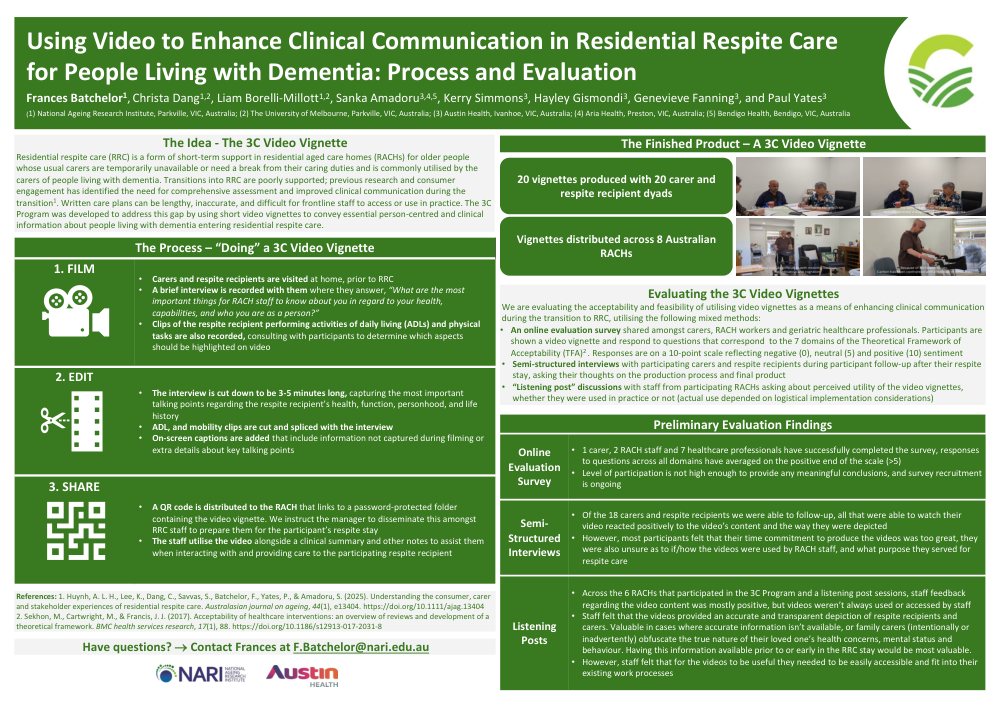
The Finished Product – A 3C Video Vignette
Evaluating the 3C Video Vignettes
We are evaluating the acceptability and feasibility of utilising video vignettes as a means of enhancing clinical communication
during the transition to RRC, utilising the following mixed methods:
• An online evaluation survey shared amongst carers, RACH workers and geriatric healthcare professionals. Participants are
shown a video vignette and respond to questions that correspond to the 7 domains of the Theoretical Framework of
Acceptability (TFA)2 . Responses are on a 10-point scale reflecting negative (0), neutral (5) and positive (10) sentiment
• Semi-structured interviews with participating carers and respite recipients during participant follow-up after their respite
stay, asking their thoughts on the production process and final product
• “Listening post” discussions with staff from participating RACHs asking about perceived utility of the video vignettes,
whether they were used in practice or not (actual use depended on logistical implementation considerations)
20 vignettes produced with 20 carer and
respite recipient dyads
Vignettes distributed across 8 Australian
RACHs
Preliminary Evaluation Findings
Online
Evaluation
Survey
• 1 carer, 2 RACH staff and 7 healthcare professionals have successfully completed the survey, responses
to questions across all domains have averaged on the positive end of the scale (>5)
• Level of participation is not high enough to provide any meaningful conclusions, and survey recruitment
is ongoing
Semi-
Structured
Interviews
• Of the 18 carers and respite recipients we were able to follow-up, all that were able to watch their
video reacted positively to the video’s content and the way they were depicted
• However, most participants felt that their time commitment to produce the videos was too great, they
were also unsure as to if/how the videos were used by RACH staff, and what purpose they served for
respite care
Listening
Posts
• Across the 6 RACHs that participated in the 3C Program and a listening post sessions, staff feedback
regarding the video content was mostly positive, but videos weren’t always used or accessed by staff
• Staff felt that the videos provided an accurate and transparent depiction of respite recipients and
carers. Valuable in cases where accurate information isn’t available, or family carers (intentionally or
inadvertently) obfuscate the true nature of their loved one’s health concerns, mental status and
behaviour. Having this information available prior to or early in the RRC stay would be most valuable.
• However, staff felt that for the videos to be useful they needed to be easily accessible and fit into their
existing work processes
References: 1. Huynh, A. L. H., Lee, K., Dang, C., Savvas, S., Batchelor, F., Yates, P., & Amadoru, S. (2025). Understanding the consumer, carer
and stakeholder experiences of residential respite care. Australasian journal on ageing, 44(1), e13404. https://doi.org/10.1111/ajag.13404
2. Sekhon, M., Cartwright, M., & Francis, J. J. (2017). Acceptability of healthcare interventions: an overview of reviews and development of a
theoretical framework. BMC health services research, 17(1), 88. https://doi.org/10.1186/s12913-017-2031-8
Have questions? → Contact Frances at F.Batchelor@nari.edu.au
Comments
Email is required but is not shown publicly.
Loading comments...