4,068 posters, 219 videos, 101 topics, 69 sessions, 14,365 authors, 6,128 institutions
ePostersLive by SciGen Technologies S.A. All rights reserved.
Alzheimer's Association International Conference 2026
July 12-15, 2026 | London, United Kingdom, and Online

3982
AI Augmented Conversational Support For Carers And People Living With Dementia
Poster Presenter
Authors
Part of Topic
Video
Dementia is one of the costliest conditions to societies worldwide, both economically and in terms of its impact on the health-related quality of life (HR-QoL). LMICs' health systems are particularly ill equipped to cope with dementia and care provision, but the challenges are also significant in high-income countries like the UK. There is a diversity of models of dementia care across countries, yet dementia care ought to be channelled through existing infrastructures of healthcare delivery. Some countries require specific considerations; for example, in many LMICs the support available comes through family members, primarily women, who lack access to information and primary and specialist care services for dementia. Artificial Intelligence offers potential to bridge these care delivery gaps.
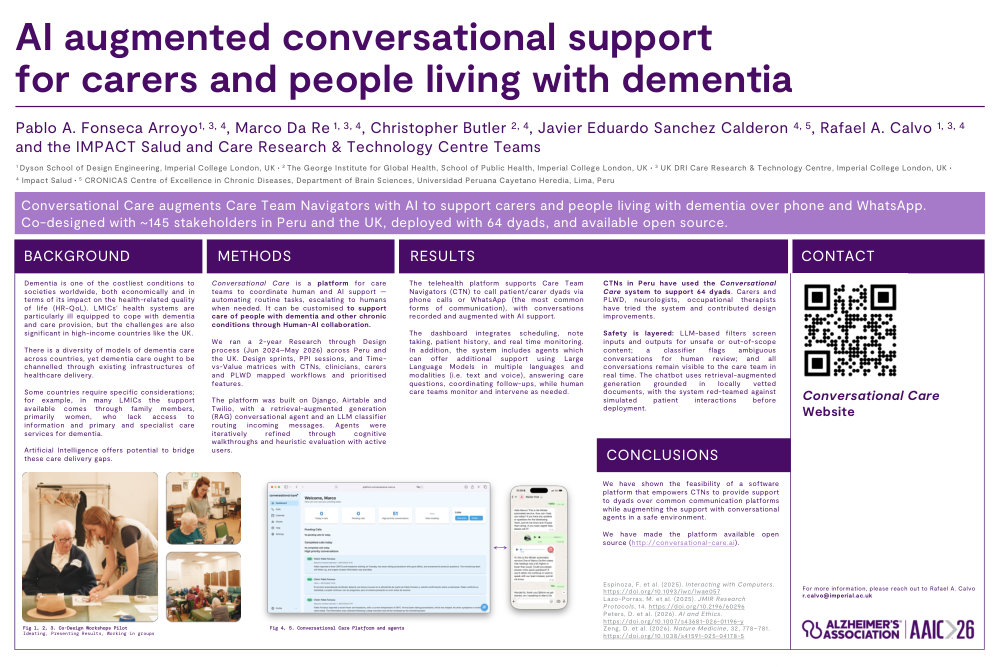
Conversational Care is a platform for care teams to coordinate human and AI support — automating routine tasks, escalating to humans when needed. It can be customised to support care of people with dementia and other chronic conditions through Human-AI collaboration. We ran a 2-year Research through Design process (Jun 2024–May 2026) across Peru and the UK. Design sprints, PPI sessions, and Time-vs-Value matrices with CTNs, clinicians, carers and PLWD mapped workflows and prioritised features. The platform was built on Django, Airtable and Twilio, with a retrieval-augmented generation (RAG) conversational agent and an LLM classifier routing incoming messages. Agents were iteratively refined through cognitive walkthroughs and heuristic evaluation with active users.
The telehealth platform supports Care Team Navigators (CTN) to call patient/carer dyads via phone calls or WhatsApp (the most common forms of communication), with conversations recorded and augmented with AI support. The dashboard integrates scheduling, note taking, patient history, and real time monitoring. In addition, the system includes agents which can offer additional support using Large Language Models in multiple languages and modalities (i.e. text and voice), answering care questions, coordinating follow-ups, while human care teams monitor and intervene as needed. CTNs in Peru have used the Conversational Care system to support 64 dyads. Carers and PLWD, neurologists, occupational therapists have tried the system and contributed design improvements. Safety is layered: LLM-based filters screen inputs and outputs for unsafe or out-of-scope content; a classifier flags ambiguous conversations for human review; and all conversations remain visible to the care team in real time. The chatbot uses retrieval-augmented generation grounded in locally vetted documents, with the system red-teamed against simulated patient interactions before deployment.
We have shown the feasibility of a software platform that empowers CTNs to provide support to dyads over common communication platforms while augmenting the support with conversational agents in a safe environment. We have made the platform available open source (http://conversational-care.ai).
Comments
Email is required but is not shown publicly.
Loading comments...