4,068 posters, 219 videos, 101 topics, 69 sessions, 14,365 authors, 6,128 institutions
ePostersLive by SciGen Technologies S.A. All rights reserved.
Alzheimer's Association International Conference 2026
July 12-15, 2026 | London, United Kingdom, and Online

4770
Linguistic biases in Cognitive Screening (CS)
Poster Presenter
Part of Topic
Introduction
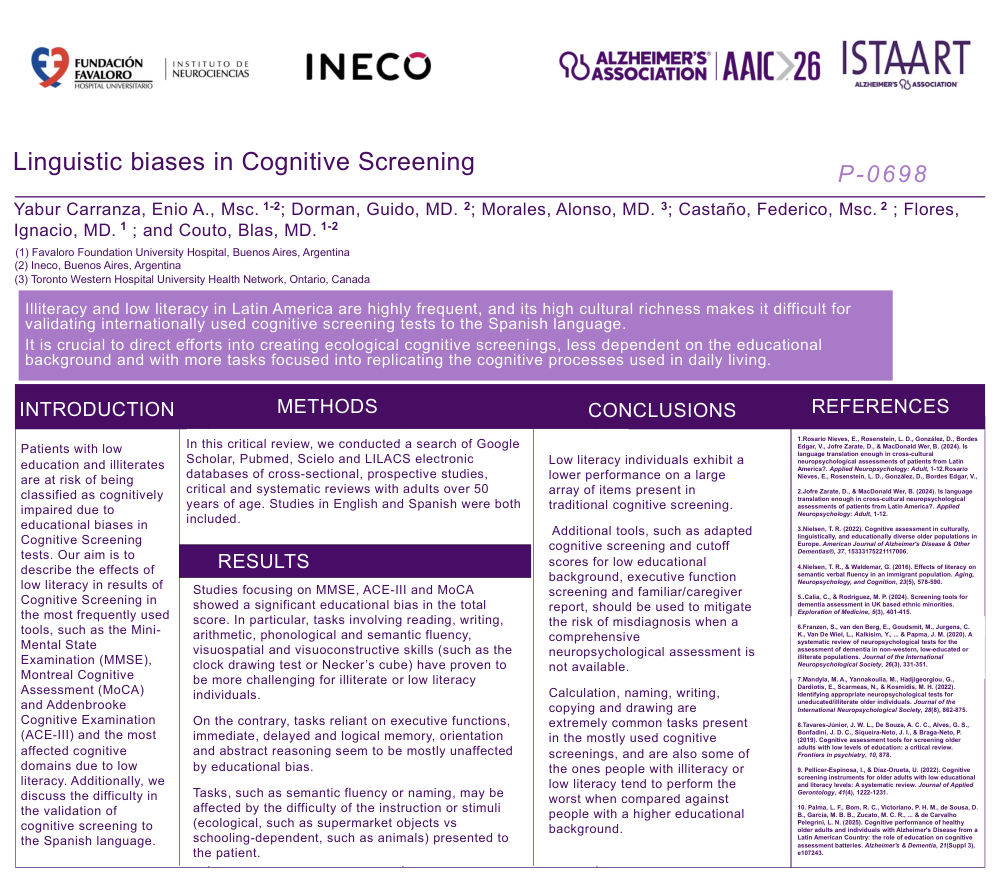
Patients with low education and illiterates are at risk of being classified as cognitively impaired due to educational biases in Cognitive Screening tests. Our aim is to describe the effects of low literacy in results of Cognitive Screening in the most frequently used tools, such as the MiniMental State Examination (MMSE), Montreal Cognitive Assessment (MoCA) and Addenbrooke Cognitive Examination (ACE-III) and the most affected cognitive domains due to low literacy. Additionally, we discuss the difficulty in the validation of cognitive screening to the Spanish language.
Method
In this critical review, we conducted a search of Google Scholar, Pubmed, Scielo and LILACS electronic databases of cross-sectional, prospective studies, critical and systematic reviews with adults over 50 years of age. Studies in English and Spanish were both included.
Results
Studies focusing on MMSE, ACE-III and MoCA showed a significant educational bias in the total score. In particular, tasks involving reading, writing, arithmetic, phonological and semantic fluency, visuospatial and visuoconstructive skills (such as the clock drawing test or Necker’s cube) have proven to be more challenging for illiterate or low literacy individuals. On the contrary, tasks reliant on executive functions, immediate, delayed and logical memory, orientation and abstract reasoning seem to be mostly unaffected by educational bias. Tasks, such as semantic fluency or naming, may be affected by the difficulty of the instruction or stimuli (ecological, such as supermarket objects vs schooling-dependent, such as animals) presented to the patient.
Conclusion
Low literacy individuals exhibit a lower performance on a large array of items present in traditional cognitive screening. Additional tools, such as adapted cognitive screening and cutoff scores for low educational background, executive function screening and familiar/caregiver report, should be used to mitigate the risk of misdiagnosis when a comprehensive neuropsychological assessment is not available. Calculation, naming, writing, copying and drawing are extremely common tasks present in the mostly used cognitive screenings, and are also some of the ones people with illiteracy or low literacy tend to perform the worst when compared against people with a higher educational background.
Comments
Email is required but is not shown publicly.
Loading comments...