4,068 posters, 219 videos, 101 topics, 69 sessions, 14,365 authors, 6,128 institutions
ePostersLive by SciGen Technologies S.A. All rights reserved.
Alzheimer's Association International Conference 2026
July 12-15, 2026 | London, United Kingdom, and Online

3532
Does School Quality Shape Cognitive Aging? A Systematic Review Of Pre-college Education And Late-life Cognition
Poster Presenter
Authors
Affiliations
Part of Topic
Video
Does School Quality Shape Cognitive Aging? A Systematic Review of Pre-College Education and Late-Life Cognition
Gavin Yang, Kenny Liu, Arthur Dong, Andrew Prasetya
Background
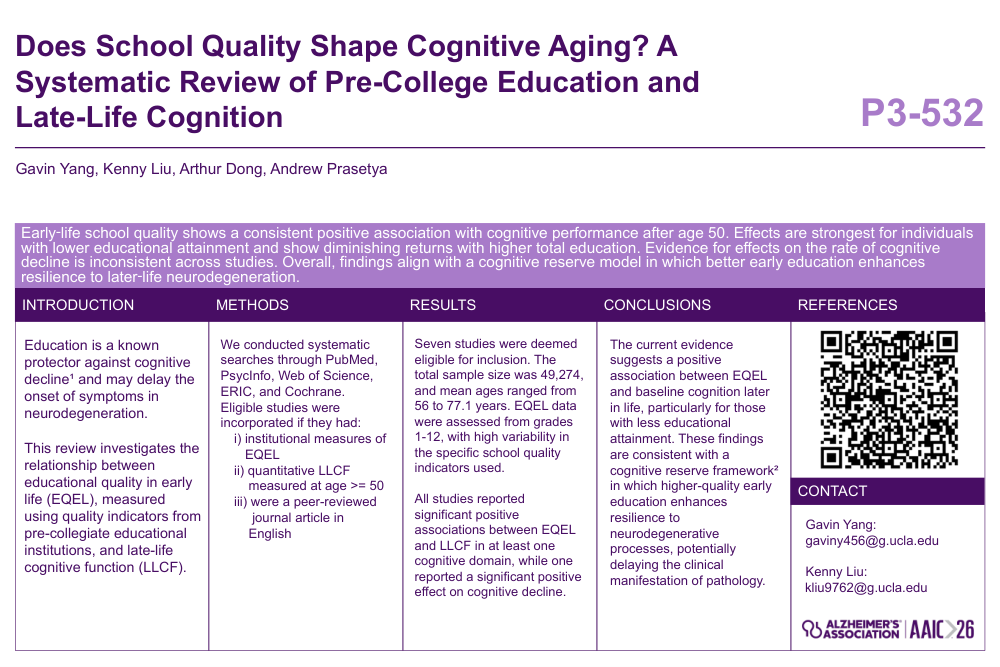
Education is a known protector against cognitive decline and may delay the onset of symptoms in neurodegeneration. While existing research focuses on years of education or educational attainment, the impact of education quality, particularly in early life, is not fully understood. This review investigates the relationship between educational quality in early life (EQEL), measured using quality indicators from pre-collegiate educational institutions, and late-life cognitive function (LLCF).
Methods
We conducted systematic searches through PubMed, PsycInfo, Web of Science, ERIC, and Cochrane. Eligible studies were incorporated if they had i) institutional measures of EQEL, ii) quantitative LLCF measured at or above age 50, and iii) were a peer-reviewed journal article in English. Study inclusion and data extraction were conducted by two independent reviewers.
Results
Seven studies were deemed eligible for inclusion (Figure 1). Study characteristics and results are reported in Tables 1 and 2. The total sample size was 49,274, and mean ages ranged from 56 to 77.1 years. EQEL data were assessed from grades 1-12, with high variability in the specific school quality indicators used. All studies reported significant positive associations between EQEL and LLCF in at least one cognitive domain, while one reported a significant positive effect on cognitive decline. Three studies of four studies incorporating multiple cognitive domains found that memory had fewer significant associations with EQEL than other domains.
Conclusion
The current evidence suggests a positive association between EQEL and baseline cognition later in life, particularly for those with less educational attainment, though its impact on cognitive decline and risk of dementia remains unclear. These findings are consistent with a cognitive reserve framework in which higher-quality early education enhances resilience to neurodegenerative processes, potentially delaying the clinical manifestation of pathology. Due to the high heterogeneity in study protocols, further research is needed to standardize educational quality measures and evaluate whether these effects are consistent across different demographic groups and sociocultural contexts. Understanding this connection can provide crucial guidance for investment in primary and secondary education, highlighting the potential for healthier cognitive aging at the population level.
Comments
Email is required but is not shown publicly.
Loading comments...