4,068 posters, 219 videos, 101 topics, 69 sessions, 14,365 authors, 6,128 institutions
ePostersLive by SciGen Technologies S.A. All rights reserved.
Alzheimer's Association International Conference 2026
July 12-15, 2026 | London, United Kingdom, and Online

9250
Multidomain Neuropsychological Profiles Reveal Cognitive-functional Subtypes Of Long-covid By Pca And Cluster Analysis
Poster Presenter
Part of Topic
Multidomain Neuropsychological Profiles Reveal Cognitive-functional Subtypes Of Long-covid By Pca And Cluster Analysis:
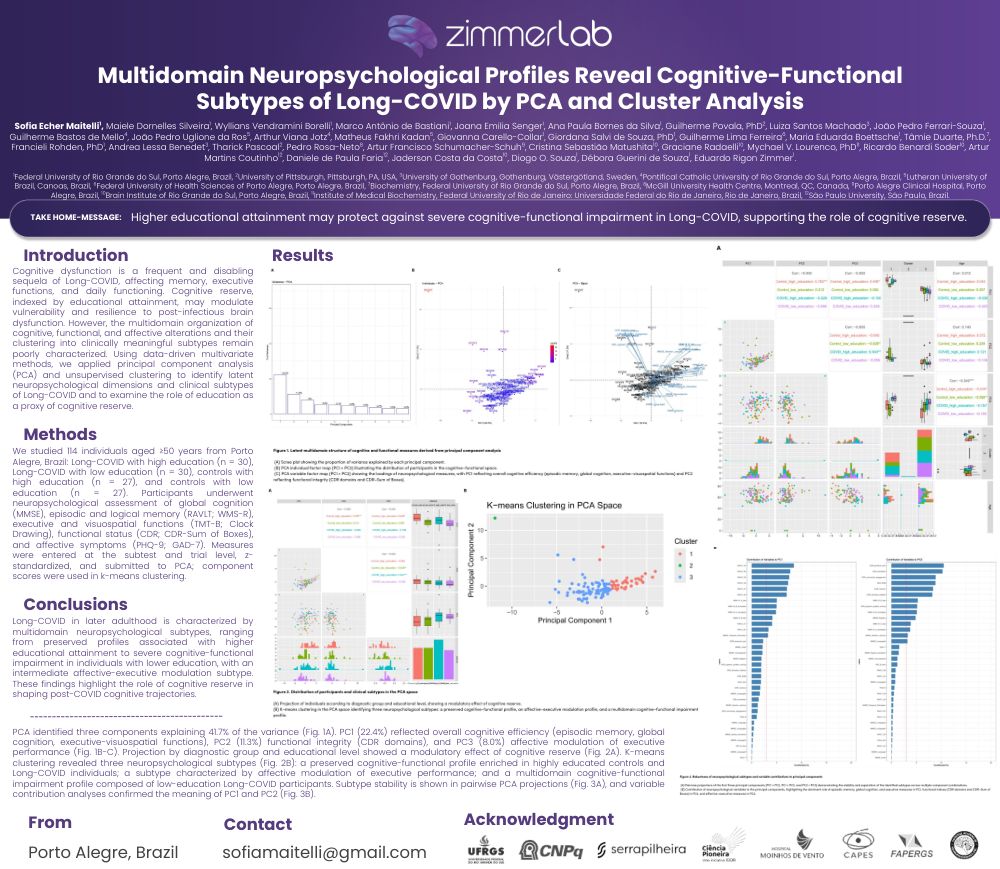
Background: Cognitive dysfunction is a frequent and disabling sequela of Long-COVID, affecting memory, executive functions, and daily functioning. Cognitive reserve, indexed by educational attainment, may modulate vulnerability and resilience to post-infectious brain dysfunction. However, the multidomain organization of cognitive, functional, and affective alterations and their clustering into clinically meaningful subtypes remain poorly characterized. Using data-driven multivariate methods, we applied principal component analysis (PCA) and unsupervised clustering to identify latent neuropsychological dimensions and clinical subtypes of Long-COVID and to examine the role of education as a proxy of cognitive reserve.
Methods: We studied 114 individuals aged ≥50 years from Porto Alegre, Brazil: Long-COVID with high education (n = 30), Long-COVID with low education (n = 30), controls with high education (n = 27), and controls with low education (n = 27). Participants underwent neuropsychological assessment of global cognition (MMSE), episodic and logical memory (RAVLT; WMS-R), executive and visuospatial functions (TMT-B; Clock Drawing), functional status (CDR; CDR-Sum of Boxes), and affective symptoms (PHQ-9; GAD-7). Measures were entered at the subtest and trial level, z-standardized, and submitted to PCA; component scores were used in k-means clustering.
Results: PCA identified three components explaining 41.7% of the variance (Fig. 1A). PC1 (22.4%) reflected overall cognitive efficiency (episodic memory, global cognition, executive-visuospatial functions), PC2 (11.3%) functional integrity (CDR domains), and PC3 (8.0%) affective modulation of executive performance (Fig. 1B-C). Projection by diagnostic group and educational level showed a modulatory effect of cognitive reserve (Fig. 2A). K-means clustering revealed three neuropsychological subtypes (Fig. 2B): a preserved cognitive-functional profile enriched in highly educated controls and Long-COVID individuals; a subtype characterized by affective modulation of executive performance; and a multidomain cognitive-functional impairment profile composed of low-education Long-COVID participants. Subtype stability is shown in pairwise PCA projections (Fig. 3A), and variable contribution analyses confirmed the meaning of PC1 and PC2 (Fig. 3B).
Conclusion: Long-COVID in later adulthood is characterized by multidomain neuropsychological subtypes, ranging from preserved profiles associated with higher educational attainment to severe cognitive-functional impairment in individuals with lower education, with an intermediate affective-executive modulation subtype. These findings highlight the role of cognitive reserve in shaping post-COVID cognitive trajectories.
Comments
Email is required but is not shown publicly.
Loading comments...