Loading...

4,068 posters, 219 videos, 101 topics, 69 sessions, 14,365 authors, 6,128 institutions

ePostersLive by SciGen Technologies S.A. All rights reserved.

Alzheimer's Association International Conference 2026

July 12-15, 2026 | London, United Kingdom, and Online

Alzheimer's Association International Conference 2026 banner

7203

Automated Scoring Of A Free Speech Task Using A Large Language Model
Part of Topic

Background

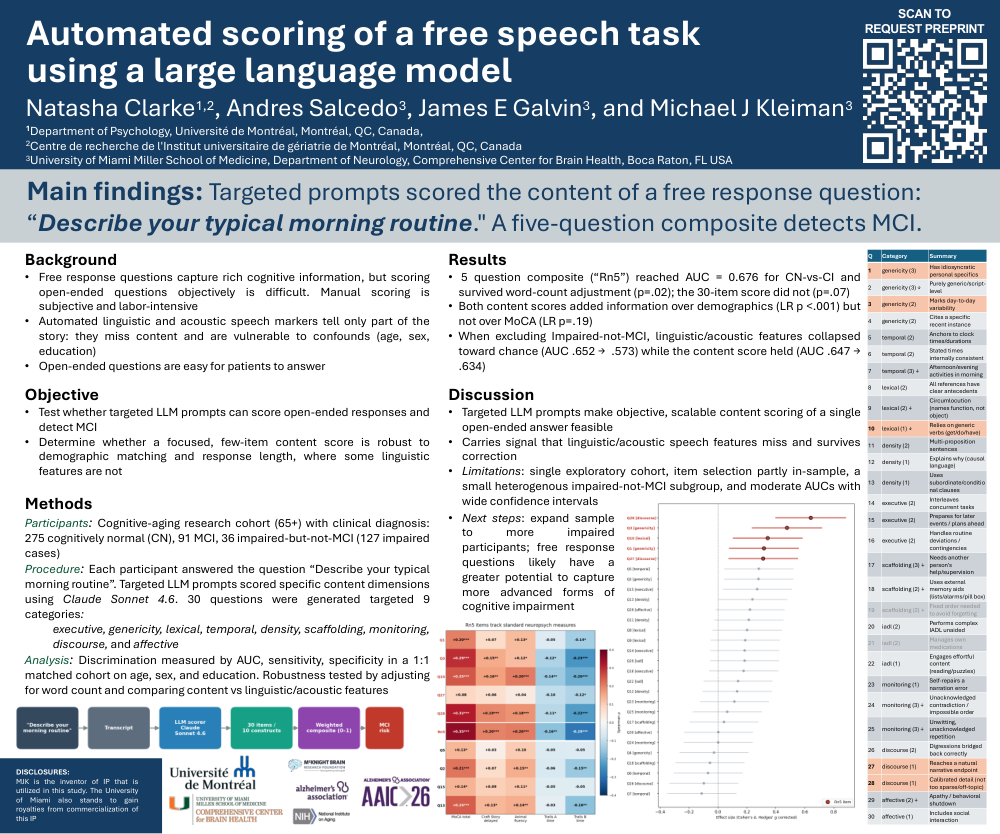
•Free response questions capture rich cognitive information, but scoring open-ended questions objectively is difficult. Manual scoring is subjective and labor-intensive
•Automated linguistic and acoustic speech markers tell only part of the story: they miss content and are vulnerable to confounds (age, sex, education)
•Open-ended questions are easy for patients to answer


Objective

•Test whether targeted LLM prompts can score open-ended responses and detect MCI
•Determine whether a focused, few-item content score is robust to demographic matching and response length, where some linguistic features are not
 

Methods

Participants: Cognitive-aging research cohort (65+) with clinical diagnosis: 275 cognitively normal (CN), 91 MCI, 36 impaired-but-not-MCI (127 impaired cases)

Procedure: Each participant answered the question “Describe your typical morning routine”. Targeted LLM prompts scored specific content dimensions using Claude Sonnet 4.6. 30 questions were generated targeted 9 categories:

  executive, genericity, lexical, temporal, density, scaffolding, monitoring,
  discourse, and affective

Analysis: Discrimination measured by AUC, sensitivity, specificity in a 1:1 matched cohort on age, sex, and education. Robustness tested by adjusting for word count and comparing content vs linguistic/acoustic features


Results

• 5 question composite (“Rn5”) reached AUC = 0.676 for CN-vs-CI and survived word-count adjustment (p=.02); the 30-item score did not (p=.07)
•Both content scores added information over demographics (LR p <.001) but not over MoCA (LR p=.19)
•When excluding Impaired-not-MCI, linguistic/acoustic features collapsed toward chance (AUC .652 →  .573) while the content score held (AUC .647 → .634)


Discussion

•Targeted LLM prompts make objective, scalable content scoring of a single open-ended answer feasible
•Carries signal that linguistic/acoustic speech features miss and survives correction
•Limitations: single exploratory cohort, item selection partly in-sample, a small heterogenous impaired-not-MCI subgroup, and moderate AUCs with wide confidence intervals


Comments

Email is required but is not shown publicly.

Loading comments...

aaic2026 banner
Copyright © 2015-2026, ePostersLive® SciGen is a registered trademark of SciGen Technologies S.A. Patent pending.

This website and third-party tools we use rely on cookies for the best user experience. By selecting "I agree", you agree to cookie usage as described in our Privacy Policy.