4,068 posters, 219 videos, 101 topics, 69 sessions, 14,365 authors, 6,128 institutions
ePostersLive by SciGen Technologies S.A. All rights reserved.
Alzheimer's Association International Conference 2026
July 12-15, 2026 | London, United Kingdom, and Online

9911
From English To Italian: A Toolkit For Coding Adult Neurological Speech And Language Disorders
Poster Presenter
Part of Topic
TITLE From English to Italian: A Toolkit for Coding Adult Neurological Speech and Language Disorders
AUTHORS Benzini A.¹ · Lanzi A.M.² · Palmirotta C.¹ · Aresta S.¹ · Battista P.¹ · Santi G.C.¹
AFFILIATIONS ¹Laboratory of Neuropsychology, Istituti Clinici Scientifici Maugeri IRCCS, Institute of Bari, Bari, Italy ²Department of Communication Sciences and Disorders, University of Delaware, Newark
BACKGROUND
Speech and language analysis provides sensitive markers for investigating adult-acquired neurological speech and language disorders.
The Codes for the Human Analysis of Transcripts (CHAT) format and the Computerized Language Analysis (CLAN) software, both developed within the CHILDES/TalkBank framework, provide a standardized and widely adopted approach for systematically transcribing and quantitatively analyzing connected speech.
The application of CHAT and CLAN to Italian adult neurological populations still poses some challenges: certain linguistically and clinically relevant features of Italian are not yet systematically captured within the current framework.
AIM
To develop the Italian CHAT Toolkit, ensuring linguistic appropriateness for Italian and clinical relevance for adult neurological populations, and provide a framework for future cross-linguistic adaptations.
METHODS
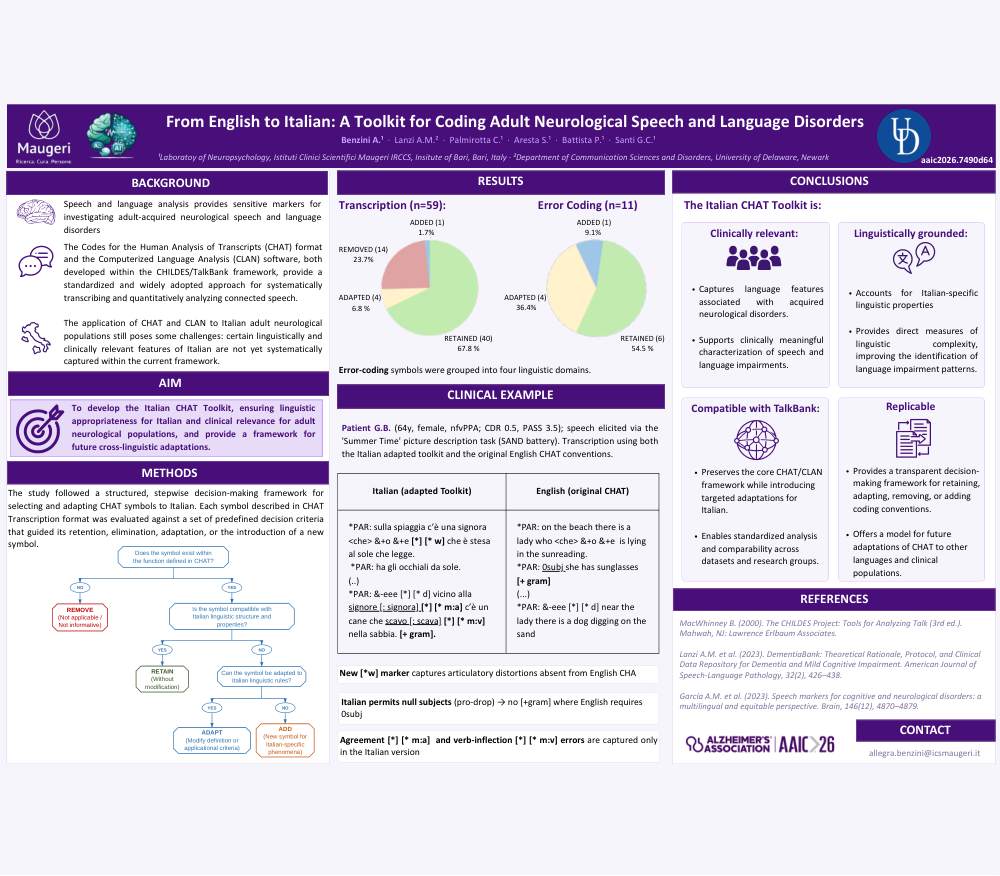
The study followed a structured, stepwise decision-making framework for selecting and adapting CHAT symbols to Italian. Each symbol described in CHAT Transcription format was evaluated against a set of predefined decision criteria that guided its retention, elimination, adaptation, or the introduction of a new symbol.
Error-coding symbols were grouped into four linguistic domains.
Decision flowchart:
- Does the symbol exist within the function defined in CHAT?
- NO → REMOVE (Not applicable / Not informative)
- YES → Is the symbol compatible with Italian linguistic structure and properties?
- YES → RETAIN (Without modification)
- NO → Can the symbol be adapted to Italian linguistic rules?
- YES → ADAPT (Modify definition or applicational criteria)
- NO → ADD (New symbol for Italian-specific phenomena)
RESULTS
Transcription (n=59):
- RETAINED (40) — 67.8%
- REMOVED (14) — 23.7%
- ADAPTED (4) — 6.8%
- ADDED (1) — 1.7%
Error Coding (n=11):
- RETAINED (6) — 54.5%
- ADAPTED (4) — 36.4%
- ADDED (1) — 9.1%
Error-coding symbols were grouped into four linguistic domains.
CLINICAL EXAMPLE
Patient G.B. (64y, female, nfvPPA; CDR 0.5, PASS 3.5); speech elicited via the 'Summer Time' picture description task (SAND battery). Transcription using both the Italian adapted toolkit and the original English CHAT conventions.
| Italian (adapted Toolkit) | English (original CHAT) |
|---|---|
| *PAR: sulla spiaggia c'è una signora <che> &+o &+e [*] [* w] che è stesa al sole che legge. | *PAR: on the beach there is a lady who <che> &+o &+e is lying in the sun reading. |
| *PAR: ha gli occhiali da sole. | *PAR: 0subj she has sunglasses [+ gram] |
| (..) | (...) |
| *PAR: &-eee [*] [* d] vicino alla signore [: signora] [*] [* m:a] c'è un cane che scavo [: scava] [*] [* m:v] nella sabbia. [+ gram]. | *PAR: &-eee [*] [* d] near the lady there is a dog digging on the sand |
- New [*w] marker captures articulatory distortions absent from English CHAT
- Italian permits null subjects (pro-drop) → no [+gram] where English requires 0subj
- Agreement [*] [* m:a] and verb-inflection [*] [* m:v] errors are captured only in the Italian version
CONCLUSIONS
The Italian CHAT Toolkit is:
Clinically relevant:
- Captures language features associated with acquired neurological disorders.
- Supports clinically meaningful characterization of speech and language impairments.
Linguistically grounded:
- Accounts for Italian-specific linguistic properties.
- Provides direct measures of linguistic complexity, improving the identification of language impairment patterns.
Compatible with TalkBank:
- Preserves the core CHAT/CLAN framework while introducing targeted adaptations for Italian.
- Enables standardized analysis and comparability across datasets and research groups.
Replicable:
- Provides a transparent decision-making framework for retaining, adapting, removing, or adding coding conventions.
- Offers a model for future adaptations of CHAT to other languages and clinical populations.
REFERENCES
MacWhinney B. (2000). The CHILDES Project: Tools for Analyzing Talk (3rd ed.). Mahwah, NJ: Lawrence Erlbaum Associates.
Lanzi A.M. et al. (2023). DementiaBank: Theoretical Rationale, Protocol, and Clinical Data Repository for Dementia and Mild Cognitive Impairment. American Journal of Speech-Language Pathology, 32(2), 426–438.
García A.M. et al. (2023). Speech markers for cognitive and neurological disorders: a multilingual and equitable perspective. Brain, 146(12), 4870–4879.
CONTACT allegra.benzini@icsmaugeri.it
Comments
Email is required but is not shown publicly.
Loading comments...