4,068 posters, 219 videos, 101 topics, 69 sessions, 14,365 authors, 6,128 institutions
ePostersLive by SciGen Technologies S.A. All rights reserved.
Alzheimer's Association International Conference 2026
July 12-15, 2026 | London, United Kingdom, and Online

2141
Risk Algorithms To Predict Elevated Plasma P-tau217 Status: A Cross-sectional Analysis
Poster Presenter
Authors
Nalin Payakachat, E. Jolanda Muenzel, Dulanji Kuruppu, Katie A. Vandergriff, Yun-Fei Chen, Karen Holdridge, Nicolae Done, Urvi Desai, Pete Zuckerman, Michael S. Rafii, Roy Yaari, Reisa A. Sperling
Affiliations
Eli Lilly and Company, Indianapolis, USA, Analysis Group, Boston, USA, University of Southern California, Los Angeles, USA, Harvard Medical School, Boston, USA
Part of Topic
Abstract:
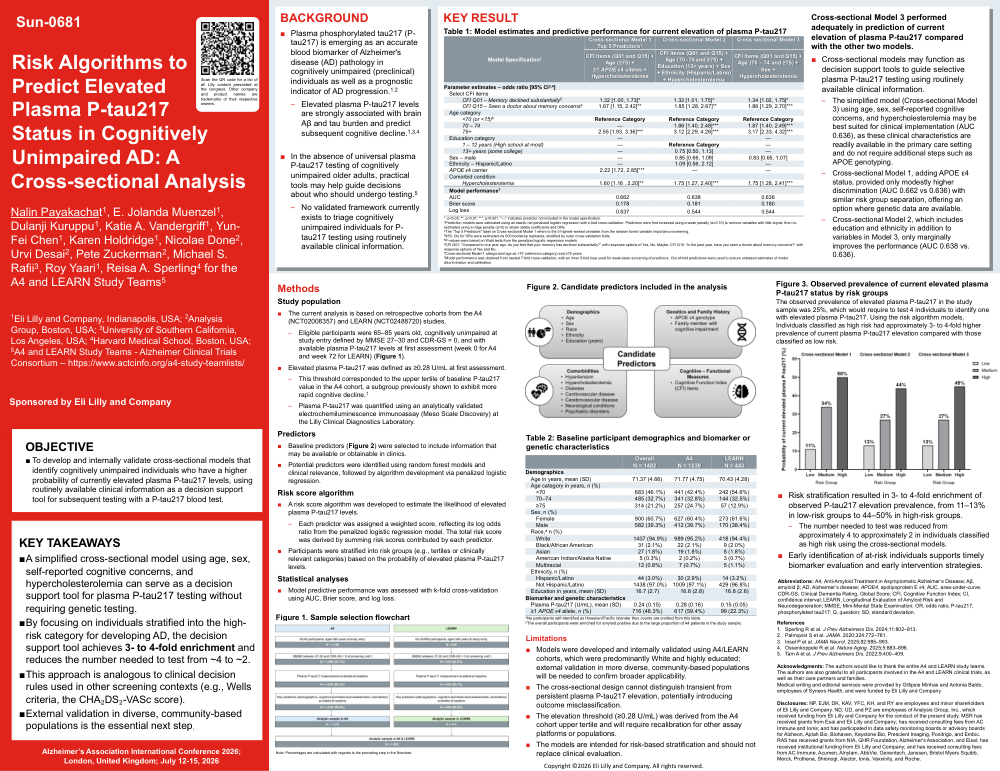
Background: Plasma phosphorylated tau217 (P-tau217) is a biomarker of Alzheimer’s disease (AD) pathology. Identifying individuals at risk for elevated P-tau217 may help clinicians determine who should receive this test. Given limited clinically applicable predictive models, we developed a simple risk algorithm to estimate the likelihood of elevated P-tau217 in cognitively unimpaired individuals.
Methods: We developed risk algorithms to predict elevated P-tau217 status using a retrospective cohort from the A4 (NCT02008357) and LEARN (NCT02488720) studies. Eligible participants were 65-85 years old, cognitively unimpaired at study entry, and had plasma P-tau217 levels at first assessment. Thirty-one candidate variables—including demographics, apolipoprotein E ε4 (APOE4) carrier status, reported comorbidities, and subjective cognitive and functional concerns (chosen from the Cognitive Functional Index) in the past year—were selected based on practical use in primary care settings. Potential predictors were then identified using Random Forest models and clinical relevance, followed by algorithm development via penalized logistic regression. Model performance was assessed with k-fold cross-validation using area under the curve (AUC), Brier score (BS), and log loss (LL). Odds ratios (ORs) with 95% confidence intervals are reported.
Results: A total of 1482 participants (A4=1039; LEARN=443) were included (mean [standard deviation] age 71.37 [4.66] years; 61% female; 95% White). A simplified model including age, hypercholesterolemia, self-reported substantial memory decline, and self-reporting seeing a doctor about memory concerns performed adequately (AUC=0.64, BS=0.18, LL=0.54) compared with the comprehensive predictors model (AUC=0.68, BS=0.18, LL=0.53). In the simplified model, elevated P-tau217 was more likely among participants with older age (age 70-74 years: OR=1.87 [1.40-2.49]; age ≥75 years: OR=3.17 [2.33-4.32], both versus <70 years), a reported doctor’s visit about memory concerns (OR=1.86 [1.29-2.70]), hypercholesterolemia (OR=1.75 [1.28-2.41]), and subjective substantial memory decline (OR=1.34 [1.02-1.75]). Elevated P-tau217 was observed at different rates by risk group in the simplified model: low-risk (13%), intermediate-risk (27%), and high-risk (45%).
Conclusion: The simplified risk algorithm identifying individuals likely to have current elevated plasma P-tau217 could easily be integrated into clinical workflow and may help prioritize cognitively unimpaired individuals for AD biomarker testing in primary care settings once effective treatments become available.
Comments
Email is required but is not shown publicly.
Loading comments...