4,068 posters, 219 videos, 101 topics, 69 sessions, 14,365 authors, 6,128 institutions
ePostersLive by SciGen Technologies S.A. All rights reserved.
Alzheimer's Association International Conference 2026
July 12-15, 2026 | London, United Kingdom, and Online

10299
Cognitive Screening In Primary Care: Gender And Racial/ethnic Disparities
Poster Presenter
Authors
Nusha Kheradbin, Liliana Guadagno, Miranda Munoz, Sarah Rodriguez, Aaron Valerio, Katherine Guillen, Scott Selinger, Heather Cuevas, Claire Harrison, Jeff Keller, Angelica Davila, Chidinma Aneiemeke, Joshua Chang, Robin Hilsabeck
Affiliations
Pennington Biomedical Research Center, University of Texas Dell Medical School, University of Texas Health San Antonio & Glenn Biggs Institute for Alzheimer’s & Neurodegenerative Diseases, The University of Texas at Austin School of Nursing, The University of Texas Dell Medical School, University of Texas Health San Antonio & Glenn Biggs Institute for Alzheimer’s & Neurodegenerative Diseases, The University of Texas Dell Medical School
Part of Topic
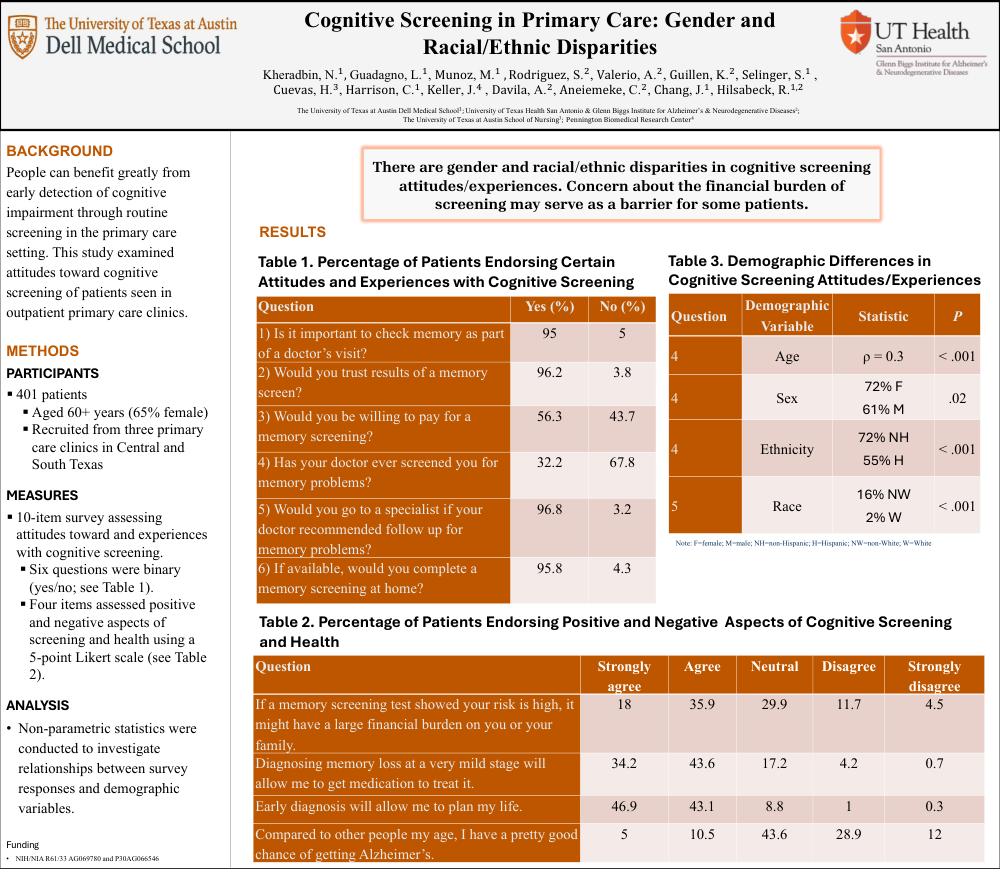
Background: People can benefit greatly from early detection of cognitive impairment through routine screening in the primary care setting. This study examined attitudes toward cognitive screening of patients seen in outpatient primary care clinics.
Methods: 401 patients aged 60+ years (65% female) recruited from three primary care clinics in Central and South Texas completed a 10-item survey assessing attitudes toward and experiences with cognitive screening. Six questions were binary (yes/no), addressing importance of screening, trust in results, willingness to pay for screening, previous screening, willingness to see a specialist, and willingness to complete screening at home. Four items assessed positive and negative aspects of screening using a five‑point Likert scale. Non-parametric statistics were conducted to investigate relationships between survey responses and demographic variables.
Results: Nearly all participants endorsed the importance of screening during medical visits (95%), while only 32% reported having been screened previously. Most participants trusted screening results (96%), would pursue specialist follow‑up (97%), and would complete home-based screening (96%). Willingness to pay for screening was endorsed by 56%. The majority agreed that early detection enables treatment access (78%) and life planning (90%). Just over half (53%) agreed that a positive screening might have a large financial burden while only 16% agreed that they had a higher risk of cognitive impairment. Older age (ρ=0.3, p <.001) was significantly associated with having been screened previously. Significantly more female (72% vs 61% of males; χ2(1)=.5.3, p=.02) and Hispanic participants (55% vs 72% of Non-Hispanic) reported never having been screened (χ2(1)=10.9, p<.001), and more non-White participants would not follow up with a specialist (16% vs. 2% of Whites; χ2(1)=17.8, p<.001).
Conclusion: Results revealed gender and racial/ethnic disparities in cognitive screening attitudes/experiences. Concern about the financial burden of screening may serve as a barrier for some patients.
Comments
Email is required but is not shown publicly.
Loading comments...