4,068 posters, 219 videos, 101 topics, 69 sessions, 14,365 authors, 6,128 institutions
ePostersLive by SciGen Technologies S.A. All rights reserved.
Alzheimer's Association International Conference 2026
July 12-15, 2026 | London, United Kingdom, and Online

10803
Impact Of Loneliness On Memory In Older Adults Using A Computerized Neuropsychological Test Battery
Poster Presenter
Authors
Part of Topic
Video
Impact Of Loneliness On Memory In Older Adults Using A Computerized Neuropsychological Test Battery
Timothy J. Herron1, Juliana V. Baldo, PhD 1, 2 Jas M. Chok1,2, Maria G. Spinelli1, Brian Curran1, Krista Schendel, PhD1, & Sandy J. Lwi, PhD1
(1) U.S. Veterans Affairs Northern California HCS, (2) University of California, Davis, (3) Palo Alto University
Introduction
Cases of dementia are expected to double in the next 35 years, making it critical for research to examine many areas of early prevention. Loneliness is one potential target given its negative impact on health and cognition. However, results examining loneliness and cognition have been mixed, often due to variability in the tests administered and the inconsistent inclusion of covariates linked to cognition. This study aimed to address this gap by examining adults on the California Cognitive Assessment Battery (CCAB), an automated and computerized neuropsychological test battery that reliably parallels gold standard paper-and-pencil neuropsychological tests [1,2].
Methods
Two community samples of healthy adults (Group 1: Age M(SD)=54.5(15.1), 59% female; Group 2: Age M(SD)=70.0 (6.1), 58% female) completed remotely administered CCAB assessments and questionnaires [3]. The questionnaires included the 3-item UCLA Loneliness Scale and the Geriatric Depression Scale. Over 30 CCAB neuropsychological tests were z-scored and averaged to characterize the following cognitive domains: attention and concentration, processing speed, language, visuospatial, learning/memory, and executive functioning [1]. Analyses assessing the impact of loneliness on cognition were adjusted for multiple covariates (i.e., age, gender, race, education, socioeconomic status, overall intellectual ability).
Results
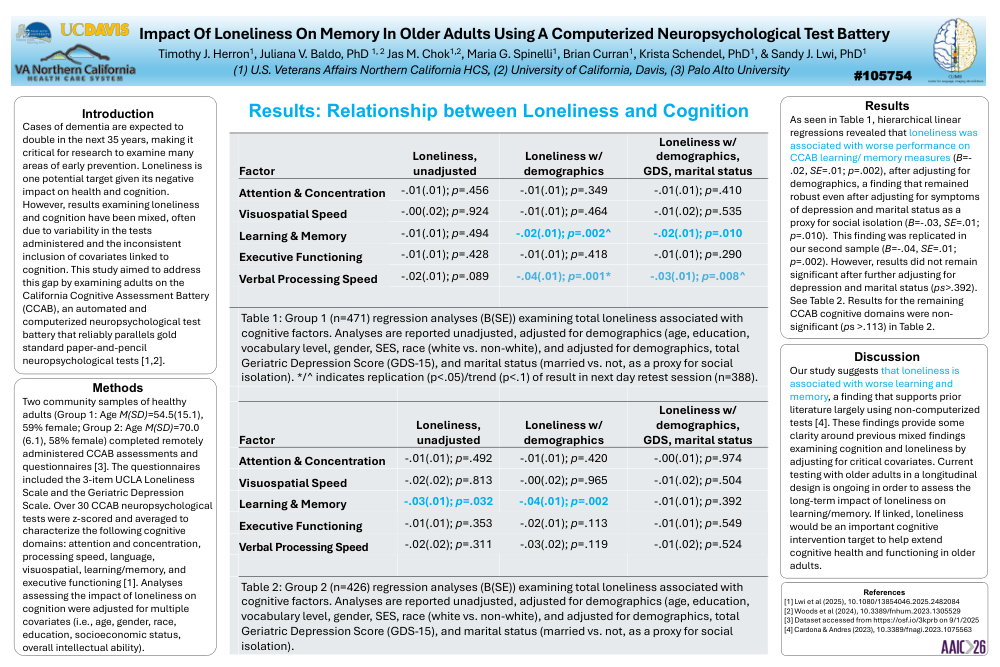
As seen in Table 1, hierarchical linear regressions revealed that loneliness was associated with worse performance on CCAB learning/ memory measures (B=-.02, SE=.01; p=.002), after adjusting for demographics, a finding that remained robust even after adjusting for symptoms of depression and marital status as a proxy for social isolation (B=-.03, SE=.01; p=.010). This finding was replicated in our second sample (B=-.04, SE=.01; p=.002). However, results did not remain significant after further adjusting for depression and marital status (ps>.392). See Table 2. Results for the remaining CCAB cognitive domains were non-significant (ps >.113) in Table 2.
Discussion
Our study suggests that loneliness is associated with worse learning and memory, a finding that supports prior literature largely using non-computerized tests [4]. These findings provide some clarity around previous mixed findings examining cognition and loneliness by adjusting for critical covariates. Current testing with older adults in a longitudinal design is ongoing in order to assess the long-term impact of loneliness on learning/memory. If linked, loneliness would be an important cognitive intervention target to help extend cognitive health and functioning in older adults.
References
[1] Lwi et al (2025), 10.1080/13854046.2025.2482084
[2] Woods et al (2024), 10.3389/fnhum.2023.1305529
[3] Dataset accessed from https://osf.io/3kprb on 9/1/2025
[4] Cardona & Andres (2023), 10.3389/fnagi.2023.1075563
Table 1: Group 1 (n=471) regression analyses (B(SE)) examining total loneliness associated with cognitive factors. Analyses are reported unadjusted, adjusted for demographics (age, education, vocabulary level, gender, SES, race (white vs. non-white), and adjusted for demographics, total Geriatric Depression Score (GDS-15), and marital status (married vs. not, as a proxy for social isolation). */^ indicates replication (p<.05)/trend (p<.1) of result in next day retest session (n=388).
Table 2: Group 2 (n=426) regression analyses (B(SE)) examining total loneliness associated with cognitive factors. Analyses are reported unadjusted, adjusted for demographics (age, education, vocabulary level, gender, SES, race (white vs. non-white), and adjusted for demographics, total Geriatric Depression Score (GDS-15), and marital status (married vs. not, as a proxy for social isolation).
Comments
Email is required but is not shown publicly.
Loading comments...