4,068 posters, 219 videos, 101 topics, 69 sessions, 14,365 authors, 6,128 institutions
ePostersLive by SciGen Technologies S.A. All rights reserved.
Alzheimer's Association International Conference 2026
July 12-15, 2026 | London, United Kingdom, and Online

4727
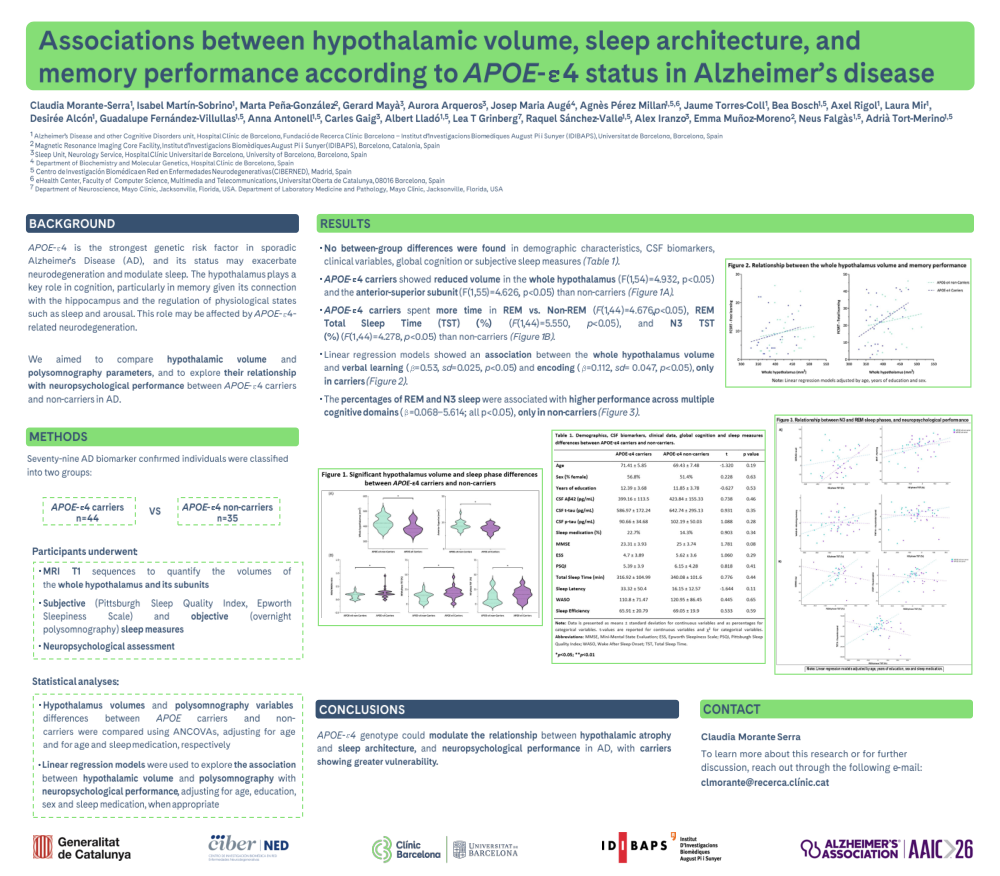
Associations Between Hypothalamic Volume, Sleep Architecture, And Memory Performance According To APOE-e4 Status In Alzheimer’s Disease
Poster Presenter
Authors
Claudia Morante-Serra, Isabel Martín-Sobrino, Marta Peña-González, Gerard Mayà, Aurora Arqueros, Josep Maria Augé, Agnès Pérez-Millan, Jaume Torres-Coll, Bea Bosch, Axel Rigol, Laura Mir, Desirée Alcón, Guadalupe Fernández-Villullas, Anna Antonell, Carles Gaig, Albert Lladó, Lea T Grinberg, Raquel Sánchez-Valle, Alex Iranzo, Emma Muñoz-Moreno, Neus Falgàs, Adrià Tort-Merino
Affiliations
Alzheimer’s Disease and other Cognitive Disorders unit, Hospital Clínic de Barcelona, Fundació de Recerca Clínic Barcelona – Institut d’Investigacions Biomèdiques August Pi i Sunyer (IDIBAPS), Universitat de Barcelona, Barcelona, Spain, Magnetic Resonance Imaging Core Facility, Institut d’Investigacions Biomèdiques August Pi i Sunyer (IDIBAPS), Barcelona, Catalonia, Spain, Sleep Unit, Neurology Service, Hospital Clínic Universitari de Barcelona, University of Barcelona, Barcelona, Spain, Department of Biochemistry and Molecular Genetics, Hospital Clínic de Barcelona, Spain, Department of Neuroscience, Mayo Clinic, Jacksonville, Florida, USA. Department of Laboratory Medicine and Pathology, Mayo Clinic, Jacksonville, Florida, USA
Part of Topic
Video
ASSOCIATIONS BETWEEN HYPOTHALAMIC VOLUME, SLEEP ARCHITECTURE, AND MEMORY PERFORMANCE ACCORDING TO APOE-Ε4 STATUS IN ALZHEIMER’S DISEASE
Claudia Morante-Serra1, Isabel Martin-Sobrino1,Marta Peña-González2, Gerard Mayà3, Aurora Arqueros3, Josep Maria Augé4, Agnès Pérez-Millan1,5,6, Jaume Torres-Coll1, Bea Bosch1,5, Axel Rigol1, Laura Mir1,Desirée Alcón1, Guadalupe Fernández-Villullas1,5, Anna Antonell1,5, Carles Gaig3, Albert Lladó1,5, Lea T Grinberg7, Raquel Sánchez-Valle1,5, Alex Iranzo3, Emma Muñoz-Moreno2,Neus Falgàs1,5, Adrià Tort-Merino1,5.
1 Alzheimer’s Disease and other Cognitive Disorders unit, Hospital Clínic de Barcelona, Fundació de Recerca Clínic Barcelona – Institut d’Investigacions Biomèdiques August Pi i Sunyer (IDIBAPS), Universitat de Barcelona, Barcelona, Spain
2 Magnetic Resonance Imaging Core Facility, Institut d’Investigacions Biomèdiques August Pi i Sunyer (IDIBAPS), Barcelona, Catalonia, Spain
3 Sleep Unit, Neurology Service, Hospital Clínic Universitari de Barcelona, University of Barcelona, Barcelona, Spain
4 Department of Biochemistry and Molecular Genetics, Hospital Clínic de Barcelona, Spain
5 Centro de Investigación Biomédica en Red en Enfermedades Neurodegenerativas (CIBERNED), Madrid, Spain
6 eHealth Center, Faculty of Computer Science, Multimedia and Telecommunications, Universitat Oberta de Catalunya, 08016 Barcelona, Spain
7 Department of Neuroscience, Mayo Clinic, Jacksonville, Florida, USA. Department of Laboratory Medicine and Pathology, Mayo Clinic, Jacksonville, Florida, USA
Background:
APOE-ε4 is the strongest genetic risk factor in sporadic Alzheimer’s Disease (AD), and its status may exacerbate neurodegeneration and modulate sleep. The hypothalamus plays a key role in cognition, particularly in memory given its connection with the hippocampus and the regulation of physiological states such as sleep and arousal. This role may be affected by APOE-ε4-related neurodegeneration.
We aimed to compare hypothalamic volume and polysomnography parameters, and to explore their relationship with neuropsychological performance between APOE-ε4 carriers and non-carriers in AD.
Methods:
Seventy-nine AD biomarker confirmed individuals were classified into two groups: APOE-ε4 carriers (n=44), APOE-ε4 non-carriers (n=35). Participants underwent structural T1-weighted MRI scans incorporating T1-weighted turbo spin-echo sequence to quantify the volumes of the whole hypothalamus and its subunits, subjective (Pittsburgh Sleep Quality Index, Epworth Sleepiness Scale) and objective (overnight polysomnography) sleep measures, and neuropsychological assessment. Statistical analyses: Hypothalamus volumes and polysomnography variables differences between APOE carriers and non-carriers were compared using ANCOVAs, adjusting for age and for age and sleep medication, respectively. Linear regression models were used to explore the association between hypothalamic volume and polysomnography with neuropsychological performance, adjusting for age, education, sex and sleep medication, when appropriate
Results:
Conclusions:
APOE-ε4 genotype could modulate the relationship between hypothalamic atrophy and sleep architecture, and neuropsychological performance in AD, with carriers showing greater vulnerability.
Contact:
Claudia Morante Serra
To learn more about this research or for further
discussion, reach out through the following e-mail:
clmorante@recerca.clínic.cat
Comments
Email is required but is not shown publicly.
Loading comments...