4,068 posters, 219 videos, 101 topics, 69 sessions, 14,365 authors, 6,128 institutions
ePostersLive by SciGen Technologies S.A. All rights reserved.
Alzheimer's Association International Conference 2026
July 12-15, 2026 | London, United Kingdom, and Online

5638
Executive Functioning, Memory, And Scam Susceptibility In Older Adults Without Dementia
Poster Presenter
Part of Topic
Background
• The prevalence of scams and fraud impacting older adults has markedly increased over the past decade, underscoring a public health concern.
• Previous work has shown that scam susceptibility is associated with impaired cognitive functioning and may reflect a functional decline related to early Alzheimer’s disease; however, it remains unclear whether older adults leverage different cognitive strategies for financial decision-making depending on their age.
Objective
• Examine the associations between executive functioning, memory, and scam susceptibility in older adults without dementia and whether there are differences in these associations for middle-aged and older adults.
Methods
Sample
• Participants included 151 older adults without dementia recruited from the greater Los Angeles community (age = 68.2±8.0 years; 72.2% female; years of education = 16.4±2.2; MMSE = 28.2±1.7; 65.6% White, 17.2% Asian, 8.6% Black or African American, 3% Mixed Race, 2.6% Other, 1% Unknown; median income = $75,000 to $99,999).
• Exclusion criteria: history of brain injury, stroke, major neurological or psychiatric illnesses, alcohol abuse in last 5 years, or other substance abuse.
Measures
• Participants completed a five-item self-report measure of scam susceptibility (Boyle et al., 2012; James et al., 2014). Items were rated on 7-point Likert scale. Items 1, 2, and 5 were reverse-scored and a total score was calculated by averaging all items.
• Participants also completed a neuropsychological test battery including measures from the Uniform Data Set v3.0 (UDS-3) and California Verbal Learning Test–Second Edition (CVLT-II).
• Executive functioning composite (UDS3-EF; Staffaroni et al., 2020) and memory composite (UDS-M+; Sanderson-Cimino et al., 2025) scores were computed.
Analyses
• Established middle-aged and older adult age groups using a median age split (<69, n = 74; ≥69, n = 77).
• Evaluated associations between UDS3-EF and UDS-M+ performance and scam susceptibility for each age group using linear regression models.
• Estimated unique contributions of UDS3-EF and UDS-M+ using nested model comparisons and calculating ΔR² from a full model with both predictors. Statistical significance was assessed using ANOVA.
• All analyses controlled for age, sex, years of education, and income.
Results
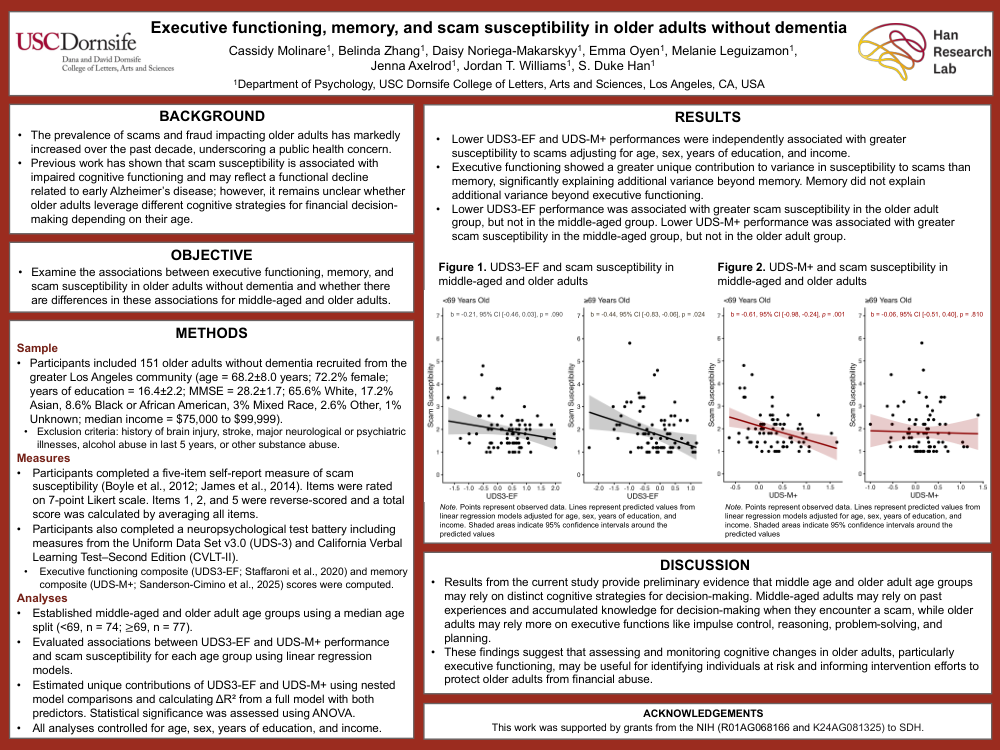
• Lower UDS3-EF and UDS-M+ performances were independently associated with greater susceptibility to scams adjusting for age, sex, years of education, and income.
• Executive functioning showed a greater unique contribution to variance in susceptibility to scams than memory, significantly explaining additional variance beyond memory. Memory did not explain additional variance beyond executive functioning.
• Lower UDS3-EF performance was associated with greater scam susceptibility in the older adult group, but not in the middle-aged group. Lower UDS-M+ performance was associated with greater scam susceptibility in the middle-aged group, but not in the older adult group.
Discussion
• Results from the current study provide preliminary evidence that middle age and older adult age groups may rely on distinct cognitive strategies for decision-making. Middle-aged adults may rely on past experiences and accumulated knowledge for decision-making when they encounter a scam, while older adults may rely more on executive functions like impulse control, reasoning, problem-solving, and planning.
• These findings suggest that assessing and monitoring cognitive changes in older adults, particularly executive functioning, may be useful for identifying individuals at risk and informing intervention efforts to protect older adults from financial abuse.
Acknowledgements
This work was supported by grants from the NIH (R01AG068166 and K24AG081325) to SDH.
Comments
Email is required but is not shown publicly.
Loading comments...