4,068 posters, 219 videos, 101 topics, 69 sessions, 14,365 authors, 6,128 institutions
ePostersLive by SciGen Technologies S.A. All rights reserved.
Alzheimer's Association International Conference 2026
July 12-15, 2026 | London, United Kingdom, and Online

8884
Evaluating Disturbances In Body Awareness Through A Tactile Remapping Task In Posterior Cortical Atrophy And Alzheimer's Disease.
Poster Presenter
Authors
Yuhan Bai, Diego Kaski, Sebastian Crutch, Matthew Longo, Patrick Haggard, Keir Yong
Affiliations
Queen Square Institute of Neurology, University College London, London, United Kingdom., Department of Psychological Sciences, Birkbeck, University of London, London, United Kingdom., Institute of Cognitive Neuroscience, University College London, London, United Kingdom.
Part of Topic
Background and Aim:
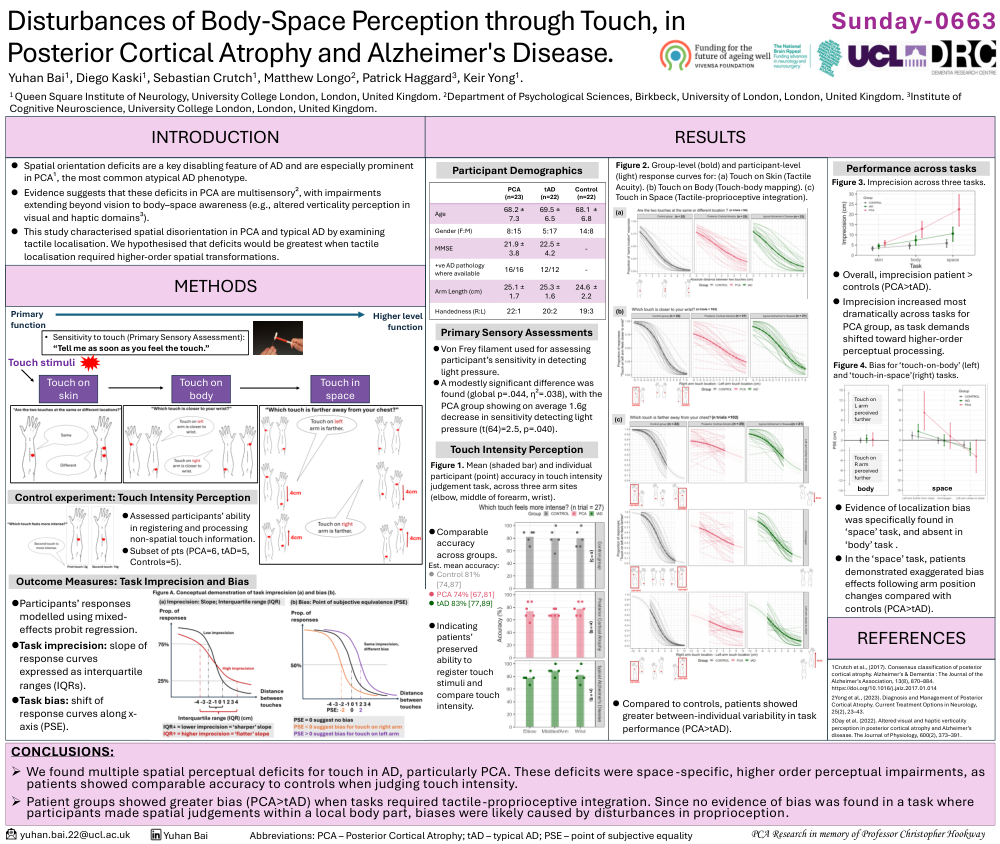
Difficulties with spatial orientation are disabling symptoms of Alzheimer’s disease(AD). Such difficulties are also early or characteristic features of atypical AD phenotypes, such as Posterior Cortical Atrophy(PCA), which is considered the most common atypical AD phenotype. PCA patients often report disturbances in body-space perception, such as difficulty locating one’s limb during walking and dressing. These disturbances are poorly assessed or understood.
This study uses a novel test to assess disturbances in body-space perception in PCA and typical AD(tAD).
Methods:
Participants (PCA=23,tAD=22,Control=22) made spatial judgements of two touches applied in succession on their forearms. In a first ‘touch-on-skin’ task, both touches were delivered to the same forearm, and participants judged whether the locations were the same, or different. In a second, ‘touch-on-body' task, the two forearms were touched in succession, and participants indicated which touch was ‘closer to the wrist’. In a third, ‘touch-in-external-space' task, participants’ right arm position was shifted by the experimenter before receiving touches, and participants indicated which touch was ‘farther away from the chest’. Contrasts across these tasks allowed isolating specific components of body-space perception: acuity of touch, touch localisation on the body, and tactile-proprioceptive integration.
Results:
Despite comparable touch detection sensitivity, patients showed space-specific impairments in touch perception. Increased imprecisions were found in patient groups, in distinguishing ‘same/different’ touch locations (group*distance p<.001), locating touches relative to the wrist(‘touch-on-body’; group*distance p<.001), and in tactile-proprioceptive integration(‘touch-in-external-space’, group*distance p<.001).
Moreover, arm position induced bias to the perceived location of the touch(position p<.001). Patient groups showed exaggerated bias than controls(PCA>tAD, group*position p<.001).
Conclusions:
We found multiple space-specific deficits in touch perception in AD, particularly PCA. Importantly, patient groups showed greater bias (PCA>tAD) when tasks required tactile-proprioceptive integration, suggesting an increased reliance on, or alteration in, proprioception. The findings offer suggestions on evaluating body-space perception in AD and related neurodegenerative conditions.
Comments
Email is required but is not shown publicly.
Loading comments...