4,068 posters, 219 videos, 101 topics, 69 sessions, 14,365 authors, 6,128 institutions
ePostersLive by SciGen Technologies S.A. All rights reserved.
Alzheimer's Association International Conference 2026
July 12-15, 2026 | London, United Kingdom, and Online

6091
Combining Temporal Dynamics And Semantic Embeddings To Assess Semantic Memory Search In Early Alzheimer’S Disease
Poster Presenter
Authors
Part of Topic
Combining Temporal Dynamics And Semantic Embeddings To Assess Semantic Memory Search In Early Alzheimer’s Disease
Background & Rationale
Semantic Memory in Alzheimer’s Disease:
Impairments in semantic memory are prominent early in AD.
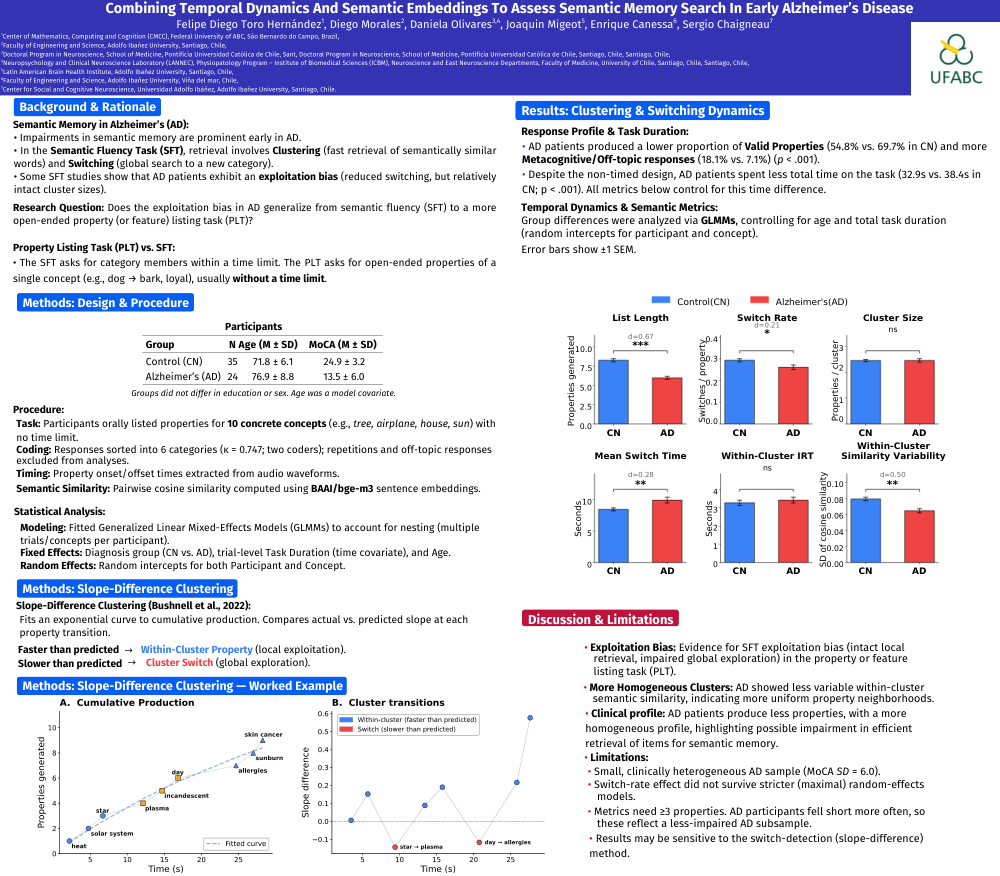
In the Semantic Fluency Task (SFT), retrieval involves Clustering, defined as fast retrieval of semantically similar words, and Switching, defined as global search to a new category.
Some SFT studies show that AD patients exhibit an exploitation bias, characterized by reduced switching but relatively intact cluster sizes.
Research Question: Does the exploitation bias in AD generalize from semantic fluency tasks to a more open-ended property or feature listing task?
Property Listing Task versus Semantic Fluency Task:
The SFT asks for category members within a time limit. The PLT asks for open-ended properties of a single concept, for example:
dog → bark, loyal
The PLT is usually administered without a time limit.
Methods
Procedure
Task: Participants orally listed properties for 10 concrete concepts, for example tree, airplane, house, and sun, with no time limit.
Coding: Responses were sorted into six categories, with inter-rater agreement of κ = 0.747 across two coders. Repetitions and off-topic responses were excluded from analyses.
Timing: Property onset and offset times were extracted from audio waveforms.
Semantic Similarity: Pairwise cosine similarity was computed using BAAI/bge-m3 sentence embeddings.
Statistical Analysis
Modeling: Generalized Linear Mixed-Effects Models were fitted to account for nesting, because there were multiple trials and concepts per participant.
Fixed Effects: Diagnosis group, CN versus AD; trial-level task duration as a time covariate; and age.
Random Effects: Random intercepts for both participant and concept.
Methods: Slope-Difference Clustering
Slope-difference clustering, following Bushnell et al. 2022, fits an exponential curve to cumulative production. It compares the actual versus predicted slope at each property transition.
Faster than predicted → Within-cluster property, interpreted as local exploitation.
Slower than predicted → Cluster switch, interpreted as global exploration.
Response Profile & Task Duration
AD patients produced a lower proportion of valid properties than controls:
AD: 54.8%
CN: 69.7%
AD patients also produced more metacognitive/off-topic responses:
AD: 18.1%
CN: 7.1%
This difference was significant at p < .001.
Despite the non-timed design, AD patients spent less total time on the task:
AD: 32.9 seconds
CN: 38.4 seconds
This difference was also significant at p < .001.
All metrics below controlled for this time difference.
Temporal Dynamics & Semantic Metrics
Group differences were analyzed using GLMMs, controlling for age and total task duration, with random intercepts for participant and concept.
List Length
AD patients generated fewer properties than controls.
Effect size shown: d = 0.67
Significance: p < .001
Switch Rate
AD patients showed a lower switch rate than controls.
Effect size shown: d = 0.21
Significance: p < .05
Cluster Size
No significant group difference.
Effect size shown: d = 0.41
Mean Switch Time
AD patients showed longer mean switch times.
Effect size shown: d = 0.28
Significance: p < .01
Within-Cluster IRT
No significant group difference.
Within-Cluster Similarity Variability
AD patients showed lower variability in within-cluster semantic similarity.
Effect size shown: d = 0.50
Significance: p < .01
Discussion & Limitations
Discussion
Exploitation Bias:
The results provide evidence for the SFT exploitation bias in the property or feature listing task. This pattern suggests relatively intact local retrieval but impaired global exploration.
More Homogeneous Clusters:
AD patients showed less variable within-cluster semantic similarity, indicating more uniform property neighborhoods.
Clinical Profile:
AD patients produced fewer properties, with a more homogeneous profile, highlighting a possible impairment in efficient retrieval of items from semantic memory.
Limitations
The AD sample was small and clinically heterogeneous, with MoCA SD = 6.0.
The switch-rate effect did not survive stricter maximal random-effects models.
The metrics require at least three properties. AD participants fell short of this requirement more often, so the results may reflect a less-impaired AD subsample.
The results may be sensitive to the switch-detection method, specifically the slope-difference approach.
Comments
Email is required but is not shown publicly.
Loading comments...