4,068 posters, 219 videos, 101 topics, 69 sessions, 14,365 authors, 6,128 institutions
ePostersLive by SciGen Technologies S.A. All rights reserved.
Alzheimer's Association International Conference 2026
July 12-15, 2026 | London, United Kingdom, and Online

7134
Improving The Detection Of Visual Symptoms In Alzheimer’s Disease Using The Graded Incomplete Letters Test
Poster Presenter
Authors
Zien Huang, Yuhan Bai, Tessa Dekker, Sebastian Crutch, Keir Yong, John Greenwood
Affiliations
Experimental Psychology, University College London, London, UK, Queen Square Institute of Neurology, University College London, London, UK, Experimental Psychology, University College London, London, UK; Institute of Ophthalmology, University College London, London, UK
Part of Topic
TITLE: Improving the detection of visual symptoms in Alzheimer's Disease using the Graded Incomplete Letters Test
AUTHORS: Zien Huang1, Yuhan Bai2, Tessa M. Dekker1,3, Sebastian J. Crutch2, Keir X. X. Yong2, John A. Greenwood1
AFFILIATIONS:
1Experimental Psychology, University College London, London, UK
2Queen Square Institute of Neurology, University College London, London, UK
3Institute of Ophthalmology, University College London, London, UK
Background
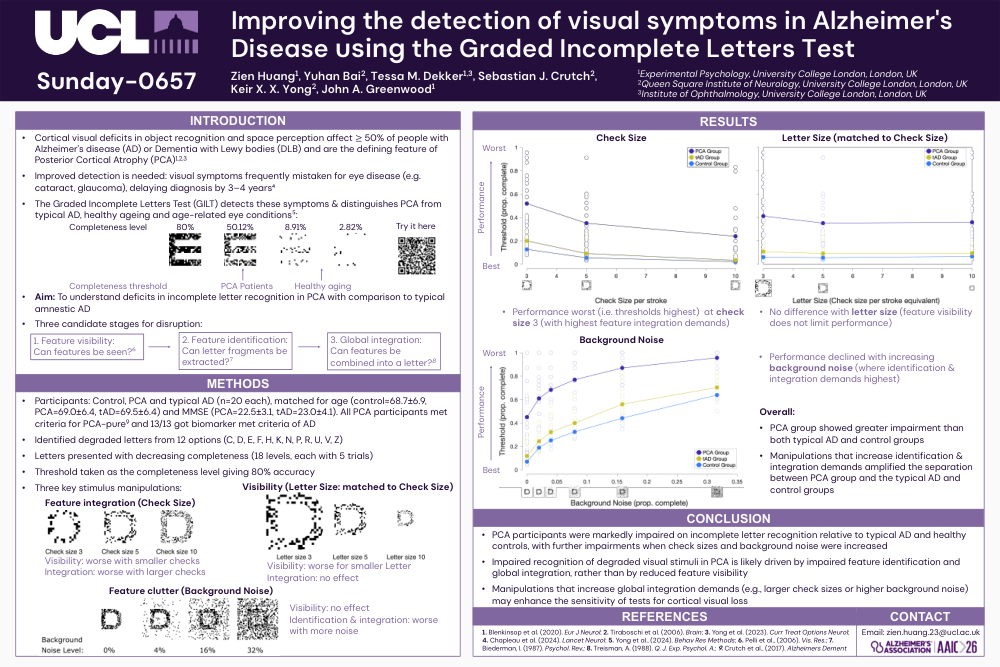
Visual deficits are common in Alzheimer’s disease (AD), particularly in the visual-led Posterior Cortical Atrophy (PCA) subtype. These cortical visual impairments can be detected by the Graded Incomplete Letters Test (GILT), which measures the threshold for recognising letters degraded by removing pixelated sections (decreasing ‘completeness’). Although GILT thresholds are strongly elevated in PCA relative to healthy ageing and typical AD (tAD), the mechanisms driving these deficits are unclear. We aimed to identify specific cortical visual factors limiting GILT performance in PCA and tAD, focussing on global integration (difficulty combining fragmented elements into recognisable objects) and crowding (impaired letter/object recognition in cluttered scenes), and to develop optimised GILT versions that target these factors more selectively.
Methods
Participants with PCA (n=20), tAD (n=20), and controls (n=20) completed modified versions of the GILT, requiring identification of letters presented at progressively lower levels of completeness. Thresholds were taken at 80% accuracy. Global integration and crowding were examined by manipulating pixel size, letter size, and background noise. Visual acuity and crowding were also directly measured.
Results
Across all conditions, PCA participants showed substantially poorer performance than controls (p<.0001; d>2.0), with tAD participants showing smaller, non-significant performance impairments (p>.05). Accuracy dropped further with increasing pixel size (which challenges global integration by concentrating the degradation; p<.0001), whereas smaller pixel sizes (which spread degradation and facilitate integration) improved performance (p<.0001). The addition of background noise (which challenges integration and increases clutter) further disrupted performance in PCA relative to controls (p<.0001), enhancing diagnostic separation. Although crowding effects were elevated in PCA, these were insufficient to account for the magnitude of GILT performance deficits observed. Moreover, increasing letter size (which should reduce crowding) did not improve GILT performance, indicating that crowding cannot fully explain these deficits.
Conclusions
These findings suggest that poor GILT performance in PCA is primarily driven by deficits in cortical-level processes of global integration. Test variations that increase pixel size and add background noise can selectively probe these integrative processes and enhance the sensitivity of the GILT for detecting and differentiating visual deficits in PCA, AD and other dementias.
Comments
Email is required but is not shown publicly.
Loading comments...