4,068 posters, 219 videos, 101 topics, 69 sessions, 14,365 authors, 6,128 institutions
ePostersLive by SciGen Technologies S.A. All rights reserved.
Alzheimer's Association International Conference 2026
July 12-15, 2026 | London, United Kingdom, and Online

4711
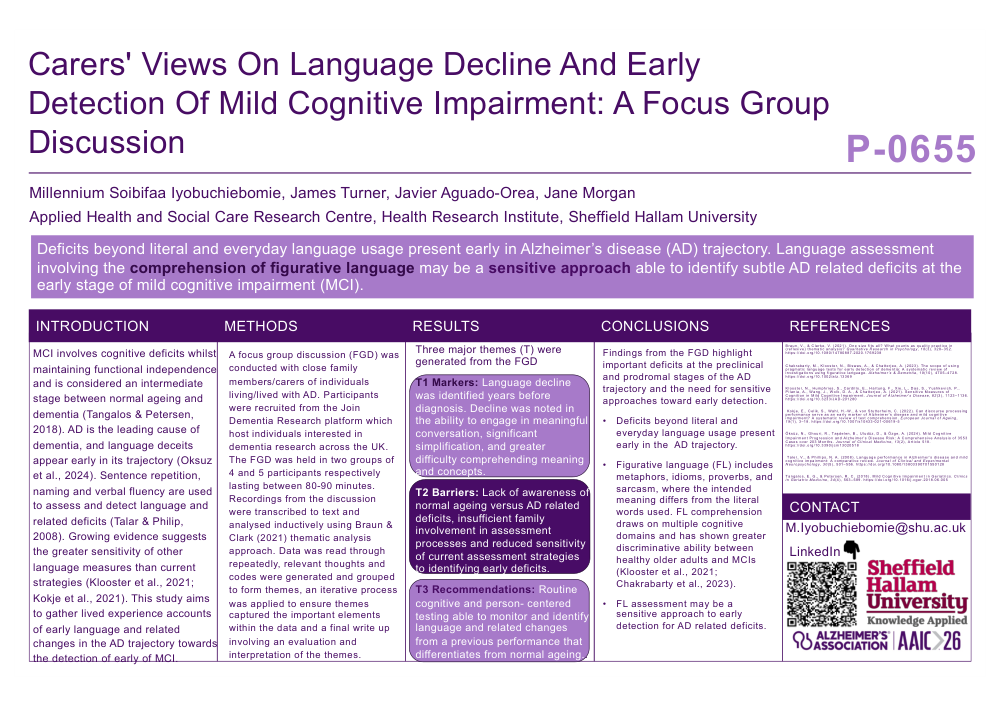
Carers' Views On Language Decline And Early Detection Of Mild Cognitive Impairment: A Focus Group Discussion
Poster Presenter
Authors
Part of Topic
Backgroud
MCI involves cognitive deficits whilst maintaining functional independence and is considered an intermediate stage between normal ageing and dementia (Tangalos & Petersen, 2018). AD is the leading cause of dementia, and language deceits appear early in its trajectory (Oksuz et al., 2024). Sentence repetition, naming and verbal fluency are used to assess and detect language and related deficits (Talar & Philip, 2008). Growing evidence suggests the greater sensitivity of other language measures than current strategies (Klooster et al., 2021; Kokje et al., 2021). This study aims to gather lived experience accounts of early language and related changes in the AD trajectory towards the detection of early of MCI.
Methods
A focus group discussion (FGD) was conducted with close family members/carers of individuals living/lived with AD. Participants were recruited from the Join Dementia Research platform which host individuals interested in dementia research across the UK. The FGD was held in two groups of 4 and 5 participants respectively lasting between 80-90 minutes. Recordings from the discussion were transcribed to text and analysed inductively using Braun & Clark (2021) thematic analysis approach. Data was read through repeatedly, relevant thoughts and codes were generated and grouped to form themes, an iterative process was applied to ensure themes captured the important elements within the data and a final write up involving an evaluation and interpretation of the themes.
Results
Three major themes (T) were generated from the FGD
T1 Markers: Language decline was identified years before diagnosis. Decline was noted in the ability to engage in meaningful conversation, significant simplification, and greater difficulty comprehending meaning and concepts.
T2 Barriers: Lack of awareness of normal ageing versus AD related deficits, insufficient family involvement in assessment processes and reduced sensitivity of current assessment strategies to identifying early deficits.
T3 Recommendations: Routine cognitive and person- centered testing able to monitor and identify language and related changes from a previous performance that differentiates from normal ageing
Conclusions
Findings from the FGD highlight important deficits at the preclinical and prodromal stages of the AD trajectory and the need for sensitive approaches toward early detection.
Comments
Email is required but is not shown publicly.
Loading comments...