4,068 posters, 219 videos, 101 topics, 69 sessions, 14,365 authors, 6,128 institutions
ePostersLive by SciGen Technologies S.A. All rights reserved.
Alzheimer's Association International Conference 2026
July 12-15, 2026 | London, United Kingdom, and Online

9758
Delayed Associative Memory And Error Patterns As Markers Of Cognitive Impairment: Preliminary Evidence From The ItFNAT
Part of Topic
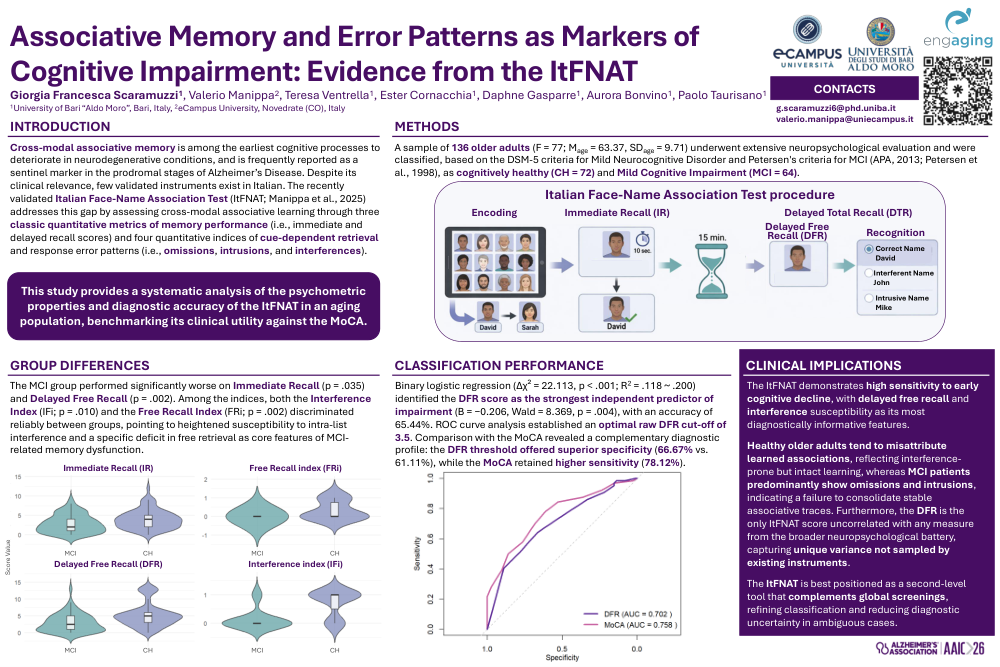
Cross-modalassociative memory isamongthe earliestcognitive processes to deteriorate in neurodegenerative conditions, and is frequently reported as a sentinel marker in the prodromal stages of Alzheimer’s Disease. Despite its clinical relevance, few validated instruments exist in Italian. The recently validated Italian Face-Name Association Test (ItFNAT; Manippa et al., 2025) addresses this gap by assessing cross-modal associative learning through three classic quantitative metrics of memory performance (i.e., immediate and delayed recall scores) and four quantitative indices of cue-dependent retrieval and response error patterns (i.e., omissions, intrusions, and interferences). This study provides a systematic analysis of the psychometric properties and diagnostic accuracy of the ItFNAT in an aging population, benchmarking its clinical utility against the MoCA.
A sample of 136 older adults (F = 77; Mage = 63.37, SDage = 9.71) underwent extensive neuropsychological evaluation and were classified, based on the DSM-5 criteria for Mild Neurocognitive Disorder and Petersen's criteria for MCI (APA, 2013; Petersen et al., 1998), as cognitively healthy (CH = 72) and Mild Cognitive Impairment (MCI = 64).
The MCI group performed significantly worse on Immediate Recall (p = .035) and Delayed Free Recall (p = .002). Among the indices, both the Interference Index (IFi; p = .010) and the Free Recall Index (FRi; p = .002) discriminated reliably between groups, pointing to heightened susceptibility to intra-list interference and a specific deficit in free retrieval as core features of MCI related memory dysfunction. Binary logistic regression (Δχ² = 22.113, p < .001; R2 = .118 ~ .200) identified the DFR score as the strongest independent predictor of impairment (B = −0.206, Wald = 8.369, p = .004), with an accuracy of 65.44%. ROC curve analysis established an optimal raw DFR cut-off of 3.5. Comparison with the MoCA revealed a complementary diagnostic profile: the DFR threshold offered superior specificity (66.67% vs. 61.11%), while the MoCA retained higher sensitivity (78.12%).
The ItFNAT demonstrates high sensitivity to early cognitive decline, with delayed free recall and interference susceptibility as its most diagnostically informative features. Healthy older adults tend to misattribute learned associations, reflecting interference prone but intact learning, whereas MCI patients predominantly show omissions and intrusions, indicating a failure to consolidate stable associative traces. Furthermore, the DFR is the only ItFNAT score uncorrelated with any measure from the broader neuropsychological battery, capturing unique variance not sampled by existing instruments. The ItFNAT is best positioned as a second-level tool that complements global screenings, refining classification and reducing diagnostic uncertainty in ambiguous cases
Comments
Email is required but is not shown publicly.
Loading comments...