4,068 posters, 219 videos, 101 topics, 69 sessions, 14,365 authors, 6,128 institutions
ePostersLive by SciGen Technologies S.A. All rights reserved.
Alzheimer's Association International Conference 2026
July 12-15, 2026 | London, United Kingdom, and Online

3695
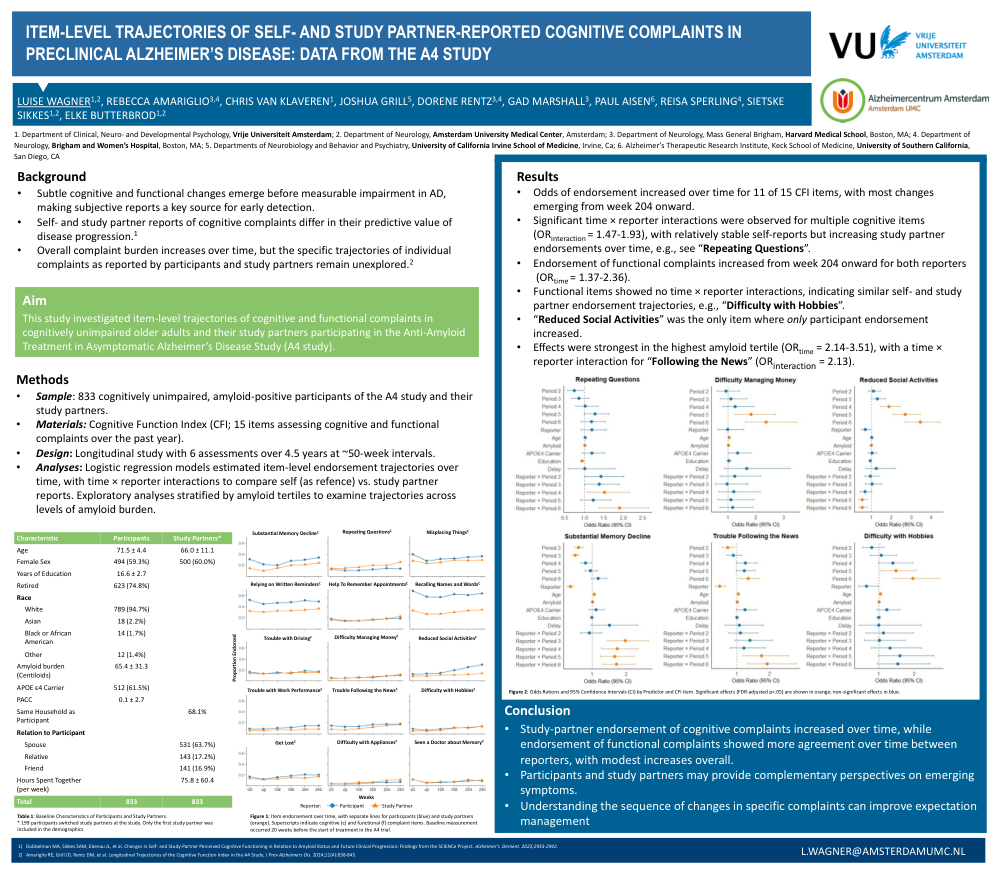
Item-level Trajectories Of Self- And Study Partner-reported Cognitive Complaints In Preclinical Alzheimer's Disease
Poster Presenter
Authors
Luise Wagner, Rebecca Amariglio, Chris van Klaveren, Joshua Grill, Dorene Rentz, Gad Marshall, Paul Aisen, Reisa Sperling, Sietske Sikkes, Elke Butterbrod
Affiliations
Department of Clinical, Neuro- and Developmental Psychology, Vrije Universiteit Amsterdam, Department of Clinical, Neuro- and Developmental Psychology, Vrije Universiteit Amsterdam; Department of Neurology, Amsterdam University Medical Center, Amsterdam, Department of Neurology, Mass General Brigham, Harvard Medical School, Boston, MA; Department of Neurology, Brigham and Women’s Hospital, Boston, MA, Departments of Neurobiology and Behavior and Psychiatry, University of California Irvine School of Medicine, Irvine, CA, Department of Neurology, Mass General Brigham, Harvard Medical School, Boston, MA, Alzheimer’s Therapeutic Research Institute, Keck School of Medicine, University of Southern California, San Diego, CA, Department of Neurology, Brigham and Women’s Hospital, Boston, MA
Part of Topic
Background
Aim
This study investigated item-level trajectories of cognitive and functional complaints in cognitively unimpaired older adults and their study partners participating in the Anti-Amyloid Treatment in Asymptomatic Alzheimer’s Disease Study (A4 study).
Methods
Results
(ORtime = 1.37-2.36).
Conclusion
Comments
Email is required but is not shown publicly.
Loading comments...