4,068 posters, 219 videos, 101 topics, 69 sessions, 14,365 authors, 6,128 institutions
ePostersLive by SciGen Technologies S.A. All rights reserved.
Alzheimer's Association International Conference 2026
July 12-15, 2026 | London, United Kingdom, and Online

10699
Differential Sensitivity Of Plasma Alzheimer’S Disease Biomarkers To Female Reproductive Life Course Factors
Poster Presenter
Authors
Affiliations
Part of Topic
Video
Background: Blood-based biomarkers (BBM) reflect distinct neurobiological pathways of Alzheimer's disease that may be differently influenced by female-specific factors. However, the comparative performance of these biomarkers in relation to reproductive history is still poorly understood.
Objective: To compare the explanatory performance of plasma levels of BBM in relation to reproductive lifecourse factors in older women.
Methods: This cross-sectional study included 45 older women from the Cog-Aging cohort. Reproductive life course factors were assessed through interviews with participants who had plasma samples collected. BBMs (pTau-217, GFAP, NFL, Aβ42, and Aβ40) from all participants were quantified using single-molecule array technology (Simoa®). Parametric (ANOVA) and non-parametric (Kruskal-Wallis) analyses were used to assess the associations between plasma BBM levels and female reproductive factors. There was no adjustment for age or education. The model performance was then compared between biomarkers. This study was approved by the Ethics Committee of UFMG.
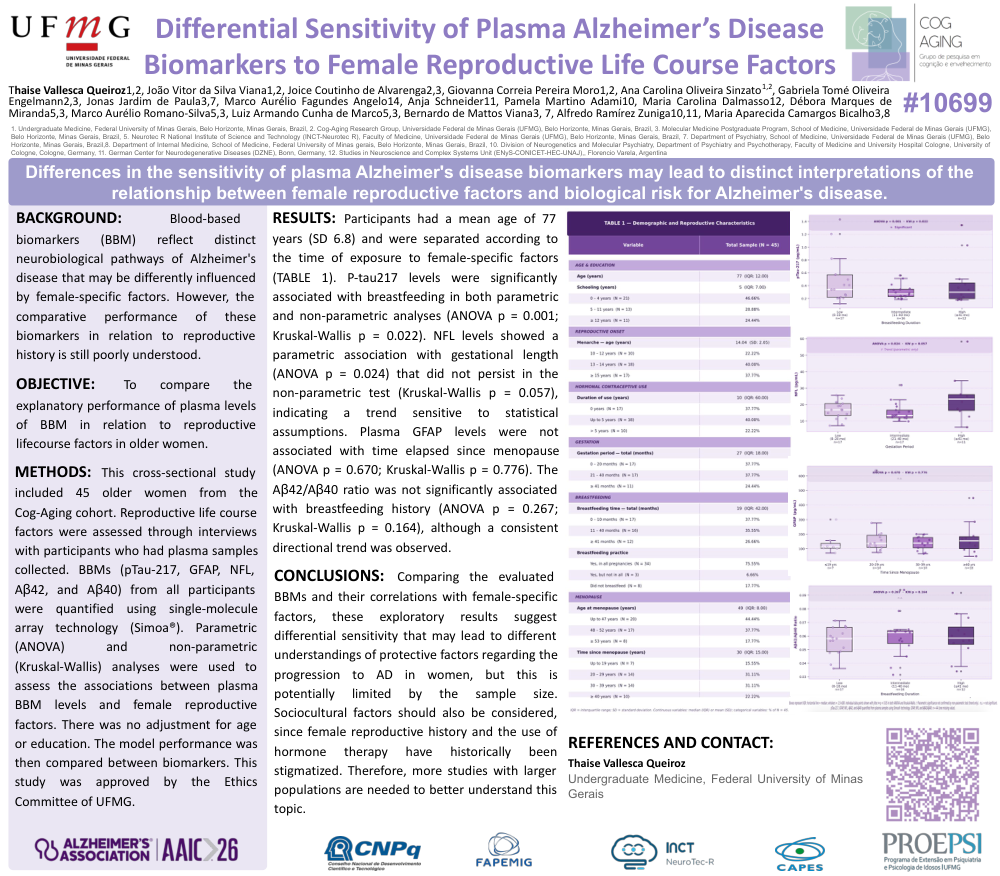
Results: Participants had a mean age of 77 years (SD 6.8) and were separated according to the time of exposure to female-specific factors (TABLE 1). P-tau217 levels were significantly associated with breastfeeding in both parametric and non-parametric analyses (ANOVA p = 0.001; Kruskal-Wallis p = 0.022). NFL levels showed a parametric association with gestational length (ANOVA p = 0.024) that did not persist in the non-parametric test (Kruskal-Wallis p = 0.057), indicating a trend sensitive to statistical assumptions. Plasma GFAP levels were not associated with time elapsed since menopause (ANOVA p = 0.670; Kruskal-Wallis p = 0.776). The Aβ42/Aβ40 ratio was not significantly associated with breastfeeding history (ANOVA p = 0.267; Kruskal-Wallis p = 0.164), although a consistent directional trend was observed.
Conclusion: Comparing the evaluated BBMs and their correlations with female-specific factors, these exploratory results suggest differential sensitivity that may lead to different understandings of protective factors regarding the progression to AD in women, but this is potentially limited by the sample size. Sociocultural factors should also be considered, since female reproductive history and the use of hormone therapy have historically been stigmatized. Therefore, more studies with larger populations are needed to better understand this topic.
Comments
Email is required but is not shown publicly.
Loading comments...