4,068 posters, 219 videos, 101 topics, 69 sessions, 14,365 authors, 6,128 institutions
ePostersLive by SciGen Technologies S.A. All rights reserved.
Alzheimer's Association International Conference 2026
July 12-15, 2026 | London, United Kingdom, and Online

9347
Day-to-day Memory Fluctuations In MCI: Linking Subjective Concerns To Real-world Performance Using Mobile Cognitive Assessment
Poster Presenter
Authors
Part of Topic
Day-to-day Memory Fluctuations in MCI: Linking Subjective Concerns to Real-world Performance Using Mobile Cognitive Assessment
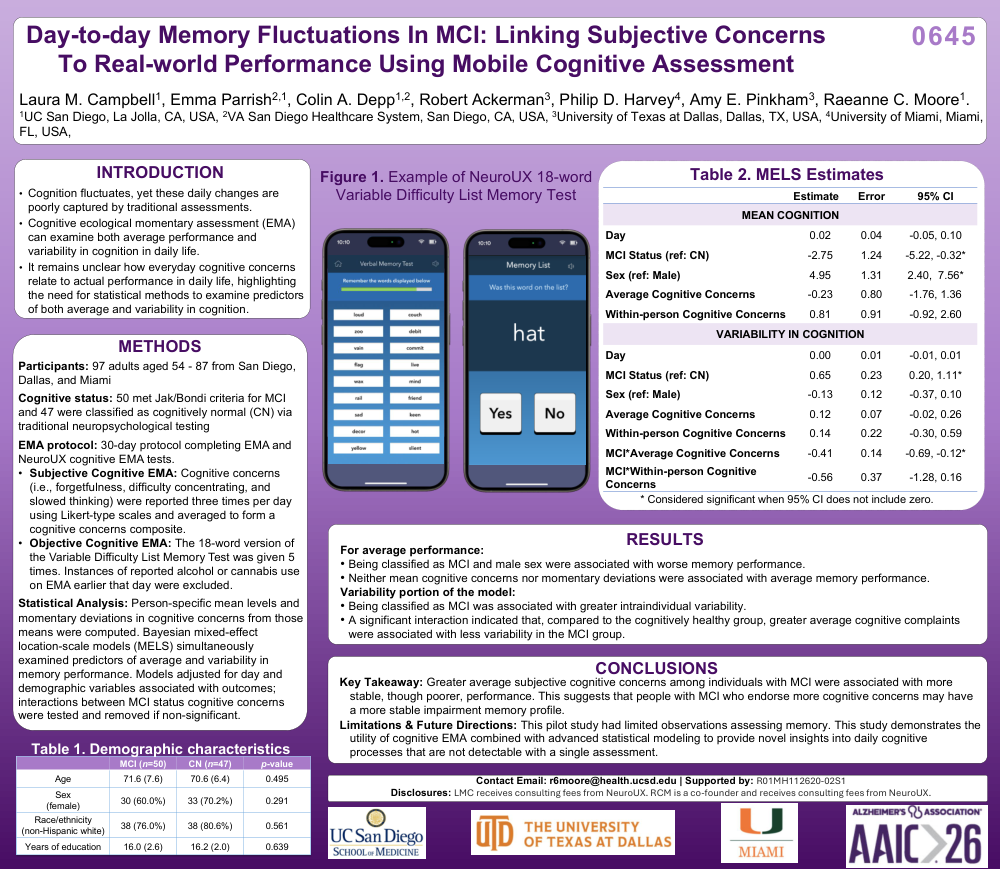
Cognition fluctuates across daily life, but these momentary changes are poorly captured by traditional clinic- or lab-based assessments. This study examined whether ecological momentary assessment (EMA) and NeuroUX mobile cognitive tests can provide real-world insight into both average memory performance and intraindividual variability among older adults with and without mild cognitive impairment (MCI).
Participants were 97 adults aged 54–87 from San Diego, Dallas, and Miami. Fifty participants met Jak/Bondi criteria for MCI and 47 were classified as cognitively normal based on traditional neuropsychological testing. Participants completed a 30-day mobile assessment protocol administered through the NeuroUX platform, including subjective cognitive EMA items assessing daily cognitive concerns and objective mobile cognitive tests measuring memory performance. Subjective cognitive EMA assessed daily cognitive concerns, including forgetfulness, difficulty concentrating, and slowed thinking, three times per day using Likert-type ratings. Objective cognition was assessed using the NeuroUX 18-word Variable Difficulty List Memory Test, administered five times during the protocol.
Bayesian mixed-effects location-scale models were used to examine predictors of both average memory performance and variability in memory performance. For average performance, MCI status and male sex were associated with worse memory performance, while average and momentary subjective cognitive concerns were not associated with average memory performance. For variability, MCI status was associated with greater intraindividual variability in memory performance. A significant interaction showed that, among individuals with MCI, greater average subjective cognitive concerns were associated with less variability, suggesting a more stable but poorer memory performance profile.
These findings demonstrate the utility of combining subjective EMA with mobile cognitive testing to capture real-world cognitive functioning and daily memory fluctuations. Mobile cognitive assessment may reveal patterns of cognitive performance and variability that are not detectable from a single traditional assessment, supporting its potential value for understanding daily cognitive processes in MCI.
Comments
Email is required but is not shown publicly.
Loading comments...