4,068 posters, 219 videos, 101 topics, 69 sessions, 14,365 authors, 6,128 institutions
ePostersLive by SciGen Technologies S.A. All rights reserved.
Alzheimer's Association International Conference 2026
July 12-15, 2026 | London, United Kingdom, and Online

10357
Comparison Of In-person And Telephone Montreal Cognitive Assessment For Cognitive Profiling In Parkinson’S Disease
Poster Presenter
Authors
Part of Topic
Background: Cognitive impairment is a common non-motor manifestation of Parkinson’s disease (PD), ranging from mild cognitive impairment (PD-MCI) to Parkinson’s disease dementia. The Montreal Cognitive Assessment (MoCA) is widely used for cognitive screening; however, access to in-person evaluations may be limited in certain clinical and geographic contexts. The telephone version of the MoCA (T-MoCA) represents a potential alternative, yet evidence regarding its performance in PD populations remains limited.
Methods: All participants completed an in-person MoCA (score: 0-30), followed by a T-MoCA (score:0-22), administered at least two weeks and no more than three months after the in-person assessment. Cognitive status was classified using established cut-off scores. For the in-person MoCA, scores of 18-21 defined PD-MCI and scores ≤17 defined dementia. For the T-MoCA, scores of 15-17 defined PD-MCI, and scores ≤14 defined dementia. Depressive symptoms were assessed using the Geriatric Depression Scale (GDS), and functional status using the Pfeffer Functional Activities Questionnaire. All assessments were conducted during the ON medication state. The study was approved by the INCN Ethics Committee.
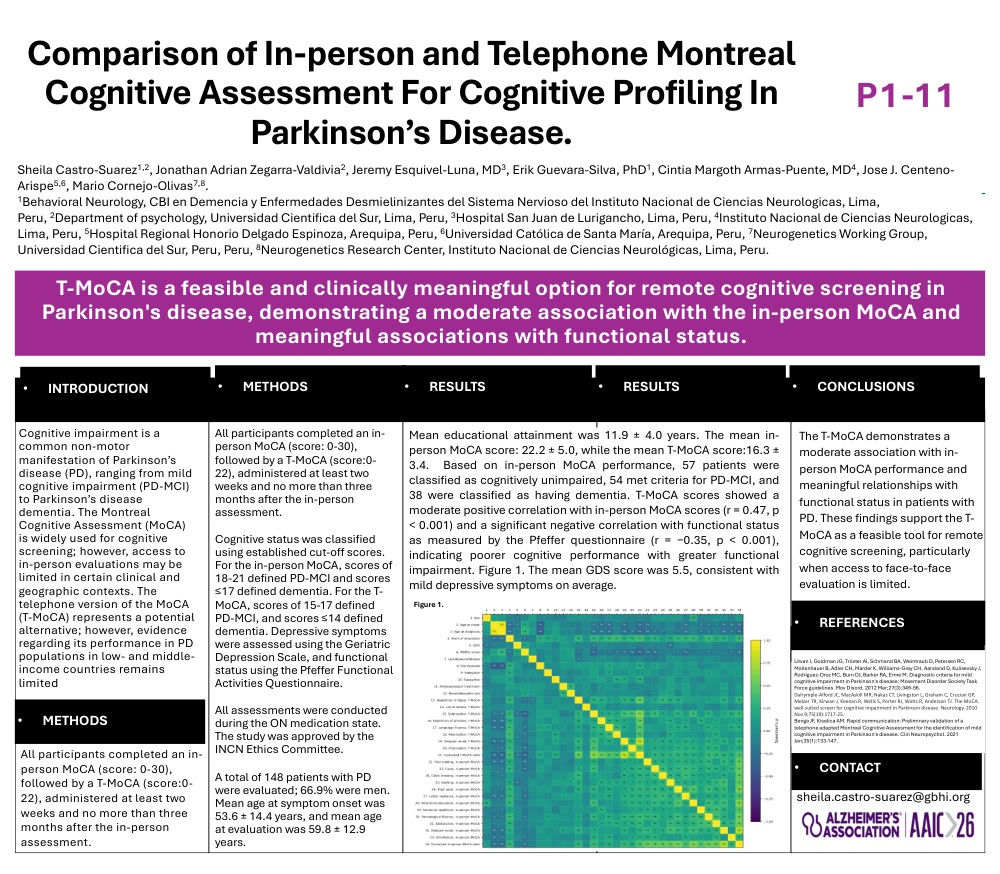
Results: A total of 148 patients with PD were evaluated; 66.9% were men. Mean age at symptom onset was 53.6 ± 14.4 years, and mean age at evaluation was 59.8 ± 12.9 years. Mean educational attainment was 11.9 ± 4.0 years. The mean in-person MoCA score: 22.2 ± 5.0, while the mean T-MoCA score:16.3 ± 3.4. Based on in-person MoCA performance, 57 patients were classified as cognitively unimpaired, 54 met criteria for PD-MCI, and 38 were classified as having dementia. T-MoCA scores showed a moderate positive correlation with in-person MoCA scores (r = 0.47, p < 0.001) and a significant negative correlation with functional status as measured by the Pfeffer questionnaire (r = −0.35, p < 0.001), indicating poorer cognitive performance with greater functional impairment. The mean GDS score was 5.5, consistent with mild depressive symptoms on average.
Conclusion: The T-MoCA demonstrates a moderate association with in-person MoCA performance and meaningful relationships with functional status in patients with PD. These findings support the T-MoCA as a feasible tool for remote cognitive screening, particularly when access to face-to-face evaluation is limited
Comments
Email is required but is not shown publicly.
Loading comments...