4,068 posters, 219 videos, 101 topics, 69 sessions, 14,365 authors, 6,128 institutions
ePostersLive by SciGen Technologies S.A. All rights reserved.
Alzheimer's Association International Conference 2026
July 12-15, 2026 | London, United Kingdom, and Online

3128
Comparing Demographic Effects Between A Novel Motor-based Assessment Of Cognition And A Traditional Memory Test In Older Adults
Poster Presenter
Authors
Sydney Schaefer, Alexandra Reed, Andrew Hooyman, Lee Ryan, Megan Johnson, Matthew De Both, Saurabh Sharma, Darian Chambers, Matthew Calamia, Matthew Huentelman
Affiliations
University of Arizona, Arizona State University, Chapman University, Translational Genomics Research Institute, Louisiana State University
Part of Topic
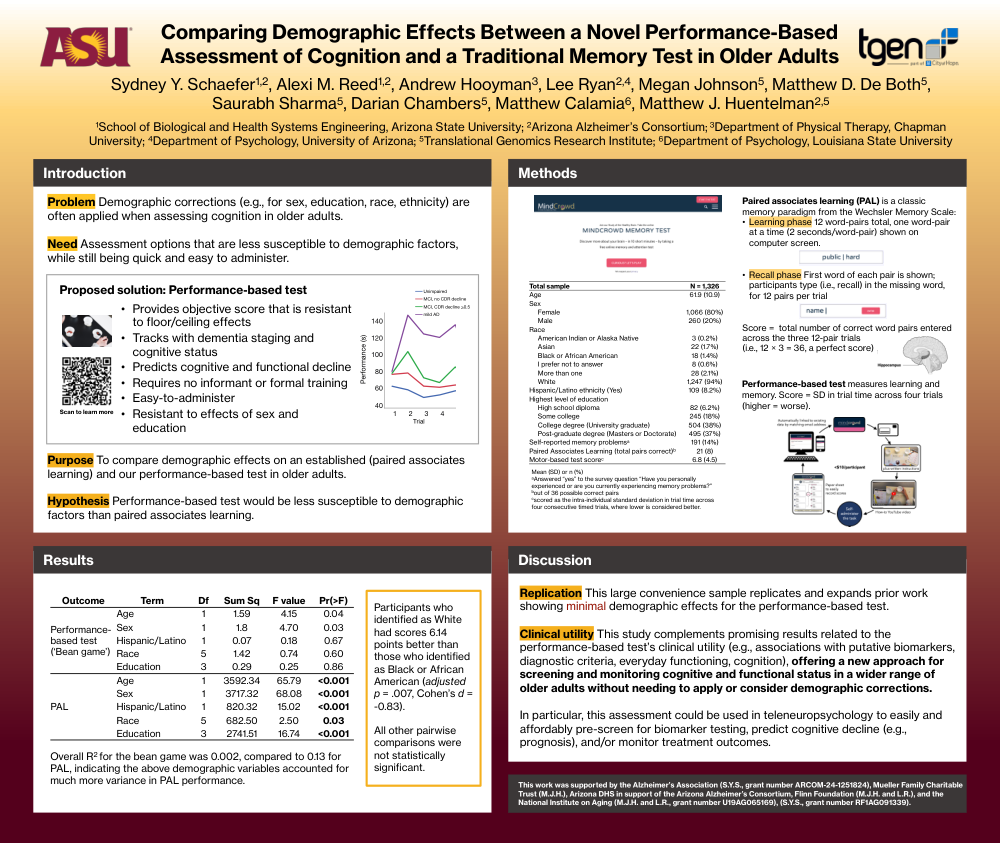
Demographic corrections (e.g., for sex, education, race, ethnicity) are often applied when assessing cognition in older adults. Assessment options that are less susceptible to demographic factors, while still being quick and easy to administer.
Purpose: To compare demographic effects on an established (paired associates learning) and our performance-based test in older adults.
Hypothesis: Performance-based test would be less susceptible to demographic factors than paired associates learning.
This large convenience sample replicates and expands prior work showing minimal demographic effects for the performance-based test.
Clinical utility This study complements promising results related to the performance-based test’s clinical utility (e.g., associations with putative biomarkers, diagnostic criteria, everyday functioning, cognition), offering a new approach for screening and monitoring cognitive and functional status in a wider range of older adults without needing to apply or consider demographic corrections. In particular, this assessment could be used in teleneuropsychology to easily and affordably pre-screen for biomarker testing, predict cognitive decline (e.g., prognosis), and/or monitor treatment outcomes.
Comments
Email is required but is not shown publicly.
Loading comments...