4,068 posters, 219 videos, 101 topics, 69 sessions, 14,365 authors, 6,128 institutions
ePostersLive by SciGen Technologies S.A. All rights reserved.
Alzheimer's Association International Conference 2026
July 12-15, 2026 | London, United Kingdom, and Online

562
Association Of Cognitive And Brain Reserve Proxies With Superaging In South Korea
Poster Presenter
Part of Topic
Introduction:
Superior cognitive performance in older ages has been linked to cognitive and brain reserve. Superagers are older adults with cognitive performance superior to that expected for their age. We examined the association of proxy measures of cognitive and brain reserve with superaging in a South Korean sample.
Methods:
The sample included cognitively normal adults aged 50+ years from the Korean Brain Aging Study for the Early Diagnosis and Prediction of Alzheimer’s disease (KBASE) baseline assessment. Brain reserve proxies were brain parenchymal fraction (BPF) and intracranial volume (ICV). BPF was calculated as the sum of gray and white matter volumes divided by ICV. The cognitive assessment was based on the Korean version of the CERAD neuropsychological assessment protocol. Cognitive reserve was measured as the residuals of a linear regression using hippocampal volume, total gray matter volume, and cortical thickness as exposures, and categorized as high (residuals > 0 SD from the sample mean) or low (residuals ≤ 0 SD from the sample mean). Participants aged 75+ years were classified as typical cognitive agers or superagers (those who scored at or above 1 SD from the mean of a younger control group on episodic memory and no lower than -1 SD from the normative mean for their age group on language and executive function tests). Logistic regression models investigated the association of BPF, ICV, and cognitive reserve with superaging, adjusted for age, sex and education.
Results:
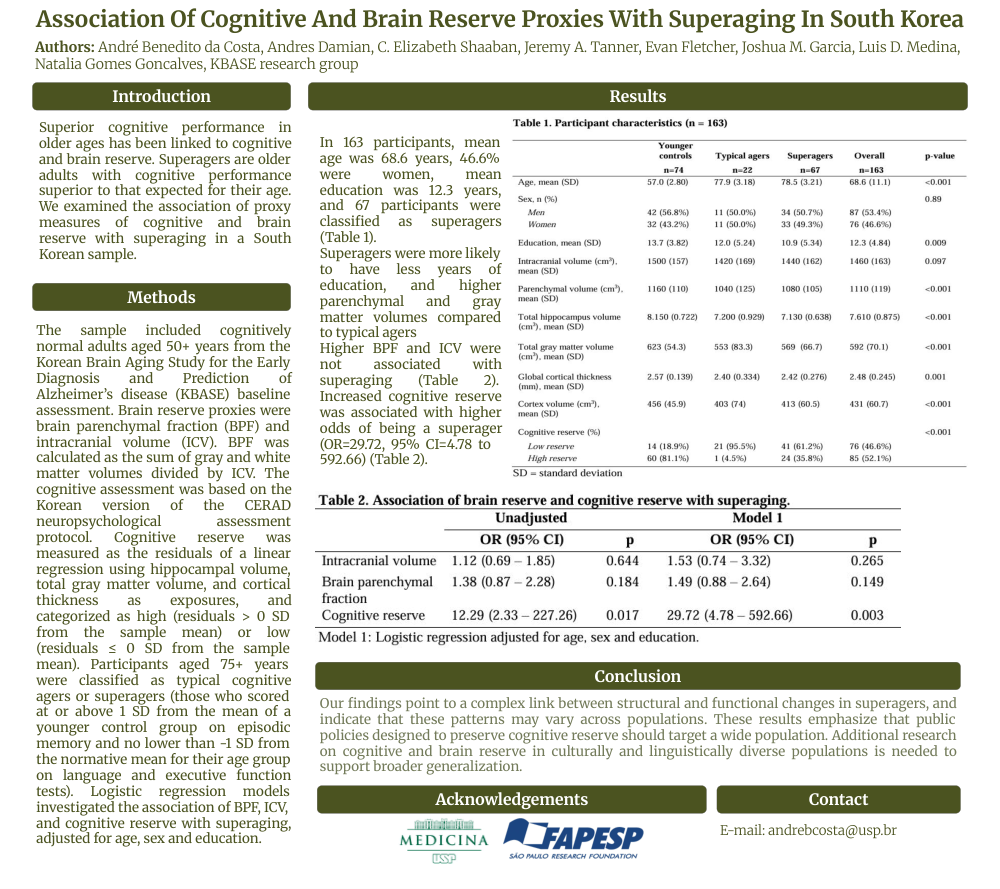
In 163 participants, mean age was 68.6 years, 46.6% were women, mean education was 12.3 years, and 67 participants were classified as superagers (Table 1). Superagers were more likely to have less years of education, and higher parenchymal and gray matter volumes compared to typical agers Higher BPF and ICV were not associated with superaging (Table 2). Increased cognitive reserve was associated with higher odds of being a superager (OR=29.72, 95% CI=4.78 to 592.66) (Table 2).
Conclusion:
Our findings point to a complex link between structural and functional changes in superagers, and indicate that these patterns may vary across populations. These results emphasize that public policies designed to preserve cognitive reserve should target a wide population. Additional research on cognitive and brain reserve in culturally and linguistically diverse populations is needed to support broader generalization.
Comments
Email is required but is not shown publicly.
Loading comments...