4,068 posters, 219 videos, 101 topics, 69 sessions, 14,365 authors, 6,128 institutions
ePostersLive by SciGen Technologies S.A. All rights reserved.
Alzheimer's Association International Conference 2026
July 12-15, 2026 | London, United Kingdom, and Online

5985
Sex Differences In Clinical And Biomarker Characteristics Of Early-Onset Dementias: Findings From The LEAF Cohort
Poster Presenter
Authors
Geon Ha Kim, Jee Hyang Jeong, Na-Yeon Jung, Sun Min Lee, Hyemin Jang, Seong-Ho Koh, Henrik Zetterberg, Liana G. Apostolova, So Young Moon, Eun-Joo Kim, LEAF investigators
Affiliations
, Department of Neurology, Ewha Womans University College of Medicine, Department of Neurology, Pusan National University Yangsan Hospital, National Institute of Dementia, Department of Neurology, Asan Medical Center, Department of Neurology, Hanyang University Guri Hospital, Department of Neurology, Ajou University School of Medicine, Department of Neurology, Pusan National University Hospital, Pusan NationalUniversity School of Medicine and Medical Research Institute,, Department of Psychiatry and Neurochemistry, Institute of Neuroscience and Physiology, University of Gothenburg, Mölndal, Sweden, Indiana Alzheimer’s Disease Research Center, Indianapolis, Indiana, USA
Part of Topic
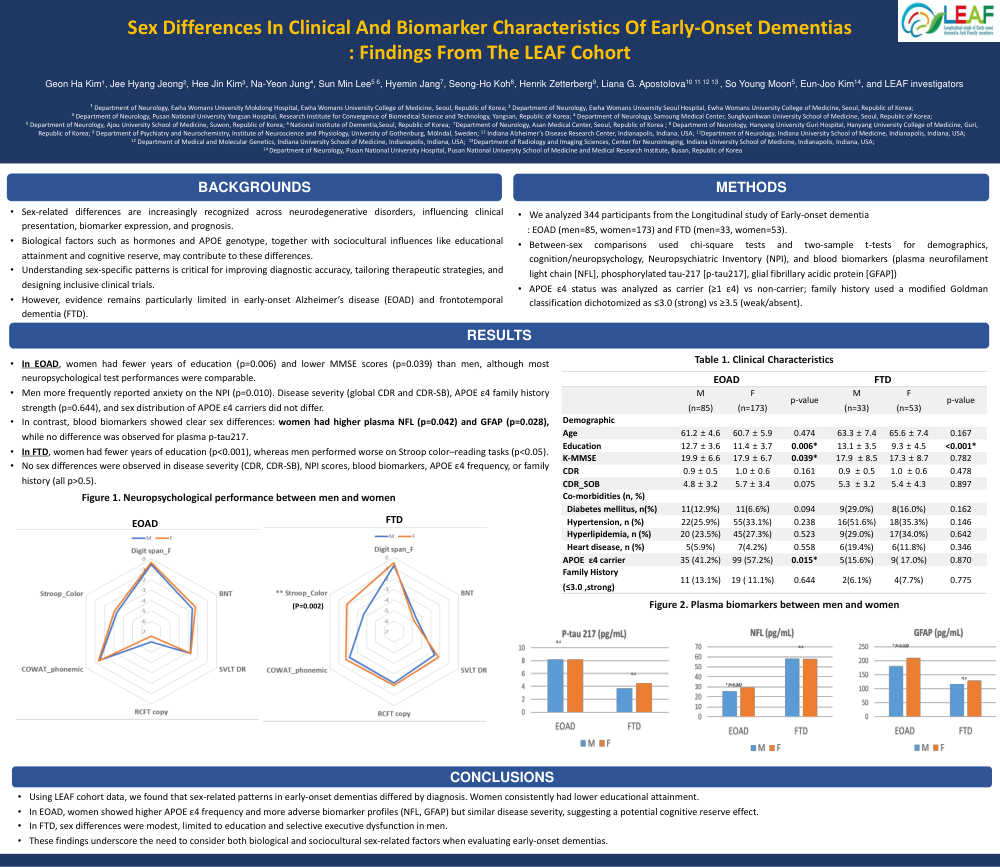
Background: Sex-related differences in clinical and biomarker profiles have been reported in neurodegenerative diseases, but data remain limited for early-onset Alzheimer’s disease (EOAD) and frontotemporal dementia (FTD).
Methods: We analyzed 344 participants from the Longitudinal study of Early-onset dementia And Family members (LEAF), including EOAD (85 men, 173 women) and FTD (33 men, 53 women). Sex-based comparisons were performed using chi-square tests and independent t-tests for demographics, cognitive and neuropsychological measures, Neuropsychiatric Inventory (NPI) domains, and plasma biomarkers (Aβ40/42 ratio, neurofilament light chain [NFL], phosphorylated tau-181 [p-tau181], and glial fibrillary acidic protein [GFAP]). APOE ε4 status was categorized as carrier versus non-carrier, and family history was dichotomized as strong versus weak/absent using a modified Goldman scale.
Results: In EOAD, women had fewer years of education (p=0.006) and lower Mini-Mental State Examination scores (p=0.040) than men, while detailed neuropsychological performance and global disease severity were comparable between sexes. Men more frequently exhibited anxiety symptoms on the NPI (p=0.010). Women showed higher plasma NFL (p=0.042) and GFAP levels (p=0.028), whereas amyloid-β measures and p-tau181 did not differ. APOE ε4 carriage was more common in women (p=0.039), while family history did not differ by sex.
In FTD, women again had lower educational attainment (p<0.001). Men performed worse on Stroop color-reading tasks (p<0.05), but no significant sex differences were observed in disease severity, neuropsychiatric symptoms, plasma biomarkers, APOE ε4 frequency, or family history.
Conclusions: The LEAF cohort demonstrates diagnosis-specific sex differences in early-onset dementias. Lower educational attainment was consistently observed in women across EOAD and FTD. In EOAD, women exhibited higher APOE ε4 prevalence and elevated markers of neurodegeneration and astroglial activation despite similar clinical severity, suggesting a potential role of cognitive reserve. In contrast, sex-related differences in FTD were limited. These findings underscore the importance of considering both biological and sociocultural factors when interpreting sex differences in early-onset dementias.
Comments
Email is required but is not shown publicly.
Loading comments...