4,068 posters, 219 videos, 101 topics, 69 sessions, 14,365 authors, 6,128 institutions
ePostersLive by SciGen Technologies S.A. All rights reserved.
Alzheimer's Association International Conference 2026
July 12-15, 2026 | London, United Kingdom, and Online

1987
Distinct Cerebral Microbleed Topographies And Cognitive Profiles In Non-demented Apoe e4 Homozygous And Notch3 R544c Carriers
Poster Presenter
Authors
Wei-Ju Lee, Hung-Chieh Chen, Yi-Ming Chen, Hsian-Min Chen, Yu-Hsiu Yang
Affiliations
Neurological Institute, Taichung Veterans General Hospital, Taichung, Taiwan, Department of Medical Imaging, Taichung Veterans General Hospital, Taichung, Taiwan, Department of Medical Research, Taichung Veterans General Hospital, Taichung, Taiwan
Part of Topic
Distinct Cerebral Microbleed Topographies and Cognitive Profiles in Non-Demented APOE ε4 Homozygous and NOTCH3 R544C Carriers
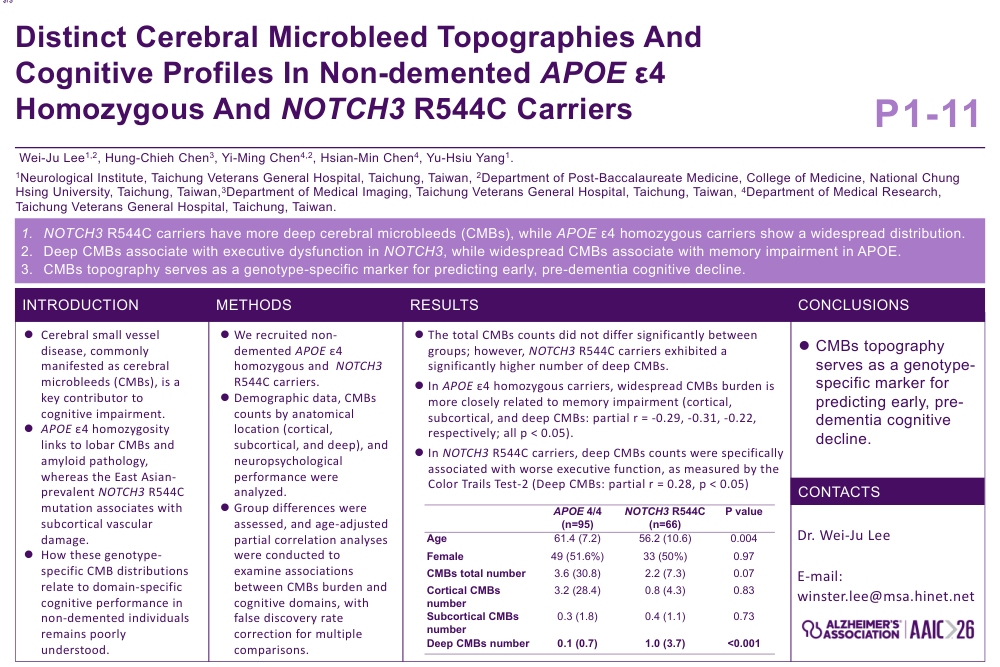
Cerebral small vessel disease (SVD), characterized by cerebral microbleeds (CMBs), is a critical driver of cognitive impairment. The topographic distribution of these microbleeds often reflects specific genetic vulnerabilities: APOE ε4 homozygosity is strongly linked to lobar CMBs and amyloid pathology, while the NOTCH3 R544C mutation—prevalent in East Asian populations—drives subcortical vascular damage. While both genotypes predispose individuals to accelerated vascular damage, the precise relationship between their distinct microbleed patterns and specific cognitive domains in non-demented individuals remains unclear. This study investigates how the spatial distribution of CMBs correlates with cognitive performance in these high-risk genetic groups, seeking to identify early neuroimaging markers of transition from "silent" SVD to clinical impairment.
We recruited 95 non-demented APOE ε4 homozygous carriers (46 men, 49 women) and 66 NOTCH3 R544C carriers (33 men, 33 women) from the TPMI cohort at Taichung Veterans General Hospital. APOE ε4 homozygous carriers were significantly older than NOTCH3 R544C carriers (61.4 ± 7.2 vs. 56.2 ± 10.6 years, p = 0.004). The total number of cerebral microbleeds (CMBs), as well as cortical and subcortical CMB counts, did not differ significantly between the two groups (total CMBs: 3.6 ± 30.8 vs. 2.2 ± 7.3, p = 0.07; cortical CMBs: 3.2 ± 28.4 vs. 2.8 ± 4.3, p = 0.83; subcortical CMBs: 0.3 ± 1.8 vs. 0.4 ± 1.1, p = 0.73, respectively). In contrast, NOTCH3 R544C carriers exhibited a significantly higher number of deep CMBs compared with APOE ε4 homozygous carriers (1.0 ± 3.7 vs. 0.1 ± 0.7, p < 0.001).
Partial correlation analyses adjusted for age demonstrated that CMB counts across all locations were significantly associated with delayed recall performance on the 12-item memory test after false discovery rate (FDR) correction for multiple comparisons. In APOE ε4 homozygous carriers, cortical, subcortical, and total CMB counts were initially correlated with category verbal fluency performance; however, these associations did not remain significant after FDR adjustment, and no association was observed with deep CMBs. In NOTCH3 R544C carriers, a significant association was identified only between deep CMB counts and performance on the Color Trails Test-2 (CTT-2).
Based on these findings, APOE ε4 homozygous and NOTCH3 R544C carriers demonstrate distinct patterns of cerebral microbleed distribution and cognitive associations, despite a comparable overall CMB burden. The predominance of deep CMBs in NOTCH3 R544C carriers and their specific association with executive dysfunction, as reflected by CTT-2 performance, are consistent with a small-vessel disease–related mechanism. In APOE ε4 homozygous carriers, CMB burden across brain regions was prominently associated with memory performance, supporting the notion that microvascular pathology may contribute to early memory vulnerability in individuals at high genetic risk for Alzheimer’s disease. Collectively, these results indicate that the anatomical distribution of CMBs, rather than total burden alone, differentially influences cognitive profiles across genetic risk groups, underscoring the importance of genotype-specific imaging biomarkers in preclinical and early-stage cognitive decline.
Comments
Email is required but is not shown publicly.
Loading comments...