4,068 posters, 219 videos, 101 topics, 69 sessions, 14,365 authors, 6,128 institutions
ePostersLive by SciGen Technologies S.A. All rights reserved.
Alzheimer's Association International Conference 2026
July 12-15, 2026 | London, United Kingdom, and Online

10507
Do Cognitive Screening Tests Reflect Subjective Cognitive Decline? Evidence From Moca, Boca, And Neuro-QOL
Poster Presenter
Part of Topic
Background:
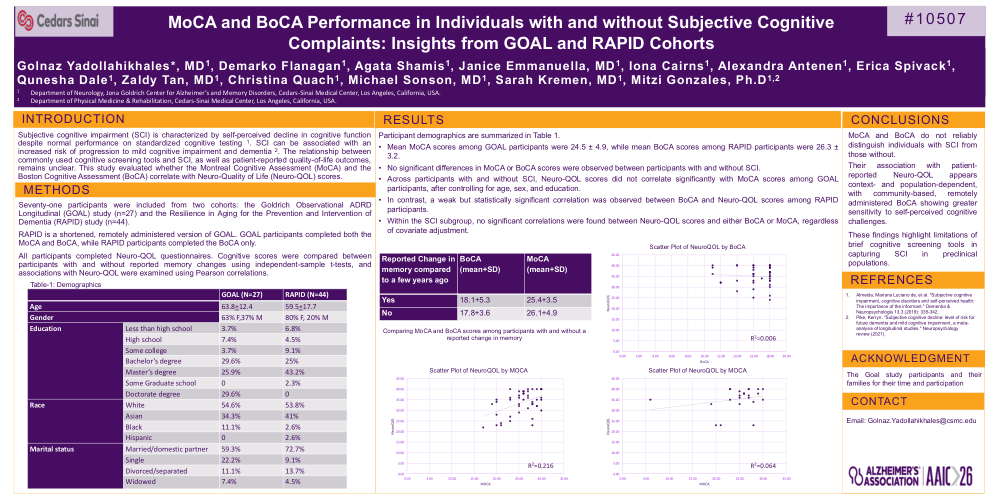
Subjective cognitive impairment (SCI) is characterized by self-perceived decline in cognitive function despite normal performance on standardized cognitive testing. SCI can be associated with an increased risk of progression to mild cognitive impairment and dementia. The relationship between commonly used cognitive screening tools and SCI, as well as patient-reported quality-of-life outcomes, remains unclear. This study evaluated whether the Montreal Cognitive Assessment (MoCA) and the Boston Cognitive Assessment (BoCA) correlate with subjective memory complaints and Neuro-Quality of Life (Neuro-QOL) scores.
Methods:
Seventy-one participants were included from two cohorts: the Goldrich Observational ADRD Longitudinal (GOAL) study (n=27) and the Resilience in Aging for the Prevention and Intervention of Dementia (RAPID) study (n=44). RAPID is a shortened, remotely administered version of GOAL. GOAL participants completed both the MoCA and BoCA, while RAPID participants completed the BoCA only. All participants completed Neuro-QOL questionnaires. Cognitive scores were compared between participants with and without reported memory changes using independent-sample t-tests, and associations with Neuro-QOL were examined using Pearson correlations.
Results:
Participant demographics are summarized in Table 1. Mean MoCA scores among GOAL participants were 24.5 ± 4.9, while mean BoCA scores among RAPID participants were 26.3 ± 3.2. No significant differences in MoCA or BoCA scores were observed between participants with and without SCI. Across participants with and without SCI, Neuro-QOL scores did not correlate significantly with MoCA scores among GOAL participants, after controlling for age, sex, and education. In contrast, a weak but statistically significant correlation was observed between BoCA and Neuro-QOL scores among RAPID participants (r = 0.492, p < 0.001). Within the SCI subgroup, no significant correlations were found between Neuro-QOL scores and either BoCA or MoCA, regardless of covariate adjustment.
Conclusions:
MoCA and BoCA do not reliably distinguish individuals with SCI from those without. Their association with patient-reported Neuro-QOL appears context- and population-dependent, with community-based, remotely administered BoCA showing greater sensitivity to self-perceived cognitive challenges. These findings highlight limitations of brief cognitive screening tools in capturing subjective cognitive experiences in preclinical populations.
Comments
Email is required but is not shown publicly.
Loading comments...