4,068 posters, 219 videos, 101 topics, 69 sessions, 14,365 authors, 6,128 institutions
ePostersLive by SciGen Technologies S.A. All rights reserved.
Alzheimer's Association International Conference 2026
July 12-15, 2026 | London, United Kingdom, and Online

9657
Text-linguistic Analysis Of Spontaneous Speech In Alzheimer’S And Parkinson’S Disease: Preliminary Results
Poster Presenter
Part of Topic
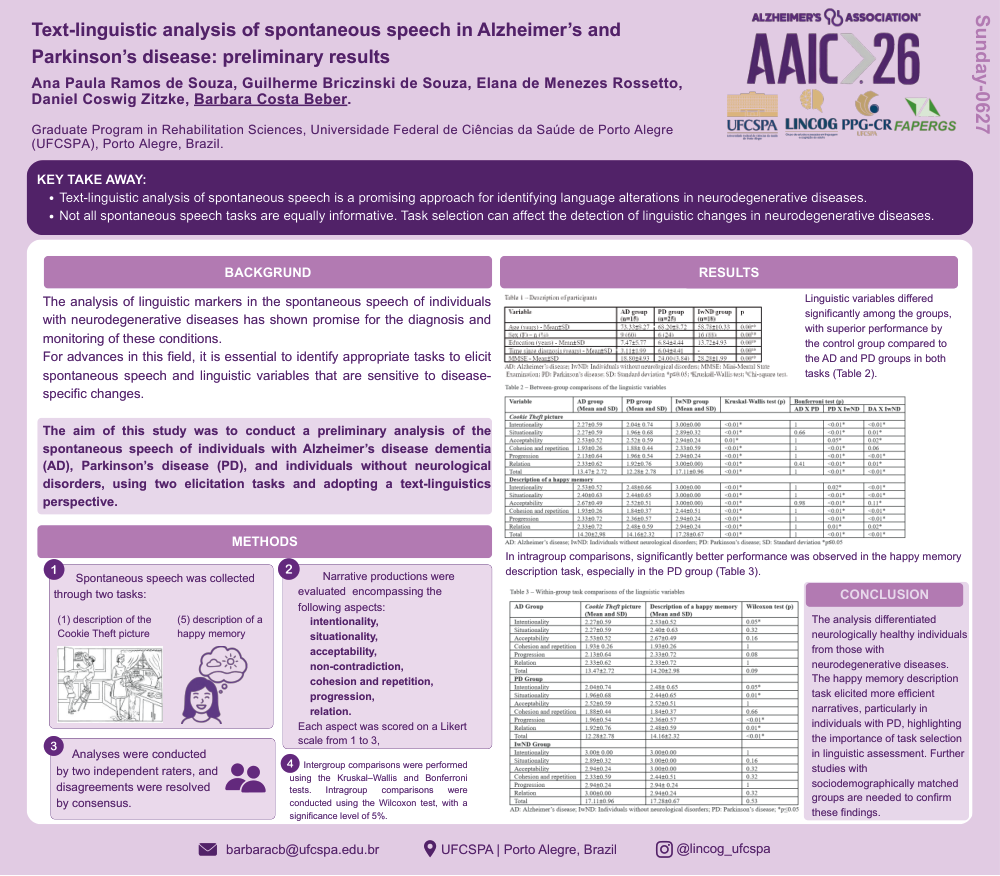
Background: The analysis of linguistic markers in the spontaneous speech of individuals with neurodegenerative diseases has shown promise for the diagnosis and monitoring of these conditions. For advances in this field, it is essential to identify appropriate tasks to elicit spontaneous speech and linguistic variables that are sensitive to disease-specific changes. The aim of this study was to conduct a preliminary analysis of the spontaneous speech of individuals with Alzheimer’s disease dementia (AD), Parkinson’s disease (PD), and individuals without neurological disorders, using two elicitation tasks and adopting a text-linguistics perspective.
Method: Spontaneous speech was collected through two tasks: (1) description of the Cookie Theft picture and (2) free description of a happy memory. Narrative productions were evaluated based on a protocol developed by the researchers, encompassing the following aspects: intentionality, situationality, acceptability, non-contradiction, cohesion and repetition, progression and relation. Each aspect was scored on a Likert scale from 1 to 3, with higher scores indicating better narrative performance. Analyses were conducted by two independent raters, and disagreements were resolved by consensus. Intergroup comparisons were performed using the Kruskal–Wallis and Bonferroni tests, while intragroup comparisons were conducted using the Wilcoxon test, with a significance level of 5%.
Results: The study included individuals with AD, individuals with PD, and individuals without neurological disorders (Table 1). Linguistic variables differed significantly among the groups, with superior performance by the control group compared to the AD and PD groups in both tasks (Table 2). In intragroup comparisons, significantly better performance was observed in the happy memory description task, especially in the PD group (Table 3).
Conclusion: The analysis proved to be sensitive in differentiating neurologically healthy individuals from those with neurodegenerative diseases. The happy memory description task promoted more efficient narratives, particularly in individuals with PD, possibly due to its open-ended nature and emotional engagement. These findings indicate that the choice of elicitation task is a crucial factor in linguistic assessment. The results should be confirmed after the completion of the study, with the groups matched for sociodemographic characteristics.
Comments
Email is required but is not shown publicly.
Loading comments...