4,068 posters, 219 videos, 101 topics, 69 sessions, 14,365 authors, 6,128 institutions
ePostersLive by SciGen Technologies S.A. All rights reserved.
Alzheimer's Association International Conference 2026
July 12-15, 2026 | London, United Kingdom, and Online

10601
Impact Of Psychological Resilience And Alzheimer's Pathology On Cognitive Trajectories
Poster Presenter
Part of Topic
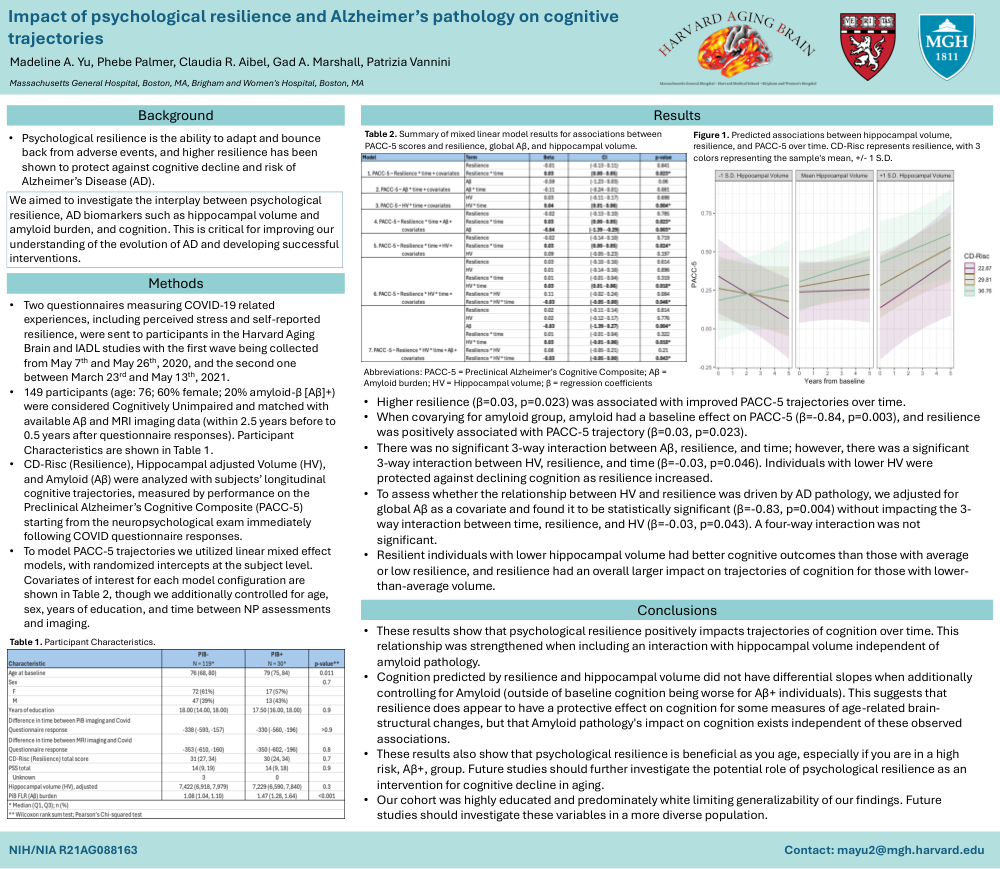
Background: Psychological resilience is the ability to adapt and bounce back from adverse events, and higher resilience has been shown to protect against cognitive decline and risk of Alzheimer’s Disease (AD). We aimed to investigate the interplay between psychological resilience, AD biomarkers such as hippocampal volume and amyloid burden, and cognition. This is critical for improving our understanding of the evolution of AD and developing successful interventions.
Methods: Two questionnaires measuring COVID-19 related experiences, including perceived stress and self-reported resilience, were sent to participants in the Harvard Aging Brain and IADL studies with the first wave being collected from May 7th and May 26th, 2020, and the second one between March 23rd and May 13th, 2021. 149 participants (age: 76; 60% female; 20% amyloid-β [Aβ]+) were considered Cognitively Unimpaired and matched with available Aβ and MRI imaging data (within 2.5 years before to 0.5 years after questionnaire responses). Participant Characteristics are shown in Table 1. CD-Risc (Resilience), Hippocampal adjusted Volume (HV), and Amyloid (Aβ) were analyzed with subjects’ longitudinal cognitive trajectories, measured by performance on the Preclinical Alzheimer’s Cognitive Composite (PACC-5) starting from the neuropsychological exam immediately following COVID questionnaire responses. To model PACC-5 trajectories we utilized linear mixed effect models, with randomized intercepts at the subject level. Covariates of interest for each model configuration are shown in Table 2, though we additionally controlled for age, sex, years of education, and time between NP assessments and imaging.
Results: Higher resilience (β=0.03, p=0.023) was associated with improved PACC-5 trajectories over time. When covarying for amyloid group, amyloid had a baseline effect on PACC-5 (β=-0.84, p=0.003), and resilience was positively associated with PACC-5 trajectory (β=0.03, p=0.023). There was no significant 3-way interaction between Aβ, resilience, and time; however, there was a significant 3-way interaction between HV, resilience, and time (β=-0.03, p=0.046). Individuals with lower HV were protected against declining cognition as resilience increased. To assess whether the relationship between HV and resilience was driven by AD pathology, we adjusted for global Aβ as a covariate and found it to be statistically significant (β=-0.83, p=0.004) without impacting the 3-way interaction between time, resilience, and HV (β=-0.03, p=0.043). A four-way interaction was not significant. Resilient individuals with lower hippocampal volume had better cognitive outcomes than those with average or low resilience, and resilience had an overall larger impact on trajectories of cognition for those with lower-than-average volume.
Conclusions: These results show that psychological resilience positively impacts trajectories of cognition over time. This relationship was strengthened when including an interaction with hippocampal volume independent of amyloid pathology. Cognition predicted by resilience and hippocampal volume did not have differential slopes when additionally controlling for Amyloid (outside of baseline cognition being worse for Aβ+ individuals). This suggests that resilience does appear to have a protective effect on cognition for some measures of age-related brain-structural changes, but that Amyloid pathology's impact on cognition exists independent of these observed associations. These results also show that psychological resilience is beneficial as you age, especially if you are in a high risk, Aβ+, group. Future studies should further investigate the potential role of psychological resilience as an intervention for cognitive decline in aging. Our cohort was highly educated and predominately white limiting generalizability of our findings. Future studies should investigate these variables in a more diverse population.
Comments
Email is required but is not shown publicly.
Loading comments...