Loading...

4,068 posters, 219 videos, 101 topics, 69 sessions, 14,365 authors, 6,128 institutions

ePostersLive by SciGen Technologies S.A. All rights reserved.

Alzheimer's Association International Conference 2026

July 12-15, 2026 | London, United Kingdom, and Online

Alzheimer's Association International Conference 2026 banner

9703

Posterior Cortical Atrophy: Clinical, Cognitive, And Neuroimaging Features From An Indian Cohort
Part of Topic

Introduction:

Background

•Posterior cortical atrophy (PCA) is a progressive neurodegenerative disorder characterized by visuospatial, visuoperceptual, and symbolic deficits.1,2
•Despite well-defined diagnostic criteria, it remains understudied, particularly in South Asian diverse populations.4
•

Aims:

1.To characterize the clinical and cognitive features of PCA in a culturally and linguistically diverse Indian cohort—diagnosed using validated tools and the current consensus classification.
2.To examine the factors associated with cognitive performance, characterize the hemispheric differences in clinical manifestations, and study the survival outcomes in PCA. 
 
Materials and Methods:

Design & Participants

•Retrospective study at a Cognitive Disorders Clinic, tertiary-care institute in South India
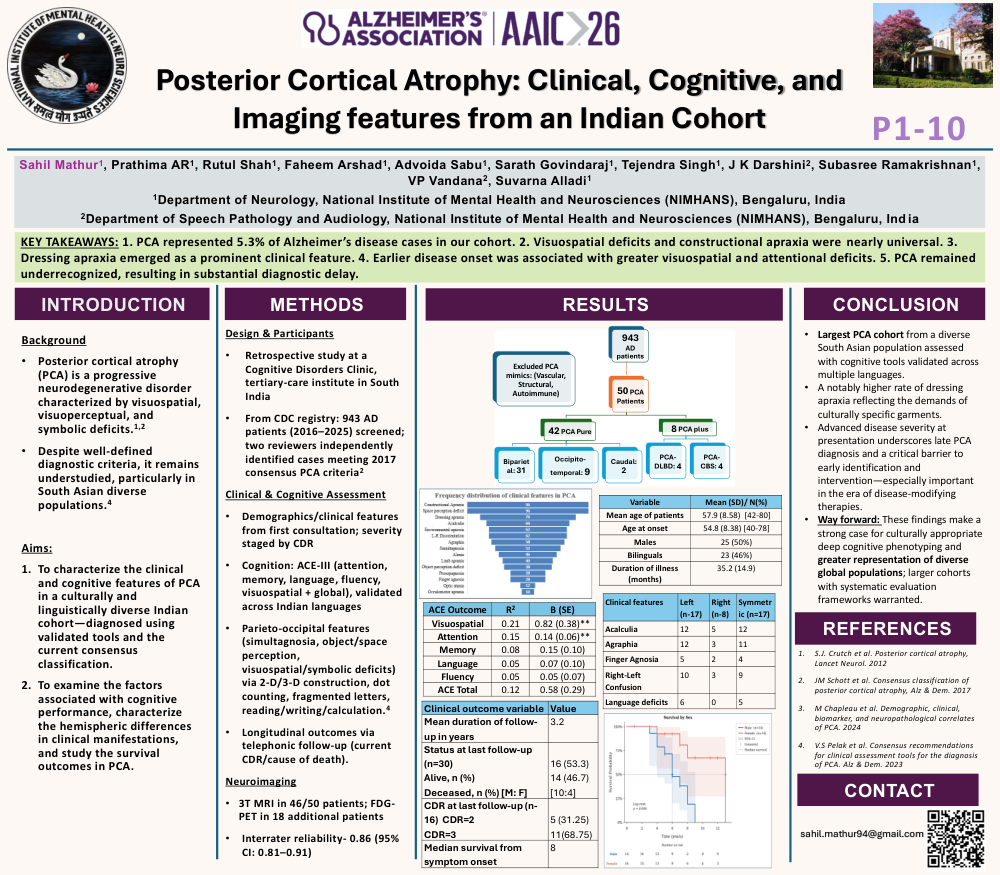
•From CDC registry: 943 AD patients (2016–2025) screened; two reviewers independently identified cases meeting 2017 consensus PCA criteria2

Clinical & Cognitive Assessment

•Demographics/clinical features from first consultation; severity staged by CDR
•Cognition: ACE-III (attention, memory, language, fluency, visuospatial + global), validated across Indian languages
•Parieto-occipital features (simultagnosia, object/space perception, visuospatial/symbolic deficits) via 2-D/3-D construction, dot counting, fragmented letters, reading/writing/calculation.4
•Longitudinal outcomes via telephonic follow-up (current CDR/cause of death).

Neuroimaging

•3T MRI in 46/50 patients; FDG-PET in 18 additional patients
•Interrater reliability- 0.86 (95% CI: 0.81–0.91)
 

Variable

Mean (SD)/ N(%)

Mean age of patients

57.9 (8.58)  [42-80]

Age at onset

54.8 (8.38) [40-78]

Males

25 (50%)

Bilinguals

23 (46%)

Duration of illness (months)

35.2 (14.9)


ACE Outcome

R2

B (SE)

Visuospatial

0.21

0.82 (0.38)**

Attention

0.15

0.14 (0.06)**

Memory

0.08

0.15 (0.10)

Language

0.05

0.07 (0.10)

Fluency

0.05

0.05 (0.07)

ACE Total

0.12

0.58 (0.29)


Clinical features

Left

(n-17)

Right (n-8)

Symmetric (n=17)

Acalculia

12

5

12

Agraphia

12

3

11

Finger Agnosia

5

2

4

Right-Left Confusion

10

3

9

Language deficits

6

0

5


Clinical outcome variable

Value

Mean duration of follow-up in years

3.2

Status at last follow-up (n=30)

Alive, n (%)

Deceased, n (%) [M: F]


16 (53.3)

14 (46.7) [10:4]

CDR at last follow-up (n-16)  CDR=2

CDR=3


5 (31.25)

11(68.75)

Median survival from symptom onset

8


Conclusion:

•Largest PCA cohort from a diverse South Asian population assessed with cognitive tools validated across multiple languages.
•A notably higher rate of dressing apraxia reflecting the demands of culturally specific garments.
•Advanced disease severity at presentation underscores late PCA diagnosis and a critical barrier to early identification and intervention—especially important in the era of disease-modifying therapies.
•Way forward:These findings make a strong case for culturally appropriate deep cognitive phenotyping and greater representation of diverse global populations; larger cohorts with systematic evaluation frameworks warranted.
 
References:
1.S.J. Crutch et al. Posterior cortical atrophy, Lancet Neurol. 2012
2.JM Schott et al. Consensus classification of posterior cortical atrophy, Alz & Dem. 2017
3.M Chapleau et al. Demographic, clinical, biomarker, and neuropathological correlates of PCA. 2024
4.V.SPelaket al. Consensus recommendations for clinical assessment tools for the diagnosis of PCA. Alz & Dem. 2023


Comments

Email is required but is not shown publicly.

Loading comments...

aaic2026 banner
Copyright © 2015-2026, ePostersLive® SciGen is a registered trademark of SciGen Technologies S.A. Patent pending.

This website and third-party tools we use rely on cookies for the best user experience. By selecting "I agree", you agree to cookie usage as described in our Privacy Policy.