4,068 posters, 219 videos, 101 topics, 69 sessions, 14,365 authors, 6,128 institutions
ePostersLive by SciGen Technologies S.A. All rights reserved.
Alzheimer's Association International Conference 2026
July 12-15, 2026 | London, United Kingdom, and Online

5491
Creutzfeldt-jakob Disease Initially Misdiagnosed As Alzheimer’S Disease: Lessons From Reported Cases
Part of Topic
INTRODUCTION
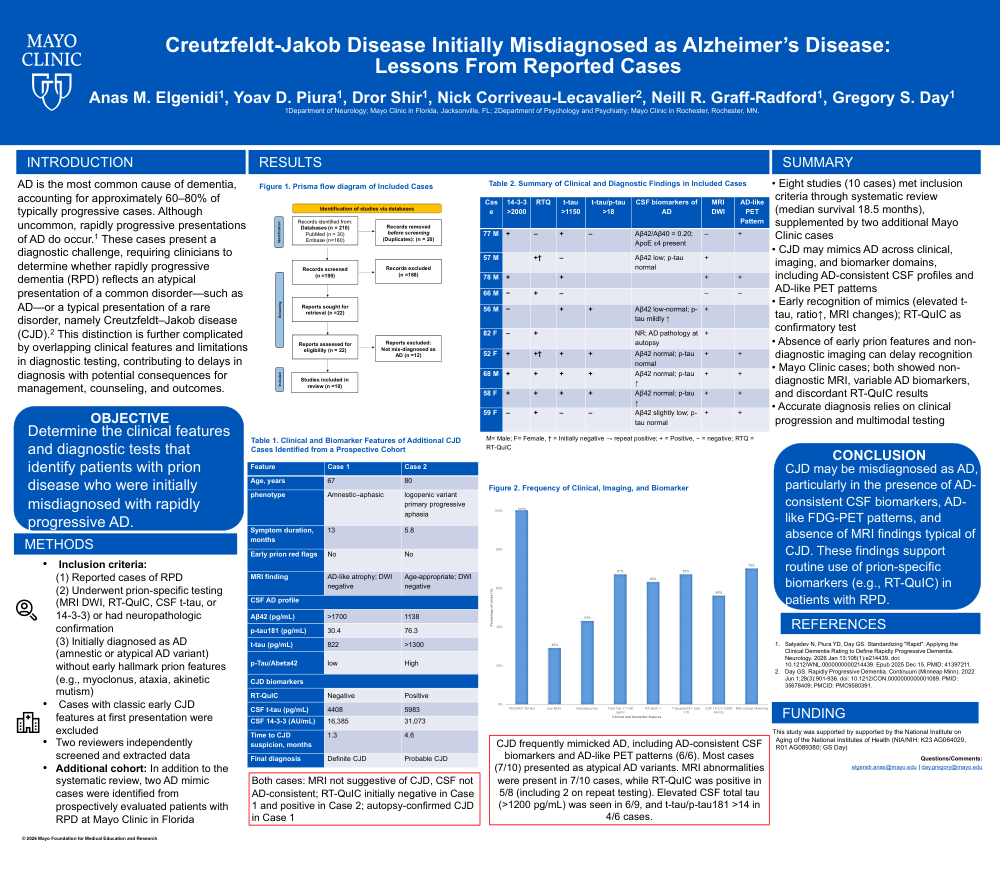
AD is the most common cause of dementia, accounting for approximately 60–80% of typically progressive cases. Although uncommon, rapidly progressive presentations of AD do occur.1 These cases present a diagnostic challenge, requiring clinicians to determine whether rapidly progressive dementia (RPD) reflects an atypical presentation of a common disorder—such as AD—or a typical presentation of a rare disorder, namely Creutzfeldt–Jakob disease (CJD).2 This distinction is further complicated by overlapping clinical features and limitations in diagnostic testing, contributing to delays in diagnosis with potential consequences for management, counseling, and outcomes.
OBJECTIVE
Determine the clinical features and diagnostic tests that identify patients with prion disease who were initially misdiagnosed with rapidly progressive AD.
METHODS
(1) Reported cases of RPD
(2) Underwent prion-specific testing (MRI DWI, RT-QuIC, CSF t-tau, or 14-3-3) or had neuropathologic confirmation
(3) Initially diagnosed as AD (amnestic or atypical AD variant) without early hallmark prion features (e.g., myoclonus, ataxia, akinetic mutism)
Both cases: MRI not suggestive of CJD, CSF not AD-consistent; RT-QuIC initially negative in Case 1 and positive in Case 2; autopsy-confirmed CJD in Case 1
CJD frequently mimicked AD, including AD-consistent CSF biomarkers and AD-like PET patterns (6/6). Most cases (7/10) presented as atypical AD variants. MRI abnormalities were present in 7/10 cases, while RT-QuIC was positive in 5/8 (including 2 on repeat testing). Elevated CSF total tau (>1200 pg/mL) was seen in 6/9, and t-tau/p-tau181 >14 in 4/6 cases.
SUMMARY
• Eight studies (10 cases) met inclusion criteria through systematic review (median survival 18.5 months), supplemented by two additional Mayo Clinic cases
• CJD may mimics AD across clinical, imaging, and biomarker domains, including AD-consistent CSF profiles and AD-like PET patterns
• Early recognition of mimics (elevated t-tau, ratio↑, MRI changes); RT-QuIC as confirmatory test
• Absence of early prion features and non-diagnostic imaging can delay recognition
• Mayo Clinic cases; both showed non-diagnostic MRI, variable AD biomarkers, and discordant RT-QuIC results
• Accurate diagnosis relies on clinical progression and multimodal testing
CONCLUSION
CJD may be misdiagnosed as AD, particularly in the presence of AD-consistent CSF biomarkers, AD-like FDG-PET patterns, and absence of MRI findings typical of CJD. These findings support routine use of prion-specific biomarkers (e.g., RT-QuIC) in patients with RPD.
Comments
Email is required but is not shown publicly.
Loading comments...