4,068 posters, 219 videos, 101 topics, 69 sessions, 14,365 authors, 6,128 institutions
ePostersLive by SciGen Technologies S.A. All rights reserved.
Alzheimer's Association International Conference 2026
July 12-15, 2026 | London, United Kingdom, and Online

1167
Yoga And Positive Psychology For Dementia Risk Reduction - A Pilot Trial
Poster Presenter
Authors
Affiliations
Part of Topic
Background
Physical activity, mindfulness, yoga, and positive psychology interventions have been associated with benefits in cognitive, emotional, and physical wellbeing among older adults, including potential reductions in dementia risk. However, limited research has explored the feasibility and preliminary effects of combining chair-based yoga with positive psychology approaches in older adults at elevated dementia risk.
Aim
This pilot study aimed to assess the feasibility and explore the preliminary effects of a home-based chair-adapted yoga intervention, with or without positive psychology components, in cognitively healthy older adults at elevated dementia risk (Cardiovascular Risk Factors, Aging, and Incidence of Dementia (CAIDE) ≥ 6).
Methods
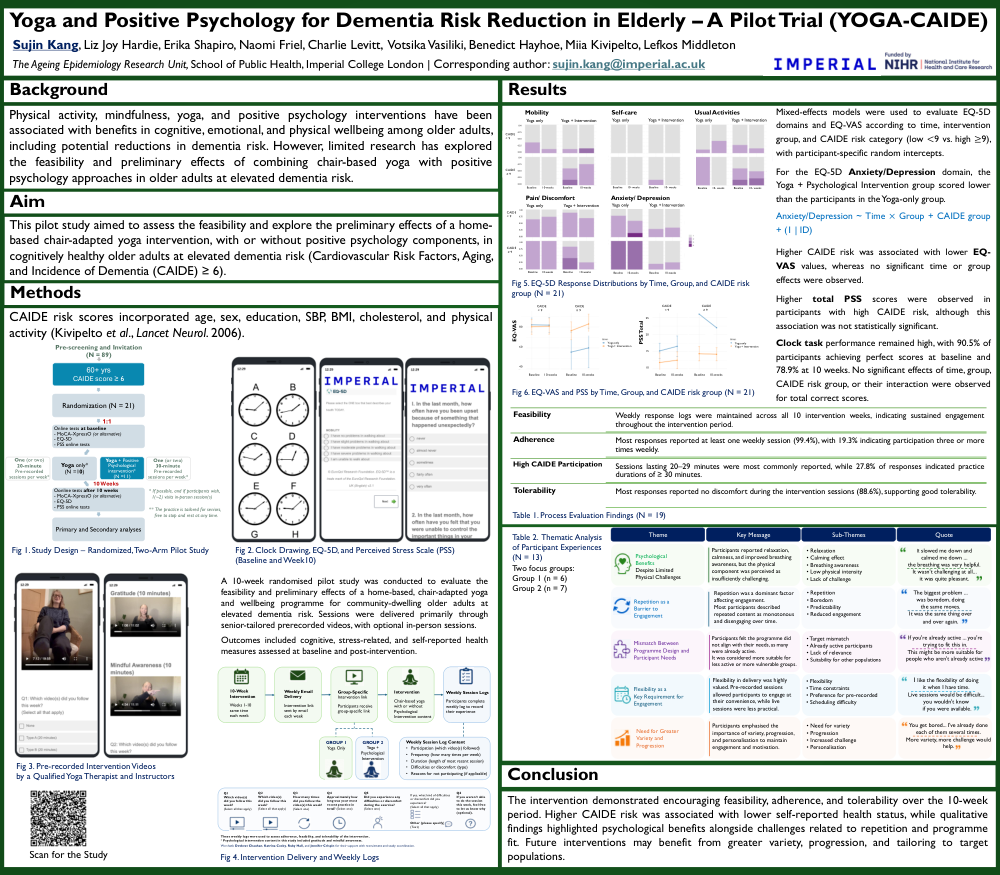
CAIDE risk scores incorporated age, sex, education, SBP, BMI, cholesterol, and physical activity (Kivipelto et al., Lancet Neurol. 2006). A 10-week randomised pilot study was conducted to evaluate the feasibility and preliminary effects of a home-based, chair-adapted yoga and wellbeing programme for community-dwelling older adults at elevated dementia risk. Sessions were delivered primarily through senior-tailored prerecorded videos, with optional in-person sessions. Outcomes included cognitive, stress-related, and self-reported health measures assessed at baseline and post-intervention.
Results
Mixed-effects models were used to evaluate EQ-5D domains and EQ-VAS according to time, intervention group, and CAIDE risk category (low <9 vs. high ≥9), with participant-specific random intercepts. For the EQ-5D Anxiety/Depression domain, the Yoga + Psychological Intervention group scored lower than the participants in the Yoga-only group. Higher CAIDE risk was associated with lower EQ-VAS values, whereas no significant time or group effects were observed.
Higher total PSS scores were observed in participants with high CAIDE risk, although this association was not statistically significant. Clock task performance remained high, with 90.5% of participants achieving perfect scores at baseline and 78.9% at 10 weeks. No significant effects of time, group, CAIDE risk group, or their interaction were observed for total correct scores.
Feasibility - Weekly response logs were maintained across all 10 intervention weeks, indicating sustained engagement throughout the intervention period.
Adherence - Most responses reported at least one weekly session (99.4%), with 19.3% indicating participation three or more times weekly.
High CAIDE Participation - Sessions lasting 20–29 minutes were most commonly reported, while 27.8% of responses indicated practice durations of ≥ 30 minutes.
Tolerability - Most responses reported no discomfort during the intervention sessions (88.6%), supporting good tolerability.
Conclusion
The intervention demonstrated encouraging feasibility, adherence, and tolerability over the 10-week period. Higher CAIDE risk was associated with lower self-reported health status, while qualitative findings highlighted psychological benefits alongside challenges related to repetition and programme fit. Future interventions may benefit from greater variety, progression, and tailoring to target populations.
Comments
Email is required but is not shown publicly.
Loading comments...