4,068 posters, 219 videos, 101 topics, 69 sessions, 14,365 authors, 6,128 institutions
ePostersLive by SciGen Technologies S.A. All rights reserved.
Alzheimer's Association International Conference 2026
July 12-15, 2026 | London, United Kingdom, and Online

9163
Examining Whether Estrogen Hormone Therapy Modifies The Associations Between Depressive Symptoms And Cognition Among Latino/a Females
Poster Presenter
Authors
Part of Topic
Video
Title: Examining whether estrogen hormone therapy modifies the associations between depressive symptoms and cognition among Latino/a females
Authors: Marco Santoscoy1, Carlos E.E. Araujo-Menendez1-2, Ariana M. Stickel1
1San Diego State University, Department of Psychology
2SDSU/UC San Diego Joint Doctoral Program in Clinical Psychology
Word count: 350/350
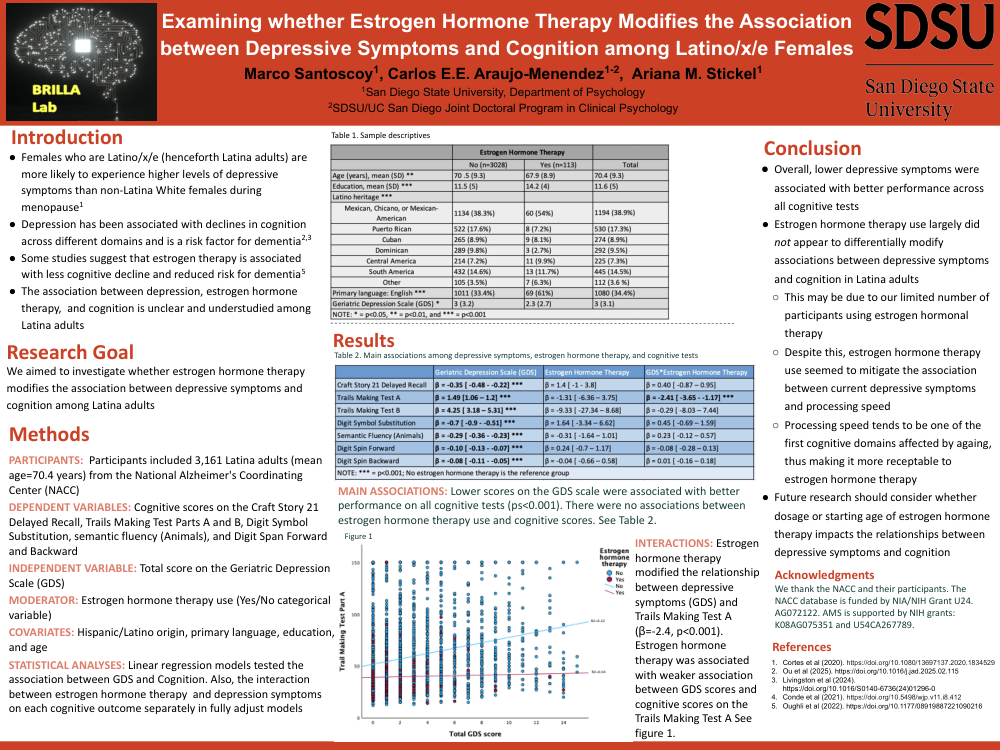
Background: Estrogen imbalances have been associated with poor cognitive performance and mood disorders in females, yet the association between estrogen hormone therapy and late-life cognition is unclear. We aimed to investigate whether estrogen hormone therapy modifies the association between depressive symptoms and cognition in the Latino/a community.
Methods: We included 3,161 female Latino/a participants over the age of 45 years from the National Alzheimer’s Coordinating Center (NACC; sites=42; data collection years: 2005-2005). The outcomes of interest were baseline cognitive scores on the Craft Story 21 delayed recall, Trails Making Test Parts A and B, Digit Symbol Substitution, semantic fluency (animals), and Digit Span Forward and Backward. The exposure was continuous total score on the Geriatric Depression Scale (GDS). Self-reported current use of estrogen hormone therapy (n=113) (yes, no) was the modifier. Covariates included Latino heritage, primary language, education, and age. Linear regression models tested 1) the associations between GDS and cognition and 2) the interaction between estrogen hormone therapy and depressive symptoms on each cognitive outcome separately in fully adjusted models.
Results: Lower scores on the GDS were associated with better performance on all cognitive tests (all ps<0.01). Additionally, the interaction between estrogen hormone therapy and depressive symptoms on the GDS was significant for Trails Making Test Parts A (β=-2.41, p<0.001). Post-hoc tests suggest that higher GDS scores were associated with significantly slower performance among individuals not using estrogen hormone therapy whereas it was not significantly associated among users, and this group difference was marginal (r(non-users)=0.22, r(hormone therapy users)=0.04, Fisher’s z=-1.79, p=0.07).
Conclusions: Overall, we found inconclusive evidence that estrogen hormonal therapy modifies the relationships between depressive symptoms and cognition, possibly due to the small number of estrogen hormonal therapy users. However, estrogen hormone therapy may protect processing speed in Latino/a females over the age of 45, but more research is needed to confirm. Future research should consider whether the amount of estrogen hormone use and starting age of therapy impacts the relationship between depressive symptoms and cognition.
Comments
Email is required but is not shown publicly.
Loading comments...