4,068 posters, 219 videos, 101 topics, 69 sessions, 14,365 authors, 6,128 institutions
ePostersLive by SciGen Technologies S.A. All rights reserved.
Alzheimer's Association International Conference 2026
July 12-15, 2026 | London, United Kingdom, and Online

3772
Psychometric Properties Of Basic-Q For Detection Of Cognitive Impairment In A Peruvian Urban Population
Poster Presenter
Part of Topic
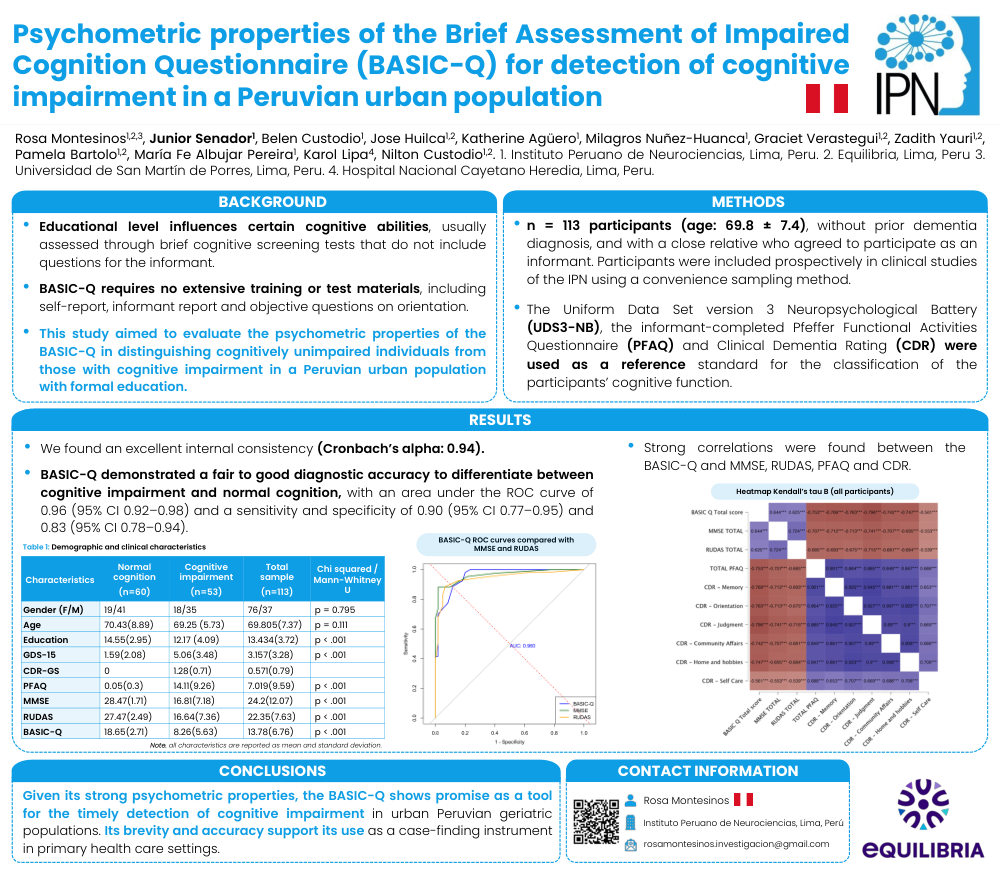
Background: Some studies showed that level educational level influences certain cognitive abilities such as visuospatial construction or praxis, usually evaluated on brief cognitive screening; and didn’t include questions to informants. The Brief Assessment of Impaired Cognition– Questionnaire (BASIC-Q) requires no extensive training or test materials and includes self-report, informant report and objective questions on orientation. To evaluate the psychometric properties of the BASIC-Q in distinguishing cognitively unimpaired individuals from those with cognitive impairment (mild cognitive impairment and dementia) in a Peruvian urban population with formal education.
Methods: We included 113 participants (age: 69.8 ± 7.4), without a prior diagnosis of dementia, and with a close relative who agreed to participate as an informant. Participants were included prospectively in clinical studies of the IPN using a convenience sampling method. The Uniform Data Set version 3 Neuropsychological Battery (UDS3-NB), the informant-completed Pfeffer Functional Activities Questionnaire (PFAQ) and Clinical Dementia Rating (CDR) were used as a reference standard for the classification of the participants’ cognitive function.
Results:
We found an excellent internal consistency (Cronbach’s alpha: 0.94). Strong correlations were found between the BASIC-Q and MMSE, RUDAS, PFAQ and CDR. BASIC-Q demonstrated a fair to good diagnostic accuracy to differentiate between people with cognitive impairment and normal cognition with an area under the ROC curve (AUC) of 0.96 (95% CI 0.92–0.98) and a sensitivity and specificity of 0.90 (95% CI 0.77–0.95) and 0.83 (95% CI 0.78–0.94).
Conclusion: Based on its excellent psychometric properties, we find the BASIC-Q suitable to aid in the opportune detection of cognitive impairment in a geriatric Peruvian urban population. It demonstrated fair to good classification accuracy in a specialized center setting and can be a useful case-finding tool to evaluate feasibility when suspecting dementia in primary health care.
Key words: Cognitive assessment screening instrument, Cognitive impairment, Dementia, Primary health care, Validation study
Comments
Email is required but is not shown publicly.
Loading comments...