4,068 posters, 219 videos, 101 topics, 69 sessions, 14,365 authors, 6,128 institutions
ePostersLive by SciGen Technologies S.A. All rights reserved.
Alzheimer's Association International Conference 2026
July 12-15, 2026 | London, United Kingdom, and Online

1500
Effects Of Script Training And Response Elaboration On Expressive Language In Adults With Aphasia In Ibadan, Nigeria
Poster Presenter
Authors
Part of Topic
Title: Effect of Script Training and Response Elaboration Training on Expressive Language Skills of Persons Living with Aphasia in Ibadan Metropolis, Nigeria
Poster Number: Sunday-0603
Authors: Boluwatife Anuoluwapo Oluwasegun¹, Ayo Osisanya²
Affiliations:
¹² Speech Pathology and Audiology Unit, Department of Special Education, University of Ibadan, Nigeria
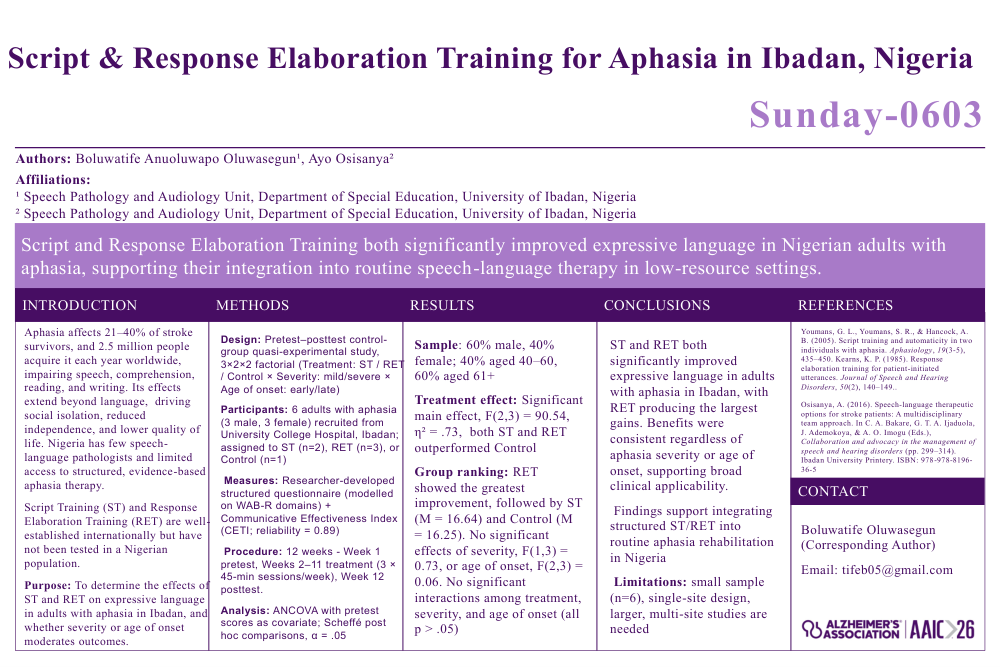
Key Takeaway: Script and Response Elaboration Training both significantly improved expressive language in Nigerian adults with aphasia, supporting their integration into routine speech-language therapy in low-resource settings.
INTRODUCTION
- Aphasia affects 21–40% of stroke survivors, and 2.5 million people acquire it each year worldwide, impairing speech, comprehension, reading, and writing.
- Its effects extend beyond language, driving social isolation, reduced independence, and lower quality of life.
- Nigeria has few speech-language pathologists and limited access to structured, evidence-based aphasia therapy.
- Script Training (ST) and Response Elaboration Training (RET) are well-established internationally but untested in a Nigerian population.
- Purpose: To determine the effects of ST and RET on expressive language in adults with aphasia in Ibadan, and whether severity or age of onset moderates outcomes.
METHODS
- Design: Pretest–posttest control-group quasi-experimental study, 3×2×2 factorial (Treatment: ST / RET / Control × Severity: mild/severe × Age of onset: early/late).
- Participants: 6 adults with aphasia (3 male, 3 female) recruited from University College Hospital, Ibadan; assigned to ST (n=2), RET (n=3), or Control (n=1).
- Measures: Researcher-developed structured questionnaire (modeled on WAB-R domains) plus Communicative Effectiveness Index (CETI; reliability = 0.89).
- Procedure: 12 weeks - Week 1 pretest, Weeks 2–11 treatment (3 × 45-minute sessions per week), Week 12 posttest.
- Analysis: ANCOVA with pretest scores as covariate; Scheffé post hoc comparisons, alpha = .05.
RESULTS
- Sample: 60% male, 40% female; 40% aged 40–60, 60% aged 61 and older.
- Treatment effect: Significant main effect, F(2,3) = 90.54, eta squared = .73 — both ST and RET outperformed Control.
- Group ranking: RET showed the greatest improvement, followed by ST (M = 16.64) and Control (M = 16.25).
- No significant effects of severity, F(1,3) = 0.73, or age of onset, F(2,3) = 0.06.
- No significant interactions among treatment, severity, and age of onset (all p > .05).
CONCLUSIONS
- ST and RET both significantly improved expressive language in adults with aphasia in Ibadan, with RET producing the largest gains.
- Benefits were consistent across aphasia severity and age of onset, supporting broad clinical applicability.
- Findings support integrating structured ST/RET into routine aphasia rehabilitation in Nigeria.
- Limitations: small sample (n=6), single-site design — larger, multi-site studies are needed.
CONTACT
Boluwatife Anuoluwapo Oluwasegun
Speech Pathology and Audiology Unit, Department of Special Education, University of Ibadan, Nigeria
Email: tifeb05@gmail.com
Comments
Email is required but is not shown publicly.
Loading comments...