4,068 posters, 219 videos, 101 topics, 69 sessions, 14,365 authors, 6,128 institutions
ePostersLive by SciGen Technologies S.A. All rights reserved.
Alzheimer's Association International Conference 2026
July 12-15, 2026 | London, United Kingdom, and Online

8575
Conversational RCTs Of Face-To-Face Group Conversation, Remote Group Conversation, And Dialogue Robots
Poster Presenter
Authors
Mihoko Otake-Matsuura, Seiki Tokunaga, Kumi Watanabe Miura, Takuya Sekiguchi, Hikaru Sugimoto, Masato S. Abe, Kazuhiro Tamura, Taishiro Kishimoto, Takashi Kudo
Affiliations
Center for Advanced Intelligence Project, RIKEN, Center for Advanced Intelligence Project, RIKEN, Japan Society for the Promotionof Science, Faculty of Culture and Information Science, Doshisha University, Center for Advanced Intelligence Project, RIKEN, School of Medicine, Keio University, Center for Advanced Intelligence Project, RIKEN, Graduate School of Medicine, Osaka University, Center for Advanced Intelligence Project, RIKEN
Part of Topic
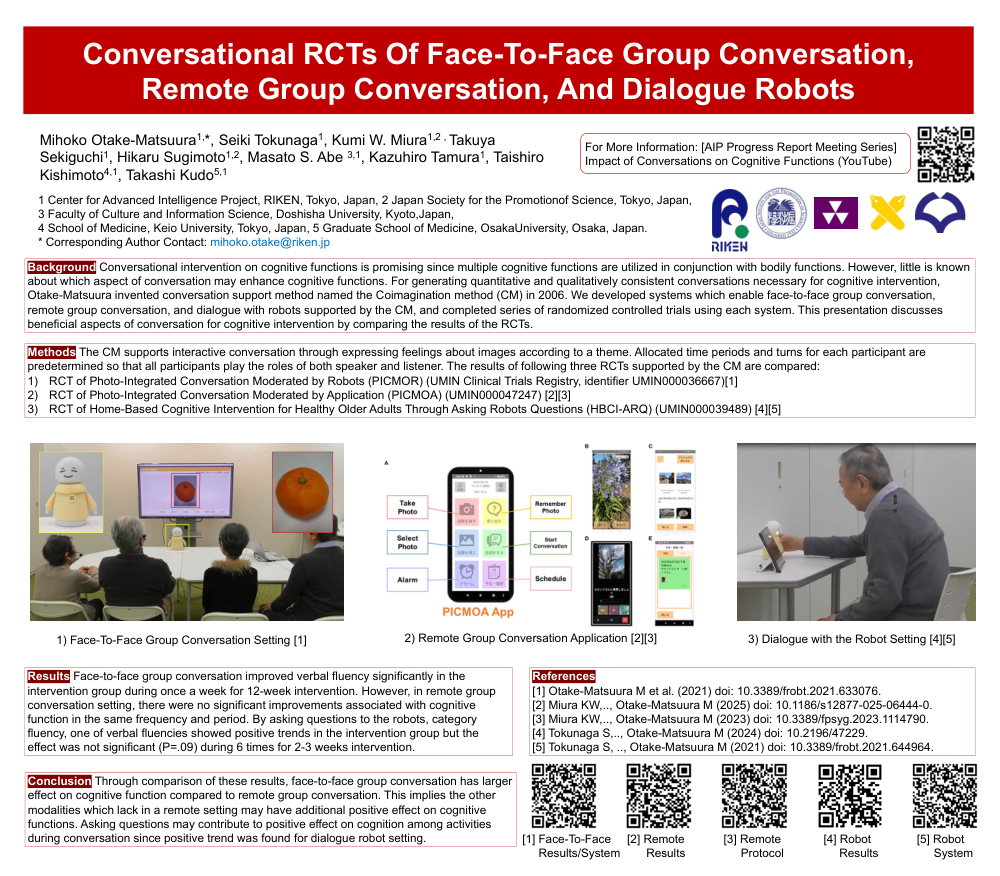
Background: Conversational intervention on cognitive functions is promising since multiple cognitive functions are utilized in conjunction with bodily functions. However, little is known about which aspect of conversation may enhance cognitive functions. For generating quantitative and qualitatively consistent conversations necessary for cognitive intervention, Otake-Matsuura invented conversation support method named the Coimagination method (CM) in 2006. We developed systems which enable face-to-face group conversation, remote group conversation, and dialogue with robots supported by the CM, and completed series of randomized controlled trials using each system. This presentation discusses beneficial aspects of conversation for cognitive intervention by comparing the results of the RCTs.
Methods: The CM supports interactive conversation through expressing feelings about images according to a theme. Allocated time periods and turns for each participant are predetermined so that all participants play the roles of both speaker and listener. The results of following three RCTs supported by the CM are compared: 1) RCT of Photo-Integrated Conversation Moderated by Robots (PICMOR) (UMIN Clinical Trials Registry, identifier UMIN000036667) published in 2021 for face-to-face group conversation; 2) RCT of Photo-Integrated Conversation Moderated by Application (PICMOA) (UMIN000047247) published in 2025 for remote group conversation; 3) RCT of Home-Based Cognitive Intervention for Healthy Older Adults Through Asking Robots Questions (HBCI-ARQ) (UMIN000039489) published in 2024 for dialogue especially asking questions to the robots.
Results: Face-to-face group conversation improved verbal fluency significantly in the intervention group during once a week for 12-week intervention. However, in remote group conversation setting, there were no significant improvements associated with cognitive function in the same frequency and period. By asking questions to the robots, category fluency, one of verbal fluencies showed positive trends in the intervention group but the effect was not significant (P=.09) during 6 times for 2-3 weeks intervention.
Conclusion: Through comparison of these results, face-to-face group conversation has larger effect on cognitive function compared to remote group conversation. This implies the other modalities which lack in a remote setting may have additional positive effect on cognitive functions. Asking questions may contribute to positive effect on cognition among activities during conversation since positive trend was found for dialogue robot setting.
Comments
Email is required but is not shown publicly.
Loading comments...