4,068 posters, 219 videos, 101 topics, 69 sessions, 14,365 authors, 6,128 institutions
ePostersLive by SciGen Technologies S.A. All rights reserved.
Alzheimer's Association International Conference 2026
July 12-15, 2026 | London, United Kingdom, and Online

9388
Real-world Data Analysis Of Post 18-months Lecanemab, Anti-amyloid Therapy From A Cognitive Disorders Clinic
Poster Presenter
Part of Topic
Real-world Data Analysis Of Post 18-months Lecanemab, Anti-amyloid Therapy From A Cognitive Disorders Clinic
Maileen G. Ulep, PhD, MSN, FNP-BC; Dylan Wint, MD, FAAN; Charles Bernick, MD, MPH
Lou Ruvo Center for Brain Health, Cognitive Disorders Clinic, Cleveland Clinic Nevada, Las Vegas, NV, USA
Abstract
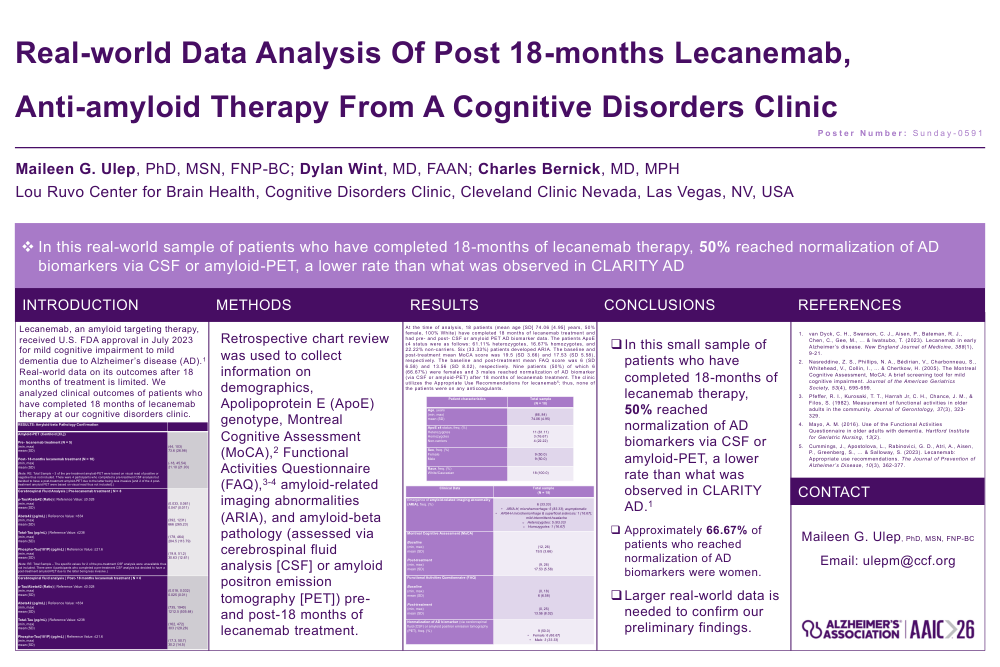
Background: Lecanemab, an amyloid targeting therapy, received U.S. FDA approval in July 2023 for early Alzheimer’s disease (AD). Real-world data on its outcomes after 18 months of treatment is limited. We analyzed clinical outcomes of patients who have completed 18 months of lecanemab therapy at our cognitive disorders clinic.
Methods: Retrospective chart review was used to collect information on demographics, Apolipoprotein E (ApoE) genotype, Montreal Cognitive Assessment (MoCA), Functional Activities Questionnaire (FAQ), amyloid-related imaging abnormalities (ARIA), and amyloid-beta pathology (assessed via cerebrospinal fluid analysis [CSF] or amyloid positron emission tomography [PET]) pre- and post-18 months of lecanemab treatment.
Results: At the time of analysis, 18 patients (mean age [SD] 74.06 [4.95] years, 50% female, 100% white) have completed 18 months of lecanemab treatment and had pre- and post- CSF or amyloid PET AD biomarker data. The patients ApoE ε4 status were as follows: 61.11% heterozygotes, 16.67% homozygotes, and 22.22% non-carriers. Six (33.33%) patients developed ARIA. The baseline and post-treatment mean MoCA score was 19.5 (SD 3.66) and 17.53 (SD 5.58), respectively. The baseline and post-treatment mean FAQ score was 6 (SD 6.58) and 13.56 (SD 8.02), respectively. Nine patients (50%) of which 6 (66.67%) were females and 3 males reached normalization of AD biomarker (via CSF or amyloid-PET) after 18 months of lecanemab treatment. The clinic utilizes the Appropriate Use Recommendations for lecanemab guidelines; thus, none of the patients were on anticoagulants.
Conclusion: In this small sample of patients who have completed 18-months of lecanemab therapy, 50% reached normalization of AD biomarkers via CSF or amyloid-PET, a lower rate than what was observed in CLARITY AD. Approximately 66.67% of patients who reached normalization of AD biomarkers were women. Larger real-world data is needed to confirm our preliminary findings.
Comments
Email is required but is not shown publicly.
Loading comments...