4,068 posters, 219 videos, 101 topics, 69 sessions, 14,365 authors, 6,128 institutions
ePostersLive by SciGen Technologies S.A. All rights reserved.
Alzheimer's Association International Conference 2026
July 12-15, 2026 | London, United Kingdom, and Online

8753
Gps-derived Mobility Phenotypes And Cognitive Function In Older Adults
Poster Presenter
Authors
Part of Topic
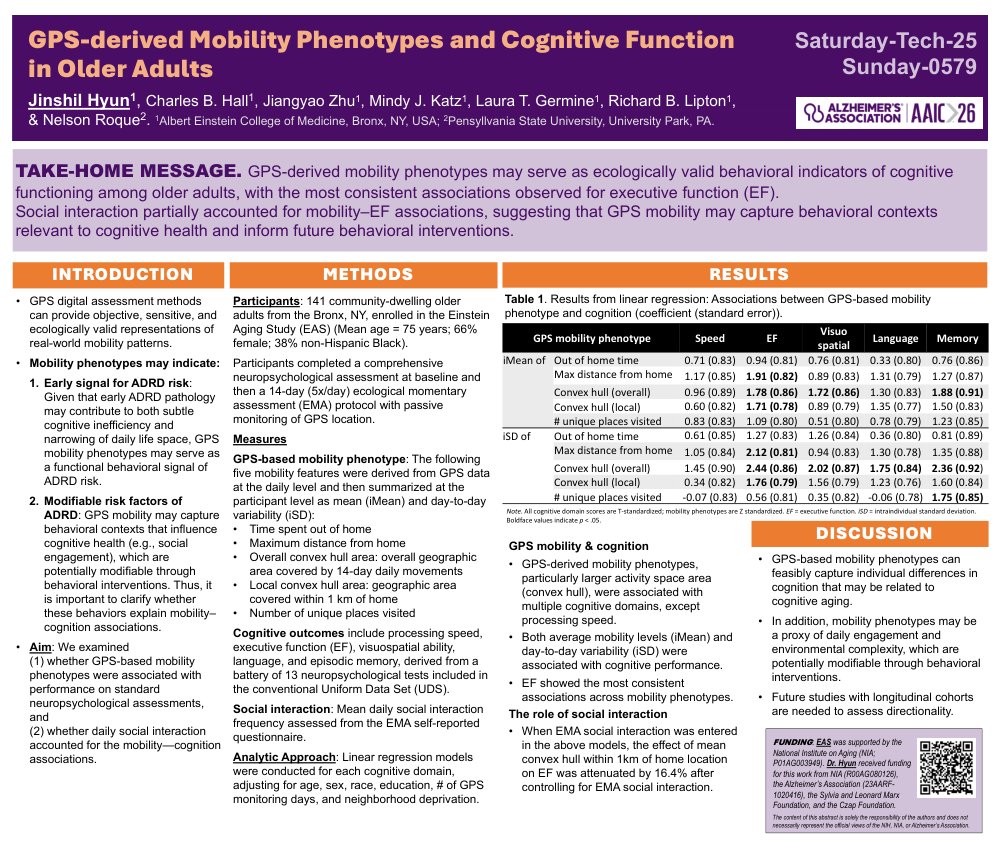
TAKE-HOME MESSAGE. GPS-derived mobility phenotypes may serve as ecologically valid behavioral indicators of cognitive functioning among older adults, with the most consistent associations observed for executive function (EF). Social interaction partially accounted for mobility–EF associations, suggesting that GPS mobility may capture behavioral contexts relevant to cognitive health and inform future behavioral interventions.
INTRODUCTION.
(1) whether GPS-based mobility phenotypes were associated with performance on standard neuropsychological assessments, and
(2) whether daily social interaction accounted for the mobility—cognition associations.
Participants: 141 community-dwelling older adults from the Bronx, NY, enrolled in the Einstein Aging Study (EAS) (Mean age = 75 years; 66% female; 38% non-Hispanic Black).
Participants completed a comprehensive neuropsychological assessment at baseline and then a 14-day (5x/day) ecological momentary assessment (EMA) protocol with passive monitoring of GPS location.
Measures
GPS-based mobility phenotype: The following five mobility features were derived from GPS data at the daily level and then summarized at the participant level as mean (iMean) and day-to-day variability (iSD):
Cognitive outcomes include processing speed, executive function (EF), visuospatial ability, language, and episodic memory, derived from a battery of 13 neuropsychological tests included in the conventional Uniform Data Set (UDS).
Social interaction: Mean daily social interaction frequency assessed from the EMA self-reported questionnaire.
Analytic Approach: Linear regression models were conducted for each cognitive domain, adjusting for age, sex, race, education, # of GPS monitoring days, and neighborhood deprivation.
RESULTS
GPS mobility & cognition
The role of social interaction
Comments
Email is required but is not shown publicly.
Loading comments...