4,068 posters, 219 videos, 101 topics, 69 sessions, 14,365 authors, 6,128 institutions
ePostersLive by SciGen Technologies S.A. All rights reserved.
Alzheimer's Association International Conference 2026
July 12-15, 2026 | London, United Kingdom, and Online

8757
The Dementia Diagnosis Gap In Brazil: A Six-year Population-based Analysis From The ELSI-Brazil Study
Part of Topic
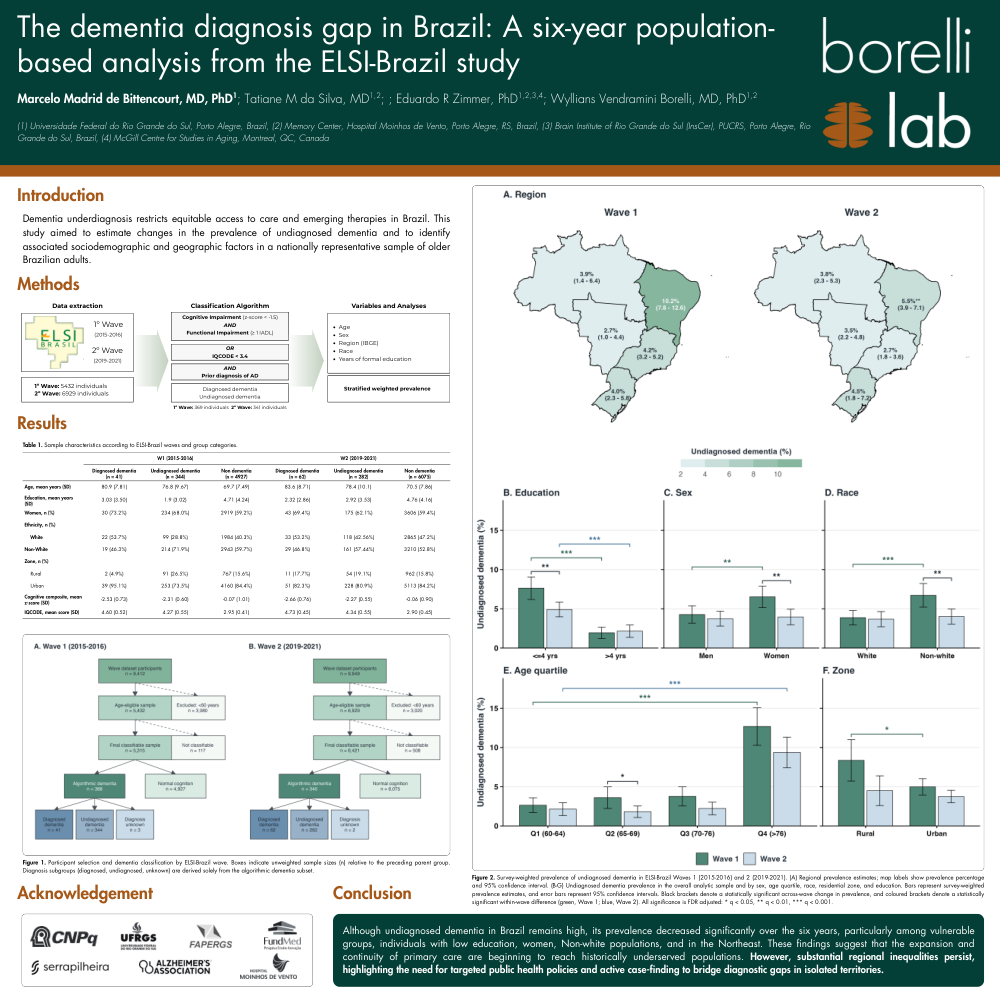
Background: Dementia underdiagnosis restricts equitable access to care and emerging therapies in Brazil. This study aimed to estimate changes in the prevalence of undiagnosed dementia and to identify associated sociodemographic and geographic factors in a nationally representative sample of older Brazilian adults.
Methods: We analyzed data from Wave 1 (W1, 2015-2016) and Wave 2 (W2, 2019-2021) of the Brazilian Longitudinal Study of Aging (ELSI-Brazil), including participants aged >59 years. Dementia classification utilized a validated algorithmic approach integrating cognitive performance (memory, orientation, verbal fluency), functional status (IADLs), and informant reports (IQCODE). Participants meeting algorithm criteria were classified as "Diagnosed" if they reported a prior medical diagnosis, or "Undiagnosed" if they did not. Prevalence estimates were calculated, and logistic-regression analyses were performed to examine sociodemographic and geographic correlates of underdiagnosis. The Model was adjusted for age, sex, and race.
Results: In W1, among individuals meeting dementia criteria, 89.03% (95% CI 84.57–93.49) were undiagnosed. In W2, underdiagnosis remained high at 76.58% (95% CI 69.73–83.44), but statistically lower than W1. Residents of the Northeast (OR 3.66; 95% CI 1.44–9.31, p = 0.007) and rural areas (OR 7.10; 95% CI 1.43-35.2, p = 0.017) presented higher odds of being undiagnosed in W1, but not in W2 (p > 0.05). In W2, the North region showed drastically higherodds of being undiagnosed (OR 72; 95% CI 8.72-607, p < 0.001). Additionally, in W2, age was associated with lower odds of being undiagnosed, particularly for those above 69 (OR 0.09; 95%CI 0.01-0.75, p = 0.027) and 76 years (OR 0.09; 95% CI 0.01–0.07, p = 0.022).
Conclusions: Over three-quarters of older Brazilians with dementia remain undiagnosed, despite modest improvement over time. These findings reveal a persistent diagnostic gap shaped by regional and age-related disparities. This suggests that underdiagnosis is influenced not only by disease burden, but also by differences in health system organization, access to care, and implementation of diagnostic practices. Targeted, scalable strategies are urgently needed to reduce diagnostic inequalities and inform dementia-related health system planning in Brazil.
Comments
Email is required but is not shown publicly.
Loading comments...