4,068 posters, 219 videos, 101 topics, 69 sessions, 14,365 authors, 6,128 institutions
ePostersLive by SciGen Technologies S.A. All rights reserved.
Alzheimer's Association International Conference 2026
July 12-15, 2026 | London, United Kingdom, and Online

7284
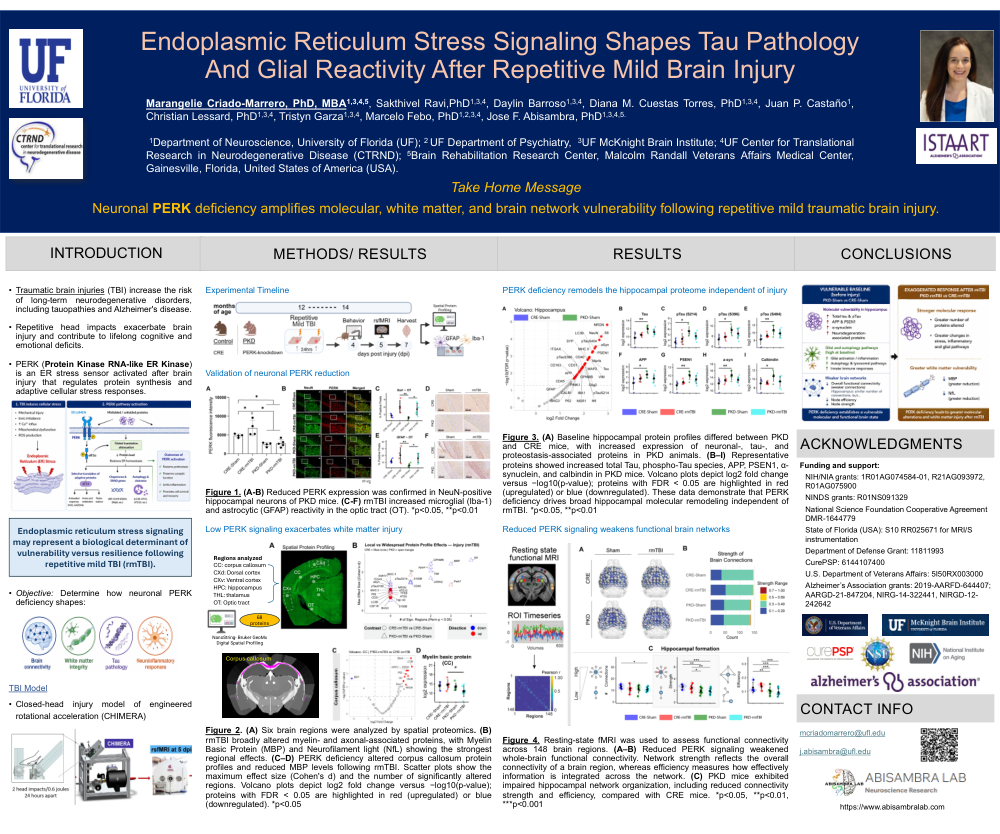
Endoplasmic Reticulum Stress Signaling Shapes Tau Pathology And Glial Reactivity After Repetitive Mild Brain Injury
Poster Presenter
Authors
Marangelie Criado-Marrero, PhD, MBA, Sakthivel Ravi, PhD, Daylin Barroso, Diana M. Cuestas Torres, PhD, Juan P. Castaño, Christian Lessard, PhD, Tristyn Garza, PhD, Marcelo Febo, PhD, Jose F. Abisambra, PhD
Affiliations
University of Florida; Malcolm Randall Veterans Affairs Medical Center, Gainesville, Florida, USA, University of Florida, Gainesville, FL, USA
Part of Topic
Background:
Repetitive mild traumatic brain injury (rmTBI) is a recognized risk factor for later-life neurodegeneration, yet the stress-response mechanisms that regulate tau pathology and glial reactivity after repeated injury remain poorly defined. Endoplasmic reticulum (ER) stress signaling, mediated in part by protein kinase RNA-like ER kinase (PERK), has been implicated in tau dysregulation and neuroinflammatory processes. Whether PERK deficiency increases molecular and network vulnerability to rmTBI is unknown.
Methods:
Using 14-month-old PERK knockdown mice, we examined the molecular, functional, and structural consequences of rmTBI. Spatial proteomics and targeted immunohistological analyses quantified tau-related, neurodegeneration-associated, and glial markers across brain regions. These molecular data were integrated with resting-state functional MRI collected 5 days post-injury to assess functional connectivity and regional network strength, with a focus on hippocampal circuitry following rmTBI.
Results:
PERK deficiency markedly amplified rmTBI-induced accumulation of pathological tau species (phospho-tau S214, S396, S404) and increased glial activation markers (Iba1 and GFAP). In parallel, neurodegeneration-associated proteins (APP, PSEN1, and α-synuclein) were elevated, indicating enhanced proteostatic stress in PERK-deficient mice. Molecular alterations were regionally concentrated in hippocampal and cortical network hubs and overlapped with disrupted functional connectivity specifically in PERK-deficient animals exposed to rmTBI. Spatial alignment of molecular and imaging findings revealed that heightened tau and glial stress responses tracked with increased vulnerability of large-scale brain networks following repetitive injury.
Conclusion:
These findings demonstrate that PERK deficiency exacerbates tau pathology, glial reactivity, and network disruption after repetitive mild brain injury. By linking ER stress dysregulation to molecular and systems-level vulnerability, this work provides mechanistic insight into how rmTBI may accelerate neurodegenerative trajectories and identifies ER stress pathways as potential targets for mitigating dementia risk after repetitive injury.
Comments
Email is required but is not shown publicly.
Loading comments...