4,068 posters, 219 videos, 101 topics, 69 sessions, 14,365 authors, 6,128 institutions
ePostersLive by SciGen Technologies S.A. All rights reserved.
Alzheimer's Association International Conference 2026
July 12-15, 2026 | London, United Kingdom, and Online

2124
One Scan, Two Biomarkers: Early-phase Amyloid PET As A Functional Alternative To FDG-PET In Alzheimer’S Disease
Poster Presenter
Authors
Affiliations
Part of Topic
One Scan, Two Biomarkers: Early-phase Amyloid PET As A Functional Alternative To FDG-PET In Alzheimer’S Disease
Author: Rocío Mesa Martínez, Javier Tejada García, Belén Clavera de la Gándara, Julia Francesca Barrutia Yovera.
Neurology, Complejo Asistencial Universitario de León (CAULE), León, Spain.
Abstract:
Background:
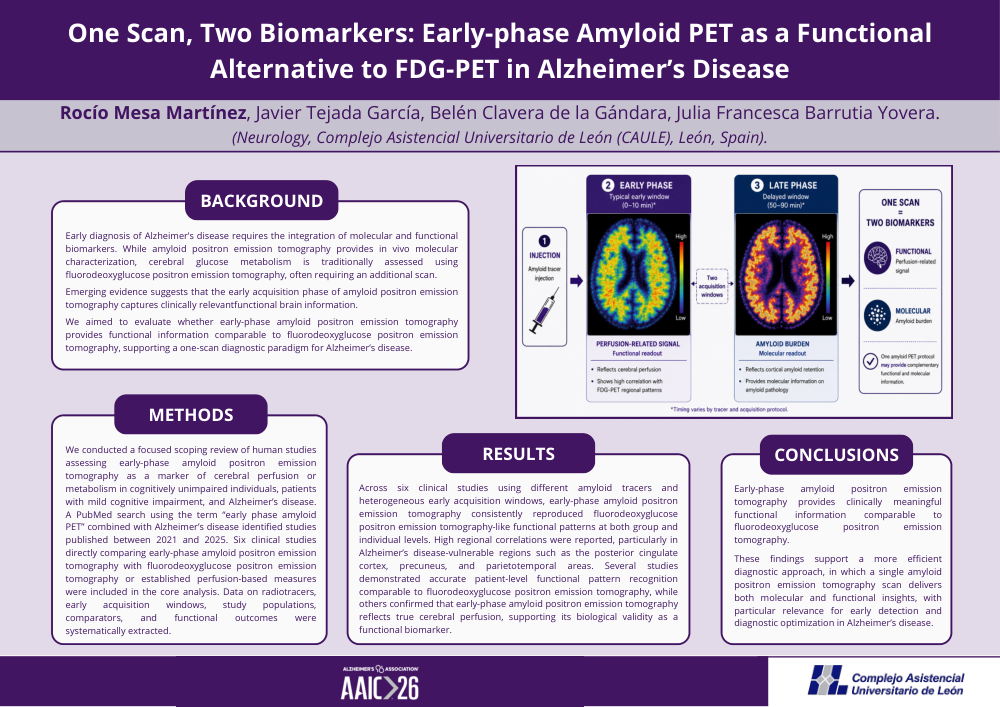
Early diagnosis of Alzheimer’s disease requires the integration of molecular and functional biomarkers. While amyloid positron emission tomographyprovides in vivo molecular characterization, cerebral glucose metabolism is traditionally assessed using fluorodeoxyglucose positron emission tomography, oftenrequiring an additional scan. Emerging evidence suggests that the early acquisition phase of amyloid positron emission tomography captures clinically relevantfunctional brain information. We aimed to evaluate whether early-phase amyloid positron emission tomography provides functional information comparable tofluorodeoxyglucose positron emission tomography, supporting a one-scan diagnostic paradigm for Alzheimer’s disease.
Methods:
We conducted a focused scoping review of human studies assessing early-phase amyloid positron emission tomography as a marker of cerebral perfusionor metabolism in cognitively unimpaired individuals, patients with mild cognitive impairment, and Alzheimer’s disease. A PubMed search using the term “early phaseamyloid PET” combined with Alzheimer’s disease identified studies published between 2021 and 2025. Six clinical studies directly comparing early-phase amyloidpositron emission tomography with fluorodeoxyglucose positron emission tomography or established perfusion-based measures were included in the core analysis.Data on radiotracers, early acquisition windows, study populations, comparators, and functional outcomes were systematically extracted.
Results:
Across six clinical studies using different amyloid tracers and heterogeneous early acquisition windows, early-phase amyloid positron emission tomographyconsistently reproduced fluorodeoxyglucose positron emission tomography-like functional patterns at both group and individual levels. High regional correlationswere reported, particularly in Alzheimer’s disease-vulnerable regions such as the posterior cingulate cortex, precuneus, and parietotemporal areas. Several studiesdemonstrated accurate patient-level functional pattern recognition comparable to fluorodeoxyglucose positron emission tomography, while others confirmed thatearly-phase amyloid positron emission tomography reflects true cerebral perfusion, supporting its biological validity as a functional biomarker.
Conclusion:
Early-phase amyloid positron emission tomography provides clinically meaningful functional information comparable to fluorodeoxyglucose positronemission tomography. These findings support a more efficient diagnostic approach, in which a single amyloid positron emission tomography scan delivers bothmolecular and functional insights, with particular relevance for early detection and diagnostic optimization in Alzheimer’s disease.
Comments
Email is required but is not shown publicly.
Loading comments...