4,068 posters, 219 videos, 101 topics, 69 sessions, 14,365 authors, 6,128 institutions
ePostersLive by SciGen Technologies S.A. All rights reserved.
Alzheimer's Association International Conference 2026
July 12-15, 2026 | London, United Kingdom, and Online

5246
Predicting Visuospatial Decline In Alzheimer's Disease Based On Atrophy Patterns
Poster Presenter
Authors
Affiliations
Brigham and Women's Hospital; Center for Brain Circuit Therapeutics; Harvard Medical School, 1Center for Brain Circuit Therapeutics, Brigham and Women’s Hospital, Boston, MA, USA. 2Department of Neurology, Brigham and Women’s Hospital, Harvard Medical School, Boston, MA, USA.. 3Center for Brain/Mind Medicine, Brigham and Women’s Hospital, Boston, MA, USA. 4Department of Cognitive and Behavioral Neurology, Brigham and Women’s Hospital, Boston, MA, USA
Part of Topic
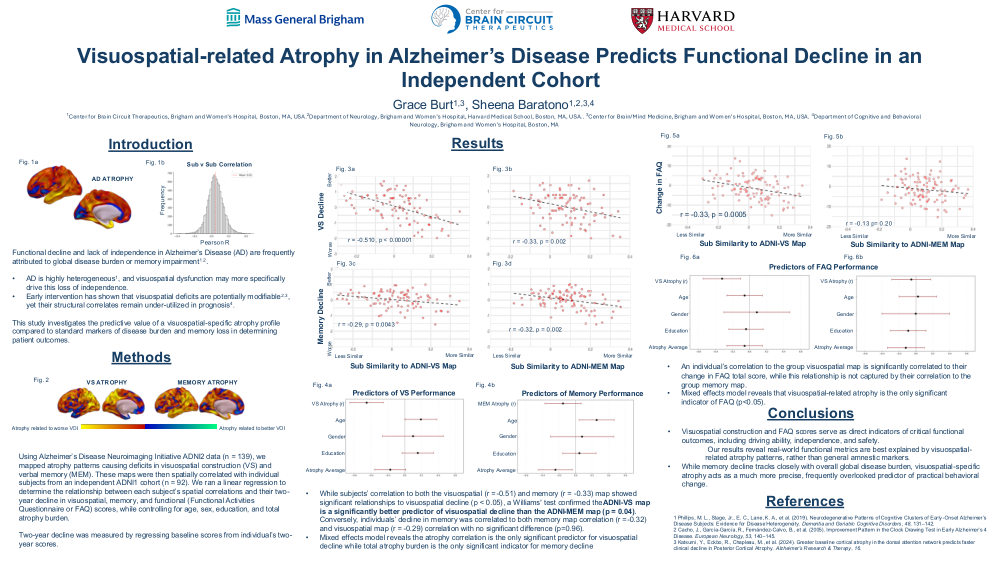
Functional decline and lack of independence in Alzheimer’s Disease (AD) are frequently attributed to global disease burden or memory impairment1,2.
This study investigates the predictive value of a visuospatial-specific atrophy profile compared to standard markers of disease burden and memory loss in determining patient outcomes.
Using Alzheimer’s Disease Neuroimaging Initiative ADNI2 data (n = 139), we mapped atrophy patterns causing deficits in visuospatial construction (VS) and verbal memory (MEM). These maps were then spatially correlated with individual subjects from an independent ADNI1 cohort (n = 92). We ran a linear regression to determine the relationship between each subject’s spatial correlations and their two-year decline in visuospatial, memory, and functional (Functional Activities Questionnaire or FAQ) scores, while controlling for age, sex, education, and total atrophy burden.
Two-year decline was measured by regressing baseline scores from individual’s two-year scores.
Our results reveal real-world functional metrics are best explained by visuospatial-related atrophy patterns, rather than general amnestic markers.
Comments
Email is required but is not shown publicly.
Loading comments...