4,068 posters, 219 videos, 101 topics, 69 sessions, 14,365 authors, 6,128 institutions
ePostersLive by SciGen Technologies S.A. All rights reserved.
Alzheimer's Association International Conference 2026
July 12-15, 2026 | London, United Kingdom, and Online

1501
Global And Regional Trends In Particulate Matter-attributable Alzheimer’s Disease And Dementia (1990-2023)
Part of Topic
Global And Regional Trends In Particulate Matter attributable Alzheimer’s Disease And Dementia (1990 2023).
Alzheimer’s disease (AD) and other dementias remain a major cause of cognitive decline and mortality worldwide. Despite advancements in healthcare and early detection, particulate matter (PM) exposure may contribute to neurodegenerative risk, particularly in regions with high industrial activity and urbanization. Understanding the impact of PM on AD and dementia trends is essential for shaping public health and environmental policies.
Data from the Global Burden of Disease Study were used to evaluate age standardised death rates and disability-adjusted life years (DALYs) attributable to particulate matter. Temporal trends from 1990-2023 were assessed globally and across various SDI classifications, and WHO regions. Joinpoint regression analysis was employed to calculate annual percent change (APC) and average annual percent change (AAPC), with 95% confidence intervals.
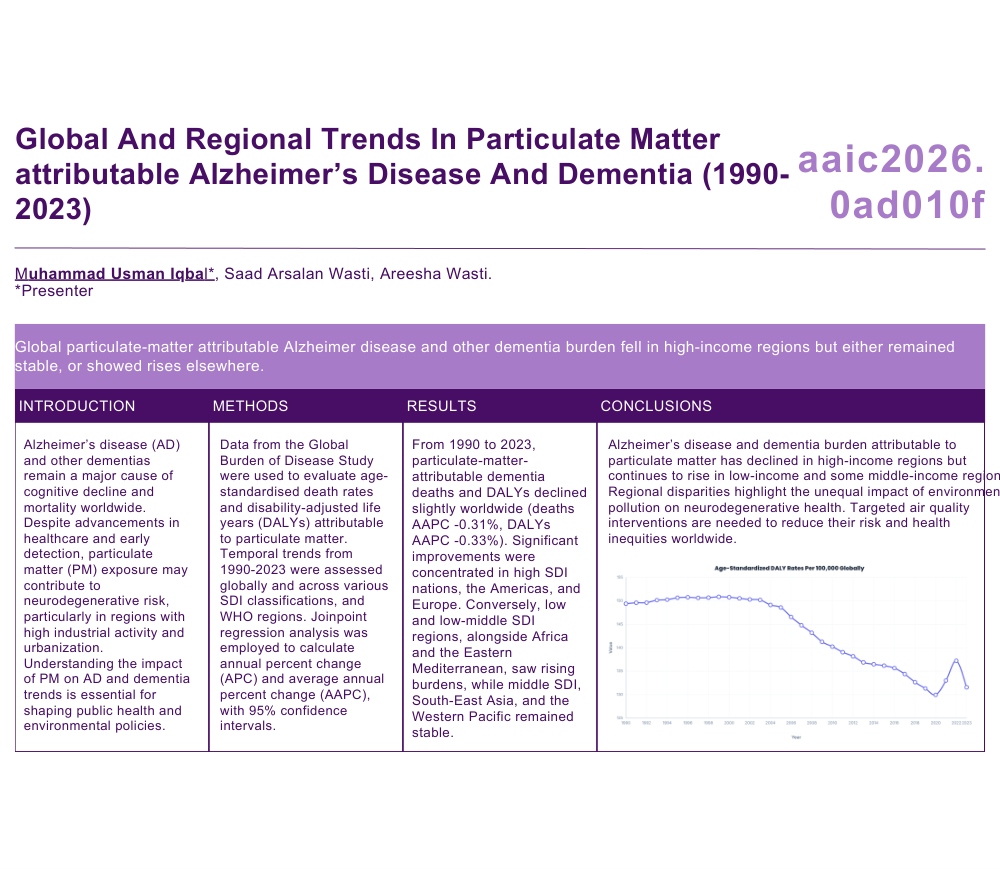
From 1990 to 2023, particulate-matter-attributable dementia deaths and DALYs declined slightly worldwide (deaths AAPC -0.31%, DALYs AAPC -0.33%). Significant improvements were concentrated in high SDI nations, the Americas, and Europe. Conversely, low and low-middle SDI regions, alongside Africa and the Eastern Mediterranean, saw rising burdens, while middle SDI, South-East Asia, and the Western Pacific remained stable.
Alzheimer’s disease and dementia burden attributable to particulate matter has declined in high-income regions but continues to rise in low-income and some middle-income regions. Regional disparities highlight the unequal impact of environmental pollution on neurodegenerative health. Targeted air quality interventions are needed to reduce their risk and health inequities worldwide.
Comments
Email is required but is not shown publicly.
Loading comments...