4,068 posters, 219 videos, 101 topics, 69 sessions, 14,365 authors, 6,128 institutions
ePostersLive by SciGen Technologies S.A. All rights reserved.
Alzheimer's Association International Conference 2026
July 12-15, 2026 | London, United Kingdom, and Online

6370
A Composite Hemodynamic Imaging Score For Risk Stratification In Cerebral Amyloid Angiopathy: Implications For Anti-amyloid Therapies
Poster Presenter
Authors
Affiliations
Part of Topic
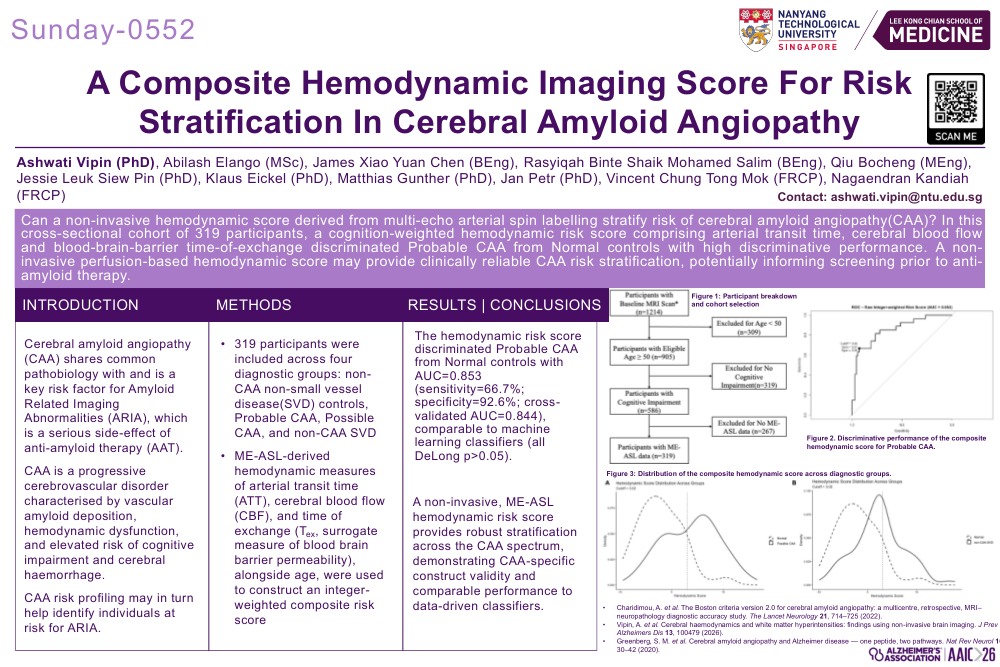
Background Cerebral amyloid angiopathy (CAA) shares common pathobiology with and is a key risk factor for Amyloid Related Imaging Abnormalities (ARIA), which are a serious side-effect of anti-amyloid treatments (AAT). CAA is a progressive cerebrovascular disorder characterised by vascular amyloid deposition, hemodynamic dysfunction, and elevated risk of cognitive impairment and lobar hemorrhage. CAA identification may in turn enable capturing of individuals at risk for ARIA. We developed and validated a cognition-weighted hemodynamic composite risk score for CAA derived from multi-echo arterial spin labelling (ME-ASL).
Methods 319 participants were included across four diagnostic groups: non-CAA non-small vessel disease(SVD) controls, Probable CAA, Possible CAA, and non-CAA SVD. Three ME-ASL-derived hemodynamic measures of arterial transit time(ATT), cerebral blood flow(CBF), and time of exchange (Tex, surrogate measure of blood brain barrier permeability), alongside age, were used to construct an integer-weighted composite risk score, with variable weights anchored to performance on the Montreal Cognitive Assessment. Discriminative performance of this score between controls and Probable CAA was evaluated by ROC analysis and 10-fold repeated cross-validation, and benchmarked against data-driven machine learning classifiers. The score was prospectively applied to Possible CAA and non-CAA SVD groups for internal validation. Construct validity of the score was tested against microbleed count, APOE4 status and blood biomarkers.
Results The hemodynamic risk score discriminated Probable CAA from Normal controls with AUC=0.853 (sensitivity=66.7%; specificity=92.6%; cross-validated AUC=0.844), comparable to machine learning classifiers (all DeLong p>0.05). The score correlated significantly with total microbleed count, white matter hyperintensity volume, plasma neurofilament light, glial fibrillary acidic protein, and Aβ40, and domain-based cognitive function (all p<0.001). In the Possible CAA group and non-CAA SVD group, only 59.5% and 40.8% respectively were classified as having CAA-like hemodynamics. APOE4 carriers showed significantly higher risk scores across CAA-spectrum groups.
Conclusion A non-invasive, ME-ASL hemodynamic risk score provides robust stratification across the CAA spectrum, demonstrating CAA-specific construct validity and comparable performance to data-driven classifiers. This score represents a clinically accessible tool for CAA risk profiling, with particular relevance for pre-treatment screening for AATs.
Comments
Email is required but is not shown publicly.
Loading comments...