4,068 posters, 219 videos, 101 topics, 69 sessions, 14,365 authors, 6,128 institutions
ePostersLive by SciGen Technologies S.A. All rights reserved.
Alzheimer's Association International Conference 2026
July 12-15, 2026 | London, United Kingdom, and Online

4858
Automated Detection Of Cerebral Microbleeds On Routine MRI Using A Two-stage Deep Learning Framework
Part of Topic
Background
Cerebral microbleeds (CMBs) are key imaging markers of cerebral small vessel disease and are an important characteristics for the evaluation of amyloid related imaging abnormalities (ARIA) in patients receiving or about to receive anti-amyloid therapies.
Methods
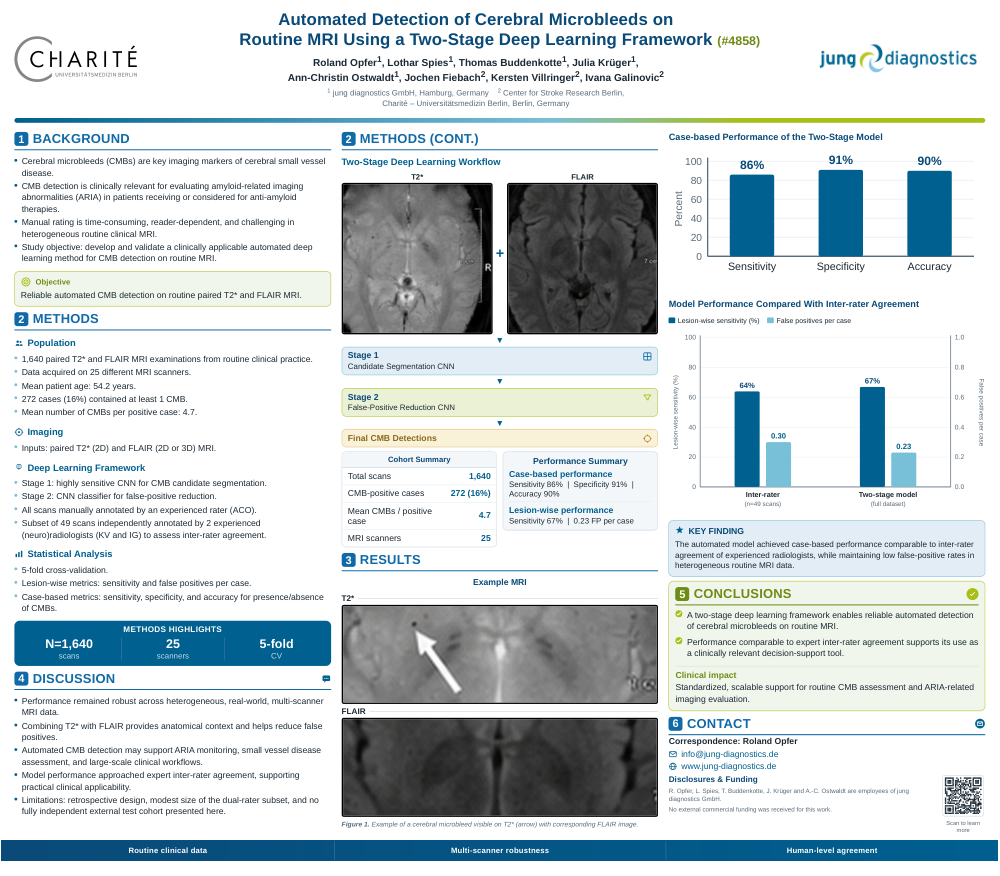
We developed a two-stage convolutional neural network (CNN) for automated CMB detection using paired T2* (2D) and FLAIR (2D or 3D) magnetic resonance images. The first network performs highly sensitive CMB candidate segmentation, followed by a second CNN classifier for false-positive reduction. The model was trained on 1,640 paired T2* and FLAIR scans acquired during routine clinical practice on 25 different MRI scanners, all manually annotated by an experienced rater (ACO). A subset of scans (N = 49) was independently annotated by two experienced (neuro)radiologists (KV and IG) to assess inter-rater agreement. Model performance was evaluated using 5-fold cross-validation. Lesion-wise metrics (sensitivity and false positives per case) and case-based metrics assessing the presence or absence of CMBs per scan were used.
Results
The full dataset (n = 1,640) had a mean patient age of 54.2 years. Overall, 272 cases (16%) contained at least one CMB, with a mean of 4.7 CMBs per positive case. On the subset of 49 cases rater-1 identified 16 positive cases (32%; mean 2.1 CMBs per case), while rater-2 identified 15 positive cases (30%; mean 1.9 CMBs per case). Case-based inter-rater agreement showed a mutual sensitivity of 85%, specificity of 90%, and accuracy of 90%, with a lesion-wise sensitivity of 64% and a mean of 0.30 false positives per case. Across 5-fold cross-validation, the proposed method achieved (on the full 1640 dataset) a lesion-wise sensitivity of 67% with 0.23 false positives per case. Case-based performance reached a sensitivity of 86%, specificity of 91%, and accuracy of 90%.
Conclusions
This clinically applicable two-stage deep learning approach enables reliable automated detection of cerebral microbleeds in heterogeneous, multi-scanner MRI data from routine clinical practice, achieving performance comparable to inter-rater agreement of experienced radiologists.
Comments
Email is required but is not shown publicly.
Loading comments...