4,068 posters, 219 videos, 101 topics, 69 sessions, 14,365 authors, 6,128 institutions
ePostersLive by SciGen Technologies S.A. All rights reserved.
Alzheimer's Association International Conference 2026
July 12-15, 2026 | London, United Kingdom, and Online

9983
Vascular Abnormality Is Associated With T2 FLAIR White Matter Hyperintensity & Glymphatic Dysfunction In Community Residing Older Adults
Poster Presenter
Authors
Kimberly J. Hemmerling, Faye McKenna, Behnam Kazemivash, Angel Garcia de la Garza, Mindy J. Katz, Carol A. Derby, Richard B. Lipton, David C. Zhu
Affiliations
Department of Radiology, Gruss Magnetic Resonance Research Center, Albert Einstein College of Medicine, Bronx, NY, USA, Saul R. Korey Department of Neurology, Division of Biostatistics, Department of Epidemiology, Albert Einstein College of Medicine, Bronx, NY, USA, Saul R. Korey Department of Neurology, Albert Einstein College of Medicine, Bronx, NY, USA
Part of Topic
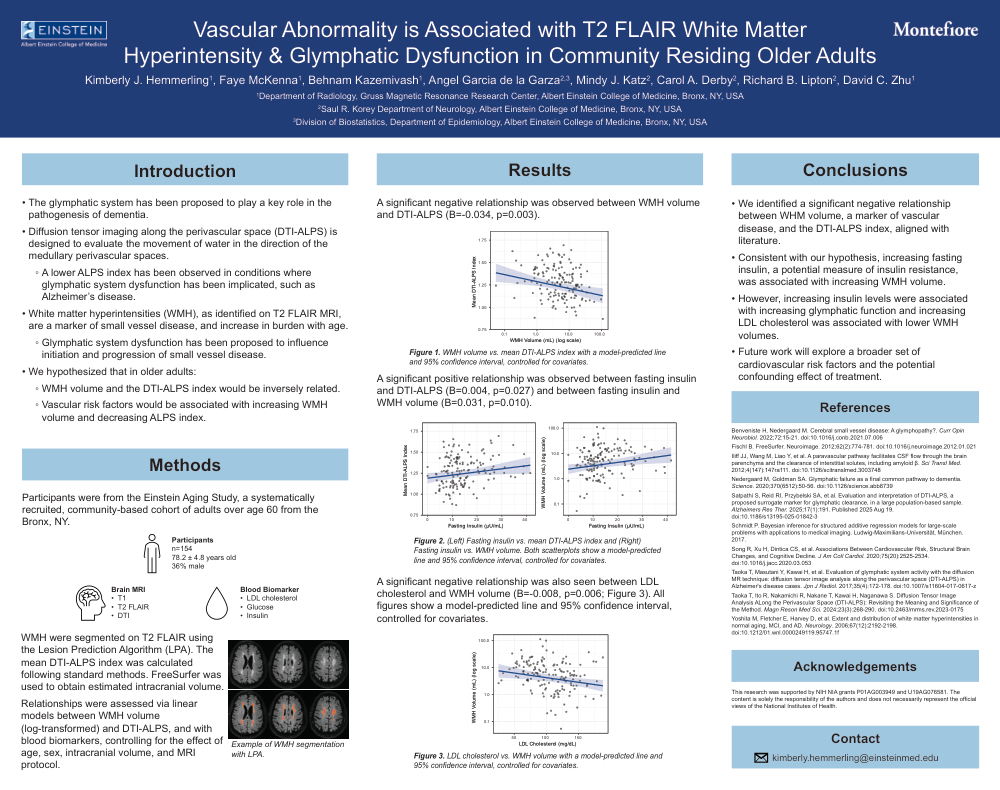
Background: We hypothesized that in older adults, vascular risk factors would be associated with increasing white matter hyperintensity (WMH) volume and decreasing glymphatic function, assessed with diffusion tensor imaging along the perivascular space (DTI-ALPS). We also hypothesized that WMH volume and glymphatic function would be inversely related.
Methods: Participants were from the Einstein Aging Study, a systematically recruited, community-based cohort of adults over age 60 from Bronx, NY. Subjects (n=154, 78.2±4.8 years old, 36% male) had brain MRI (T1, T2 FLAIR, and DTI) and blood biomarker data (LDL cholesterol, glucose, insulin). WMH were segmented on T2 FLAIR using the Lesion Prediction Algorithm. The mean DTI-ALPS index was calculated following standard methods. Relationships were assessed via linear models between WMH volume (log-transformed) and DTI-ALPS, and with blood biomarkers, controlling for the effect of age, sex, estimated intracranial volume, and MRI protocol.
Results: A significant negative relationship was observed between WMH volume and DTI-ALPS (B=-0.034, p=0.003; Figure 1). A significant positive relationship was observed between fasting insulin and DTI-ALPS (B=0.004, p=0.027) and between fasting insulin and WMH volume (B=0.031, p=0.010; Figure 2). A significant negative relationship was also seen between LDL cholesterol and WMH volume (B=-0.008, p=0.006; Figure 3). All figures show a model-predicted line and 95% confidence interval, controlled for covariates.
Conclusion: As predicted, we identified a significant negative relationship between WHM volume, a marker of vascular disease, and glymphatic function, as measured by DTI-ALPS. Also consistent with our hypotheses, increasing fasting insulin, a potential measure of insulin resistance, was associated with increasing WMH volume. Contrary to expectation, increasing insulin levels were associated with increasing glymphatic function and increasing LDL cholesterol was associated with lower WMH volumes. Future work will explore a broader set of cardiovascular risk factors and the potential confounding effect of treatment.
Comments
Email is required but is not shown publicly.
Loading comments...