4,068 posters, 219 videos, 101 topics, 69 sessions, 14,365 authors, 6,128 institutions
ePostersLive by SciGen Technologies S.A. All rights reserved.
Alzheimer's Association International Conference 2026
July 12-15, 2026 | London, United Kingdom, and Online

2244
Evidence-Guided Generation of MRI Reports for Alzheimer’s Disease Using CNNs and LLMs
Poster Presenter
Authors
Devesh Singh, Dhanush H. Babu, Mathias Manzke, Marc-André Weber, Majid Ramedani, Arijana Bohr, Emmanuelle Salin, Björn Eskofier, Stefan Teipel, Martin Dyrba
Affiliations
German Center for Neurodegenerative Diseases (DZNE), Rostock, Germany, Institute of Radiology, Pediatric Radiology & Neuroradiology, University Medical Center Rostock, Germany, Friedrich-Alexander-Universität Erlangen-Nürnberg, Germany, Clinic for Psychosomatic Medicine, Rostock University Medical Center, Rostock, Germany
Part of Topic
Introduction
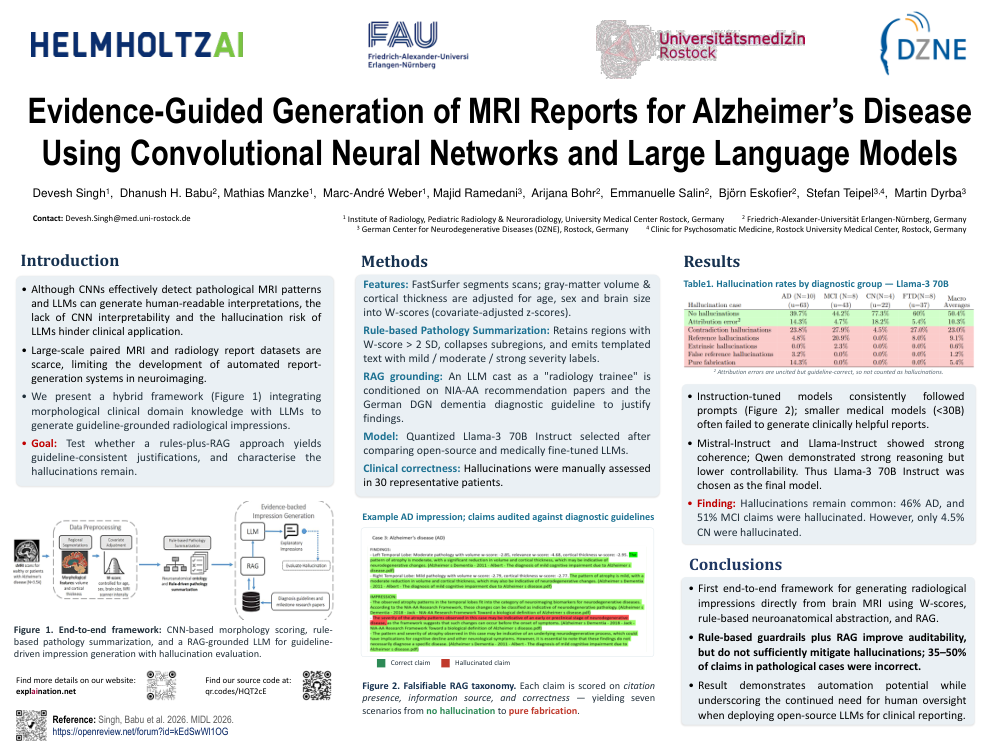
• Although CNNs effectively detect pathological MRI patterns and LLMs can generate human-readable interpretations, the lack of CNN interpretability and the hallucination risk of LLMs hinder clinical application.
• Large-scale paired MRI and radiology report datasets are scarce, limiting the development of automated report-generation systems in neuroimaging.
• We present a hybrid framework (Figure 1) integrating morphological clinical domain knowledge with LLMs to generate guideline-grounded radiological impressions.
• Goal: Test whether a rules-plus-RAG approach yields guideline-consistent justifications, and characterise the hallucinations remain.
Methods
• Features: FastSurfer segments scans; gray-matter volume & cortical thickness are adjusted for age, sex and brain size into W-scores (covariate-adjusted z-scores).
• Rule-based Pathology Summarization: Retains regions with W-score > 2 SD, collapses subregions, and emits templated text with mild / moderate / strong severity labels.
• RAG grounding: An LLM cast as a "radiology trainee" is conditioned on NIA-AA recommendation papers and the German DGN dementia diagnostic guideline to justify findings.
• Model: Quantized Llama-3 70B Instruct selected after comparing open-source and medically fine-tuned LLMs.
• Clinical correctness: Hallucinations were manually assessed in 30 representative patients.
Results
• Instruction-tuned models consistently followed prompts (Figure 2); smaller medical models (<30B) often failed to generate clinically helpful reports.
• Mistral-Instruct and Llama-Instruct showed strong coherence; Qwen demonstrated strong reasoning but lower controllability. Thus Llama-3 70B Instruct was chosen as the final model.
• Finding: Hallucinations remain common: 46% AD, and 51% MCI claims were hallucinated. However, only 4.5% CN were hallucinated.
Conclusions
• First end-to-end framework for generating radiological impressions directly from brain MRI using W-scores, rule-based neuroanatomical abstraction, and RAG.
• Rule-based guardrails plus RAG improve auditability, but do not sufficiently mitigate hallucinations; 35–50% of claims in pathological cases were incorrect.
• Result demonstrates automation potential while underscoring the continued need for human oversight when deploying open-source LLMs for clinical reporting.
Comments
Email is required but is not shown publicly.
Loading comments...