4,068 posters, 219 videos, 101 topics, 69 sessions, 14,365 authors, 6,128 institutions
ePostersLive by SciGen Technologies S.A. All rights reserved.
Alzheimer's Association International Conference 2026
July 12-15, 2026 | London, United Kingdom, and Online

1435
Data-driven Functional Decline Trajectories Correspond To Distinct Brain Perfusion Imaging Patterns
Poster Presenter
Authors
Sofia Michopoulou, Dave Evenden, Angus Prosser, John Dickson, Jessica Teeling, Christopher Kipps
Affiliations
Clinical Experimental Sciences, University of Southampton and University Hospital Southampton NHS Foundation Trust, Clinical Experimental Sciences, University of Southampton, University College London Hospitals NHS Foundation Trust, Biological Sciences, University of Southampton
Part of Topic
Data-driven functional decline trajectories correspond to distinct brain perfusion imaging patterns
Sofia Michopoulou¹,², Dave Evenden², Angus Prosser², John Dickson³, JessicaTeeling², Christopher Kipps¹,²
¹University Hospital Southampton NHS Foundation Trust, ²University of Southampton, ³University College London Hospitals
Study Background and Aim
- Cognitive decline is heterogeneous, limiting prognosis and care planning.
- Clinical tools such as CDR-SB track functional decline but provide limited biological insight.
- Perfusion SPECT provides a physiological marker of regional synaptic dysfunction, often before structural change.
Aim: To assess whether cerebral perfusion distinguishes individuals with different functional decline trajectories.
Methods
- Design: Brain Imaging in Dementia (BRAIID) longitudinal cohort (n = 232).
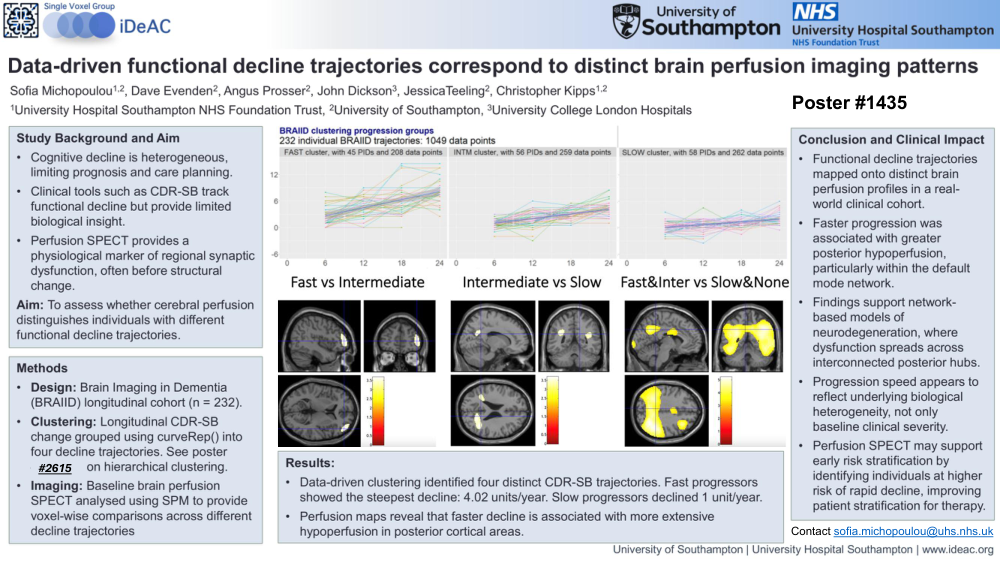
- Clustering: Longitudinal CDR-SB change grouped using curveRep() into four decline trajectories. See poster #2615 for on hierarchical clustering.
- Imaging: Baseline brain perfusion SPECT analysed using SPM to provide voxel-wise comparisons across different decline trajectories
Results:
- Data-driven clustering identified four distinct CDR-SB trajectories. Fast progressors showed the steepest decline: 4.02 units/year. Slow progressors declined 1 unit/year.
- Perfusion maps reveal that faster decline is associated with more extensive hypoperfusion in posterior cortical areas.
Conclusion and Clinical Impact
- Functional decline trajectories mapped onto distinct brain perfusion profiles in a real-world clinical cohort.
- Faster progression was associated with greater posterior hypoperfusion, particularly within the default mode network.
- Findings support network-based models of neurodegeneration, where dysfunction spreads across interconnected posterior hubs.
- Progression speed appears to reflect underlying biological heterogeneity, not only baseline clinical severity.
- Perfusion SPECT may support early risk stratification by identifying individuals at higher risk of rapid decline, improving patient stratification for therapy.
Contact sofia.michopoulou@uhs.nhs.uk
University of Southampton | University Hospital Southampton | www.ideac.org
Comments
Email is required but is not shown publicly.
Loading comments...