Loading...

4,068 posters, 219 videos, 101 topics, 69 sessions, 14,365 authors, 6,128 institutions

ePostersLive by SciGen Technologies S.A. All rights reserved.

Alzheimer's Association International Conference 2026

July 12-15, 2026 | London, United Kingdom, and Online

Alzheimer's Association International Conference 2026 banner

1895

Slowing Of Rapid Eye Movement Sleep Brain Activity Is Linked To Smaller Basal Forebrain Volume In Older Adults
Poster Presenter

Aaron Lam

Authors

Aaron Lam

Part of Topic

Introduction

The basal forebrain is one of the earliest regions affected in Alzheimer’s disease1. Within the basal forebrain, the nucleus basalis of Meynert (NbM) provides the major cholinergic input to the neocortex and cortical activation during REM sleep2. REM electroencephalography (EEG) slowing has been consistently observed in older adults with Alzheimer’s disease and amnestic mild cognitive impairment (MCI)3.

Aims

We investigated associations between REM EEG slowing and NbM volume. We also investigated whether cognitive status, sex, or sleep apnea severity moderated this relationship.

Materials and methods

Participants: Adults aged ≥60 years with subjective cognitive impairment (SCI) or MCI.

Assessments: Neuropsychological, medical, overnight polysomnography, and magnetic resonance imaging.

Brain measures: Bilateral NbM and Ch1–3 volumes (corrected for intracranial volume).

REM EEG slowing is the ratio of delta and theta (<8Hz) to alpha, sigma, and beta bands (8-32Hz).

Results

Main analyses:

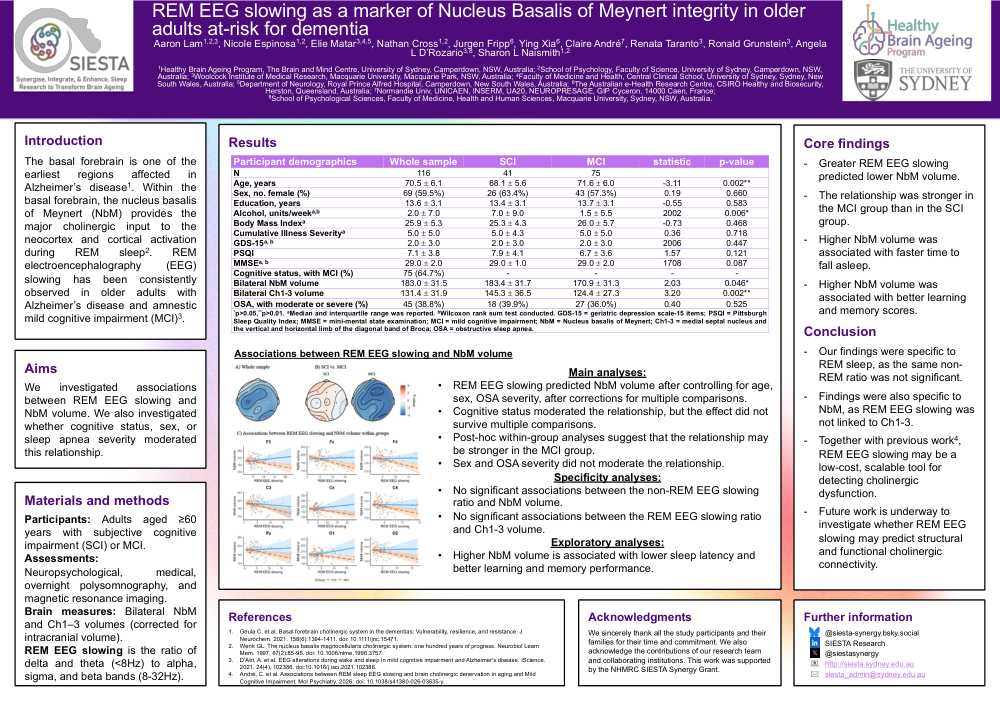
•REM EEG slowing predicted NbM volume after controlling for age, sex, OSA severity, after corrections for multiple comparisons.
•Cognitive status moderated the relationship, but the effect did not survive multiple comparisons.
•Post-hoc within-group analyses suggest that the relationship may be stronger in the MCI group.
•Sex and OSA severity did not moderate the relationship.

Specificity analyses:

•No significant associations between the non-REM EEG slowing ratio and NbM volume.
•No significant associations between the REM EEG slowing ratio and Ch1-3 volume.

Exploratory analyses:

•Higher NbM volume is associated with lower sleep latency and better learning and memory performance.

Core findings

-Greater REM EEG slowing predicted lower NbMvolume.
-The relationship was stronger in the MCI group than in the SCI group.
-Higher NbM volume was associated with faster time to fall asleep.
-Higher NbM volume was associated with better learning and memory scores.

Conclusion

-Our findings were specific to REM sleep, as the same non-REM ratio was not significant.
-Findings were also specific to NbM, as REM EEG slowing was not linked to Ch1-3.
-Together with previous work4, REM EEG slowing may be a low-cost, scalable tool for detecting cholinergic dysfunction.
-Future work is underway to investigate whether REM EEG slowing may predict structural and functional cholinergic connectivity.

Comments

Email is required but is not shown publicly.

Loading comments...

aaic2026 banner
Copyright © 2015-2026, ePostersLive® SciGen is a registered trademark of SciGen Technologies S.A. Patent pending.

This website and third-party tools we use rely on cookies for the best user experience. By selecting "I agree", you agree to cookie usage as described in our Privacy Policy.